 Sign In














 Email Marketing
 ABM
ABM  List Building
  Lead Generation
  Growth Hacker
  Digital Marketing
  Data Enrichment
  Software as a Service
  Data as a Service
  Waterfall Enrichment
  Startup
  Revenue Performance
  Job Change Tracking
  Customer Data Platform
  CRM
CRM 


 Knowledge Base
  Video Tutorials
  Help Center
  Tarpitting Scoring
  ROI Calculator
  About us
  Contact us
  Testimonials
  Automation
Why Email Engagement Signals Matter More Than Open Rates in 2026

20 Aug 2026
Sreerag
12 Minutes
Read

 Blog
FAQ
Case Studies
Knowledge Base
Video Tutorials
Help Center
SEG Validation
Tarpitting Scoring
ROI Calculator
About us
Contact us
Testimonials
Blog
FAQ
Case Studies
Knowledge Base
Video Tutorials
Help Center
SEG Validation
Tarpitting Scoring
ROI Calculator
About us
Contact us
Testimonials
Email deliverability is your overall ability to reach inboxes over time, shaped by sender reputation, authentication, and list quality. Inbox placement is the specific outcome of one send: whether that message landed in the primary inbox, promotions, spam, or was blocked.
Open rate measures neither of these reliably anymore: Apple Mail Privacy Protection alone now accounts for roughly half of all tracked opens, inflating reported open rates by an estimated 15 to 20 percentage points regardless of whether a recipient actually read the message.
Here’s why that shift happened, which mailbox provider signals actually drive decisions now, and why not all of them carry equal weight.
Email engagement describes every action a recipient takes in response to a message, not just whether they opened it. Real user engagement includes replying, clicking, forwarding, adding a sender to contacts, and rescuing a message from spam. Non-engagement includes deleting without opening, ignoring, unsubscribing, and marking as spam. Both directions are signals; mailbox providers treat the absence of a positive action as informative too, not just its presence.
Open tracking works by embedding a small, invisible tracking pixel in the email body. When the image loads, that counts as an open. This worked reasonably well until mailbox providers started loading images automatically, on the recipient’s behalf, before the email was ever opened.
Apple Mail Privacy Protection (MPP), rolled out in iOS 15 and still in effect, pre-fetches every image in an email through Apple’s own proxy servers as soon as the message arrives, regardless of whether the recipient opens it. As of recent industry tracking, MPP-driven prefetches account for close to half of all opens recorded across senders, meaning a substantial share of every reported open rate reflects Apple’s background fetch, not a person.
Gmail’s image proxy works similarly for cached images, though its impact on open tracking is smaller and more inconsistent than Apple’s.
The practical result: a meaningful share of “opens” reported by any ESP are not real recipient engagement at all. Two campaigns can show identical open rates while one generates real replies and clicks and the other generates none, and open rate alone won’t tell you which is which.
Deliverability signals aren’t binary, positive or negative doesn’t mean equally weighted. Infrastructure providers that work directly with mailbox filtering data describe engagement as a graduated scale, where some email interaction metrics carry far more influence over sender reputation than others.
Strongest positive signals:
Moderate positive signals:
Weak positive signals:
Negative signals, in ascending severity:
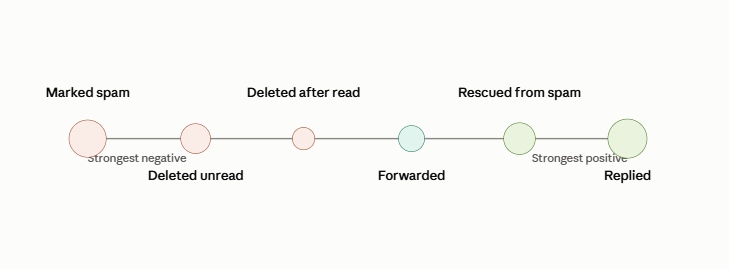
Engagement signals lose most of their value if they happen too late. Actions taken more than roughly 24 hours after a message arrives are typically excluded from the engagement data mailbox providers use for filtering decisions. A message read within the first few minutes of arrival carries more weight than the same action taken hours later.
This has a practical consequence for send strategy: the reaction of the first few hundred recipients on a send often shapes inbox placement for everyone who receives the campaign afterward. Sending to your most consistently engaged segment first, rather than blasting an entire list simultaneously, gives mailbox providers an early positive signal before the rest of the send goes out.
Click data is useful for measuring marketing performance, but it’s worth knowing that some mailbox providers do not factor click activity into their spam-filtering and engagement-scoring algorithms at all, largely for privacy reasons. That doesn’t make click-through rate useless as a business metric, it still correlates with content relevance and can inform what you send next, but it means click rate shouldn’t be assumed to directly influence inbox placement the way a reply or a spam complaint does.
| Metric | What It Measures | Why It’s More Reliable |
|---|---|---|
| Click-to-send rate | Recipients who clicked a link, out of total sent | Requires deliberate action; can’t be triggered by a proxy fetch |
| Reply rate | Recipients who responded | The strongest possible engagement signal; nearly impossible to fake |
| Forward rate | Recipients who forwarded the email | Signals genuine perceived value |
| Spam complaint rate | Recipients who marked it as spam | Direct negative signal mailbox providers weight heavily |
| Unsubscribe rate trend | Rate of opt-outs over time | A rising trend signals declining relevance before complaints spike |
None of these can be triggered by an automated image fetch. Each one requires the recipient to actually do something, which is exactly why mailbox providers trust them more than open data when scoring sender reputation.
Engagement signals aren’t just a reporting nuance, they’re a direct input into where your next email lands. A sender whose list shows strong reply and click rates but a mediocre open rate is, from a mailbox provider’s perspective, performing better than the open number suggests. A sender optimizing content purely to chase open rate, without checking whether recipients are actually clicking or replying, can be quietly losing inbox placement while their dashboard looks stable. Engagement is one of the core inboxing factors that separates inbox placement from simple email deliverability, alongside authentication and sender reputation, and it feeds directly into how mailbox providers calculate sender reputation over time.
Is open rate completely useless now?
Not entirely, it can still show broad trend direction, but it’s no longer accurate at the individual level due to Apple Mail Privacy Protection inflating results. Treat it as a rough signal, not a reliable metric on its own.
What is Apple Mail Privacy Protection?
A feature introduced in iOS 15 that automatically pre-loads images in emails through Apple’s proxy servers, causing nearly all MPP-protected emails to register as opened regardless of actual recipient behavior.
Which single metric should replace open rate as the primary KPI?
Reply rate is the strongest single substitute, since it requires deliberate recipient action and correlates most directly with genuine interest, but click rate and complaint trend should be tracked alongside it rather than relying on one number alone.
Do mailbox providers actually see the same inflated open data senders do?
No. Mailbox providers evaluate engagement using their own internal signals, including data senders don’t have access to, so their placement decisions are already accounting for real behavior even when a sender’s own open-rate report is skewed.
Engagement signals only mean something if they’re coming from real recipients in the first place. An invalid or disposable address can’t click, reply, or forward, but it can still show up in your list dragging down every rate you calculate, since it’s counted in the denominator without ever being able to contribute a genuine signal.
Gamalogic verifies addresses before they enter your sending list, so the engagement metrics above reflect real recipient behavior rather than being diluted by contacts that were never going to engage in the first place.



Improving your sender reputation should be one of the first priorities for every email marketer, sales team, and business running cold outreach campaigns. Here, what email sender reputation is, why Google values it so highly, and how simple practices like email verification and list hygiene.
Many businesses blame poor results on changing trends, but the real issue is execution. Generic templates, scraped lead lists, and surface level personalization have flooded inboxes with noise. The result is predictable: low open rates, even lower replies, and the mistaken belief that cold email no longer works.
Even the most compelling email won't drive results if it never reaches the inbox—learn eight proven strategies to improve email deliverability, protect your sender reputation, and maximize campaign performance with Gamalogic.


 No credit card required
Post your Comment.