 Sign In














 Email Marketing

 ABM
 List Building
 Lead Generation
 Growth Hacker
 Digital Marketing
 Data Enrichment
 Software as a Service
 Data as a Service
 Waterfall Enrichment
 Startup
 Revenue Performance
 Job Change Tracking
 Customer Data Platform
 CRM



 Knowledge Base
 Video Tutorials
 Help Center
 Tarpitting Scoring
 ROI Calculator
 About us
 Contact us
 Testimonials
 Automation
DeBounce Alternatives Free Plans & No-Expiry Credits That Never Expire

31 Oct 2026
Sreerag
12 Minutes
Read

 Blog
FAQ
Case Studies
Knowledge Base
Video Tutorials
Help Center
SEG Validation
Tarpitting Scoring
ROI Calculator
About us
Contact us
Testimonials
DeBounce already has credits that never expire. Its own pricing page and help center say so, and at 10,000 credits its published price ($25) is the lowest of the tools in this guide. So the reasons to look at an alternative are different: a recurring free plan (DeBounce gives 100 credits once), a smaller first pack (DeBounce’s smallest is 5,000 credits), catch-all checks that do not cost extra (DeBounce charges 10 credits each), or a finder in the same account.
| If you need… | Consider | Why (from published pages) |
|---|---|---|
| A free plan that renews | Hunter (also QuickEmailVerification and Verifalia) | Hunter: 50 credits a month. QuickEmailVerification: 100 a day. Verifalia: 25 a day |
| A pack smaller than 5,000 credits | Bouncer or Gamalogic | Packs start at 1,000 credits |
| Catch-all results without extra credits | MillionVerifier or Gamalogic | MillionVerifier does not charge for risky results. Gamalogic includes catch-all validation at one credit |
| Unknown results free or refunded | Bouncer or Emailable | Both say unknowns are free or refunded |
| The lowest price at 100,000 credits and up | MillionVerifier | $149 at 100,000 credits |
| The lowest price at 10,000 credits | Stay with DeBounce | $25 against $30 to $60 |
Our read, from published prices and policies. Your best choice depends on your list.
All of this comes from DeBounce’s own pricing page and help center unless noted.
Pages that compare themselves with DeBounce do not agree with each other. Here is what we could match against DeBounce’s own pages (checked [DATE]).
| Claim | Where we saw it | What DeBounce’s own pages say | Our read |
|---|---|---|---|
| DeBounce credits expire after 12 months | Two competitor comparison pages | “Purchased validation credits never expire” (help center) and “credits never expire” (pricing page) | Not supported |
| DeBounce credits expire after 6 months | One competitor comparison page (the same vendor’s other page says they never expire) | Same as above | Not supported |
| DeBounce gives 100 free credits every month | A competitor’s comparison table | “One-time 100 free credits… will not refill at the end of the month” (help center) | Not supported |
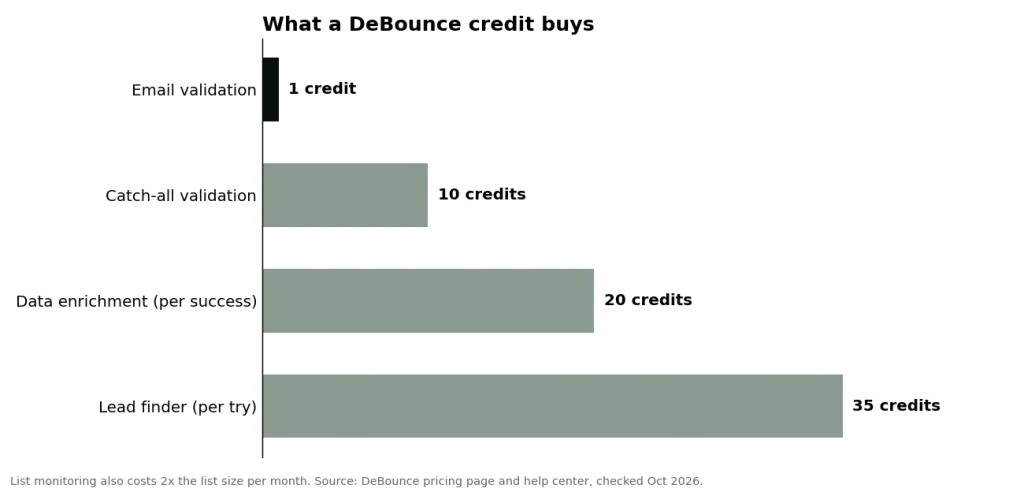
| Catch-all checks cost extra credits | A competitor’s comparison page | Catch-all validation costs 10 credits per validation (pricing page) | Supported |
| DeBounce is verification-only, with no finder | One competitor page | The help center describes a lead finder at 35 credits per try, and enrichment at 20 credits per success | Not supported [CONFIRM current features] |
| DeBounce costs $990 per million credits | Text on one competitor page (its own table shows $750) | A September 2026 snapshot lists $750 | The page contradicts itself |
| DeBounce raised prices about 50% in 2026 | One competitor blog | Not confirmed on DeBounce’s pages | Plausible, single source |
Why this matters: if a comparison page tells you DeBounce credits expire, check DeBounce’s pricing page before you switch for that reason. The same advice applies to this guide, so every claim here links to its source.
| Type | Examples | What to watch |
|---|---|---|
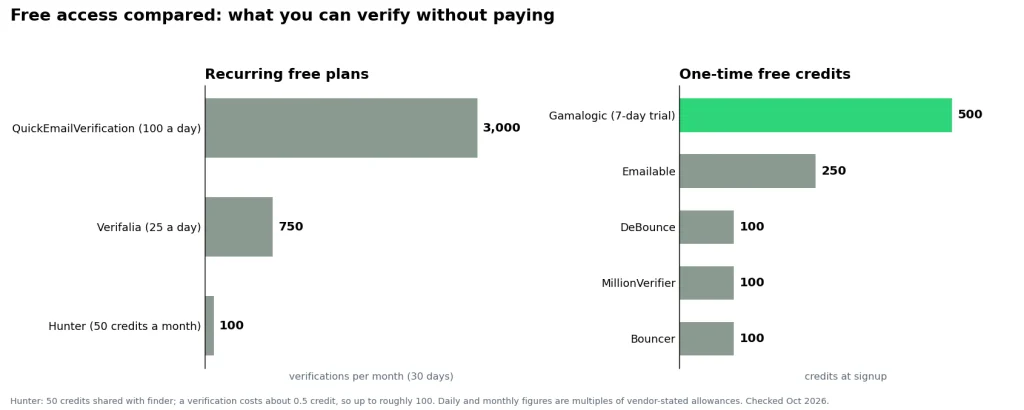
| One-time credits | DeBounce 100, MillionVerifier 100, Bouncer 100, Emailable 250 , Gamalogic 500 | They do not renew. Some expire (Gamalogic’s trial runs 7 days ) |
| Recurring monthly | Hunter 50 credits a month | Credits reset and do not roll over. A verification costs about half a credit, and the pool is shared with the finder |
| Recurring daily | QuickEmailVerification 100 a day, Verifalia 25 a day [CONFIRM both] | Daily limits cap how fast you can clean a list |
| Free single checks | Many vendors offer a one-address checker | Good for a spot check, not for a list |
| Tool | Smallest purchase | 10,000 credits | Credits expire? | Unknown or risky results |
|---|---|---|---|---|
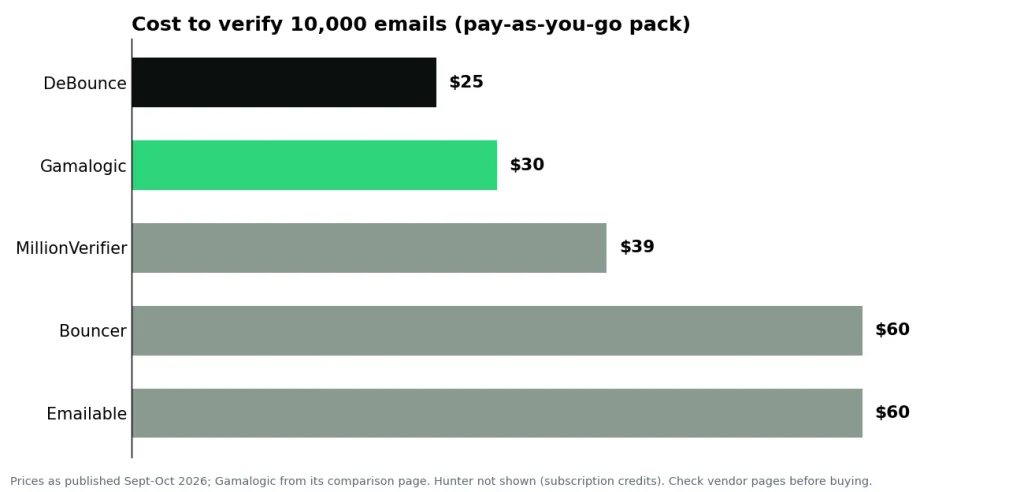
| DeBounce | 5,000 credits | $25 ($2.50 per 1,000) | Never | Free. Catch-all check costs 10 credits |
| Bouncer | 1,000 credits, $8 | $60 | Never | Free |
| Emailable | 5,000 credits | $60 | Never | Refunded |
| Gamalogic | 1,000 credits [CONFIRM price] | $30 | Never | Catch-all included at one credit. [CONFIRM unknown billing] |
| Hunter | A subscription, not packs | n/a | Monthly credits reset. Packs expire after 3 months | See Hunter’s help docs |
| MillionVerifier | 10,000 credits ($39). A 2,000-credit trial costs $4.90 | $39 | Never | Risky results are not charged |
Sources (verified on [DATE]): DeBounce pricing and help center, Bouncer, Emailable, Gamalogic, Hunter and Hunter’s plans help page, MillionVerifier. Policies were cross-checked against Reoon’s September 2026 snapshot of vendor pricing pages.
What the numbers say: at 10,000 credits, none of these tools is cheaper than DeBounce except in the sense of the smaller pack or the free tier. So a switch here is about fit, not price. For larger lists, see ZeroBounce alternatives compared by cost per 1,000 emails.
DeBounce checks catch-all domains with a separate validation that costs 10 credits each. An illustration, using the 10,000-credit rate of $2.50 per 1,000 credits :
The catch-all validator is optional, so you can choose which addresses get it. Other tools handle the same problem differently. MillionVerifier does not charge for risky results. Bouncer and Emailable make unknowns free or refund them. Gamalogic includes catch-all validation in its one-credit price. For how each tool reports catch-all addresses, see NeverBounce alternatives compared on catch-all handling.
Two vendors outside the five publish renewing free plans: QuickEmailVerification (up to 100 addresses a day) and Verifalia (25 a day) [CONFIRM both]. If you only need to clean a few hundred addresses a month, a daily free plan may cover you without paying.
| Your situation | Look at | Why |
|---|---|---|
| A one-off clean of fewer than 2,000 addresses | MillionVerifier trial, Bouncer or Gamalogic (1,000 packs) | Below DeBounce’s 5,000 minimum |
| A few hundred addresses every month | A renewing free plan (Hunter, QuickEmailVerification or Verifalia) | No payment needed |
| 5,000 to 100,000 addresses, price first | DeBounce, then MillionVerifier above 100,000 | Lowest published prices |
| A list with many corporate catch-all domains | Gamalogic or MillionVerifier | No separate catch-all charge |
| You want refunds for unknowns | Bouncer or Emailable | Free or refunded |
| Finding and verifying in one place | Hunter, Gamalogic or DeBounce’s lead finder | All include a finder |
What is the best DeBounce alternative?
It depends on what you need. Bouncer and Gamalogic offer packs from 1,000 credits, MillionVerifier does not charge for risky results, and Hunter has a renewing free plan. None is cheaper than DeBounce at 10,000 credits on published prices.
Do DeBounce credits expire?
No, according to DeBounce’s pricing page and help center. A few competitor pages claim 6 or 12 months, but we could not match that to DeBounce’s own pages. Check the live pricing page before you decide.
Does DeBounce have a free plan?
It gives 100 free credits once per account, and the help center says they do not refill monthly. For a renewing free plan, look at Hunter, QuickEmailVerification or Verifalia.
How much does DeBounce cost?
A September 2026 snapshot lists $25 for 10,000 credits, $135 for 100,000 and $750 for 1,000,000, with a 5,000-credit minimum. Prices include taxes and fees. Confirm on DeBounce’s pricing page.
Does DeBounce charge extra for catch-all checks?
Yes. Catch-all validation costs 10 credits per validation.
Which email verification credits never expire?
DeBounce, Bouncer, Emailable, MillionVerifier and Gamalogic’s paid credits say they do not expire. Hunter’s monthly credits reset, and its credit packs expire after 3 months. Free trial credits can expire, so check each one.
Is pay-as-you-go cheaper than a subscription?
For occasional cleaning, usually yes, because you only buy what you use. For steady monthly volume a subscription can be cheaper. Hunter’s subscription costs about five times DeBounce’s per-1,000 price if you only verify (an estimate, under the assumptions above).
Is a cheaper email verifier less accurate?
Not necessarily. Accuracy figures are the vendors’ own claims, measured on different data. The only figure worth trusting is one you measure on a sample of your own list.
Can I verify emails for free?
Yes. Each vendor gives free credits, and a few have renewing free plans. For a single address, try the Gamalogic free fake email checker. For lists.
What do “accept-all”, “risky” and “unknown” mean?
They describe addresses a verifier cannot confirm, often because the mail server accepts everything. Treat them as higher risk: send in small batches, or suppress them. .
DeBounce is hard to beat on published price from 5,000 credits upward, and its credits never expire. The reasons to choose something else are fit: a pack under 5,000 credits, a renewing free plan, catch-all checks that do not cost extra, or a finder in the same account. Check each vendor’s pricing page, because the figures on comparison sites disagree, then test your top choice on 100 of your own addresses.
Try Gamalogic on a small list: get 500 free credits for 7 days, with credits that never expire once purchased.
Disclosure: Gamalogic publishes this guide and is one of the five tools. To keep it fair, the tools are in alphabetical order, every figure has a named source, we say where DeBounce is the better choice, and we flag claims about DeBounce on other sites that its own pages do not support. See an error? Email info@gamalogic.com and we will correct it.



Stop fake SaaS signups and trial abuse with email verification. Learn How to Prevent Free Trial Abuse in SaaS Using Email Verification, reduce fraud, and improve user quality from signup.

Struggling with low SaaS activation rates? Learn How Email Validation Improves SaaS Onboarding & Activation Rates, reduces fake users, and drives higher retention and growth.


 No credit card required
Post your Comment.