 Sign In














 Email Marketing
 ABM
ABM  List Building
  Lead Generation
  Growth Hacker
  Digital Marketing
  Data Enrichment
  Software as a Service
  Data as a Service
  Waterfall Enrichment
  Startup
  Revenue Performance
  Job Change Tracking
  Customer Data Platform
  CRM
CRM 


 Knowledge Base
  Video Tutorials
  Help Center
  Tarpitting Scoring
  ROI Calculator
  About us
  Contact us
  Testimonials
  Automation
Email Verification vs Email Validation: What’s the Difference (and Why It Matters for Deliverability)

17 Jul 2026
Sreerag
12 Minutes
Read

 Blog
FAQ
Case Studies
Knowledge Base
Video Tutorials
Help Center
SEG Validation
Tarpitting Scoring
ROI Calculator
About us
Contact us
Testimonials
Blog
FAQ
Case Studies
Knowledge Base
Video Tutorials
Help Center
SEG Validation
Tarpitting Scoring
ROI Calculator
About us
Contact us
Testimonials
If you’ve seen “email validation” and “email verification” used interchangeably and wondered whether that’s a typo or two genuinely different things you’re not wrong to be confused. Most tools blur the line on purpose, because building only one of the two is a lot cheaper than building both. But the difference isn’t semantic. It’s the reason two “verified” lists can have wildly different bounce rates.
| Feature | Email Validation | Email Verification |
|---|---|---|
| Checks syntax | ✓ | ✓ |
| Checks domain & MX records | ✓ | ✓ |
| Detects disposable domains | ✓ | ✓ |
| Confirms the mailbox exists | ✗ | ✓ |
| Detects catch-all domains | ✗ | ✓ |
| SMTP server handshake | ✗ | ✓ |
| Reduces hard bounces | Limited | High |
| Best for | Signup forms | Bulk campaigns & outreach |
Email validation is a surface-level check. It confirms an address is structurally plausible nothing more. It checks syntax (does the address follow standard local-part@domain formatting?), domain existence (does an MX record show the domain can receive mail at all?), and disposable-domain detection (is this a known throwaway provider like Mailinator?).
Here’s what validation can’t tell you: whether the specific mailbox john.smith@ versus jsmith@ versus j.smith@, actually exists. notarealperson@gmail.com passes every validation check. Syntax is fine, Gmail’s MX records are obviously live, it’s not a disposable domain. Validation gives it a pass. It will still bounce.
Verification goes one layer deeper: it checks whether the specific mailbox is live and able to receive mail, not just whether the domain could theoretically accept something. It adds an SMTP-level handshake (connecting to the mail server and asking, without sending an actual email, whether that mailbox exists), catch-all detection (flagging domains configured to accept mail to any address, which makes individual confirmation unreliable), and role-based/risk scoring (flagging generic addresses like info@, which exist but behave differently for outreach purposes).
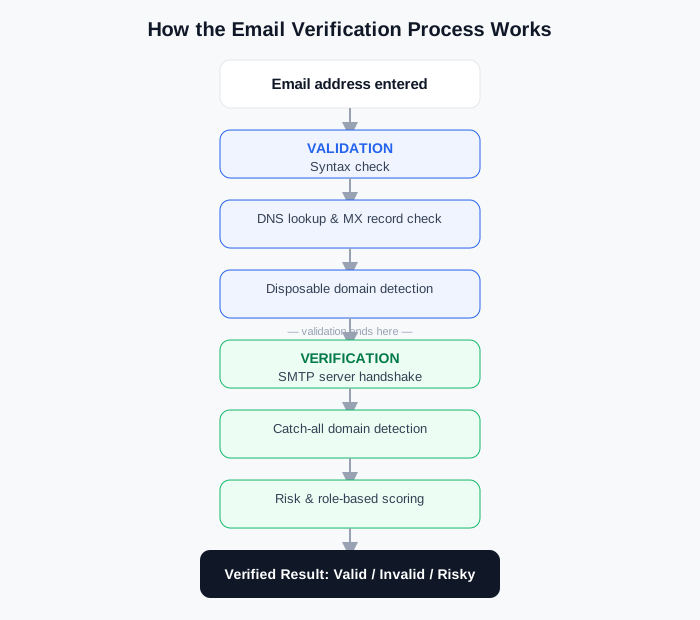
Verification runs through several layers in sequence: syntax check → DNS lookup and MX record check → disposable-domain detection (this is where validation typically stops) → SMTP handshake → catch-all detection → risk scoring → a final result of Valid, Invalid, or Risky. Each layer catches something the previous one misses, which is why skipping straight from syntax to “verified” undersells what real verification involves.
| Situation | Recommended |
|---|---|
| Website signup form | Validation (fast, real-time, low friction) |
| Newsletter subscription | Validation, ideally paired with periodic verification |
| CRM cleanup | Verification |
| Cold outreach / sales prospecting | Verification |
| Bulk email campaign | Verification |
| Pre-send list hygiene | Verification |
The pattern here: anything checked at the moment someone types it in favors validation, because speed matters more than catching every edge case. Anything you’re about to send mail to in bulk needs verification, because that’s exactly where dead mailboxes turn into bounces and reputation damage.
Myth: Validation guarantees deliverability. Reality: it doesn’t check whether the mailbox exists only whether the domain could theoretically receive mail.
Myth: SMTP verification sends a real email. Reality: it performs a server handshake and reads the response, without ever delivering a message to the inbox. If you want the full breakdown of this process, including why it’s safer than sending a test email, see how to check if an email address is valid for free.
Myth: All verification tools produce the same result. Reality: providers differ meaningfully in how they handle catch-all domains, greylisting servers, and ambiguous responses, this is exactly where “99% accuracy” claims start to diverge between vendors.
This isn’t a technicality, it’s the difference between a list that performs and one that quietly tanks your sender reputation. Every hard bounce tells Gmail, Outlook, and Google Workspace’s spam filters that you’re sending to addresses that don’t exist. Enough of those, and your inbox placement drops for your next campaign too even for subscribers who are genuinely engaged.
Verification specifically protects a few things validation can’t touch:
Say you’re about to send a cold outreach campaign to 10,000 scraped B2B contacts.
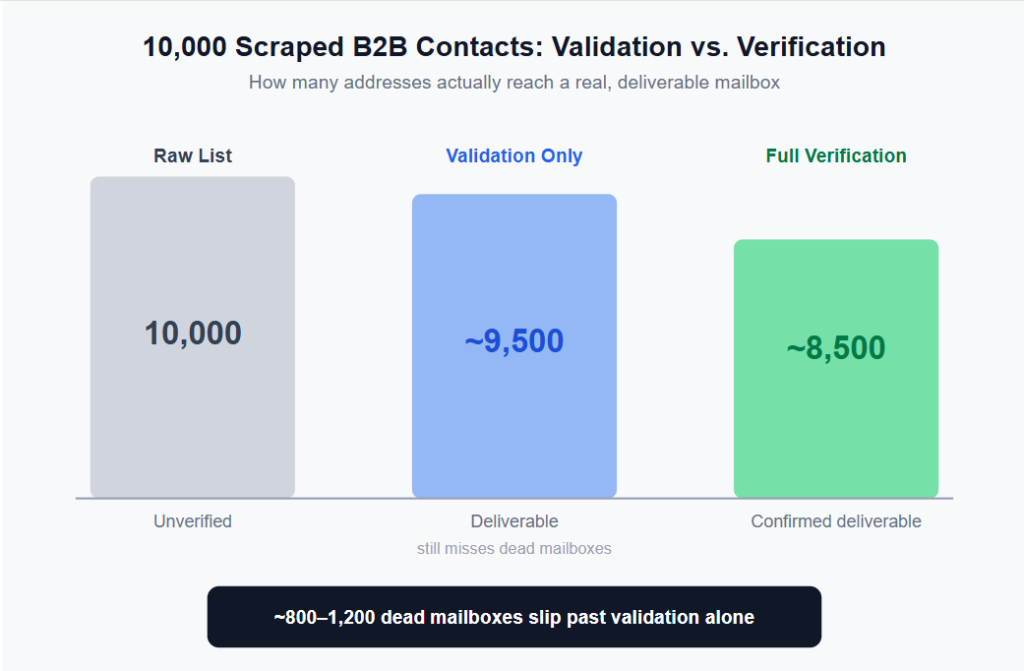
That gap is exactly the range that tips a sending domain from “healthy” into “under review” with most major mailbox providers.
Most teams run a validation tool for real-time signup-form checks and a separate verification pass before any bulk send. Historically that’s meant two subscriptions and two dashboards to check.
Gamalogic’s email validation API performs both in a single call — syntax, MX, and disposable-domain validation and real-time SMTP-level verification, including catch-all and role-based detection, so you’re not stitching together two tools.
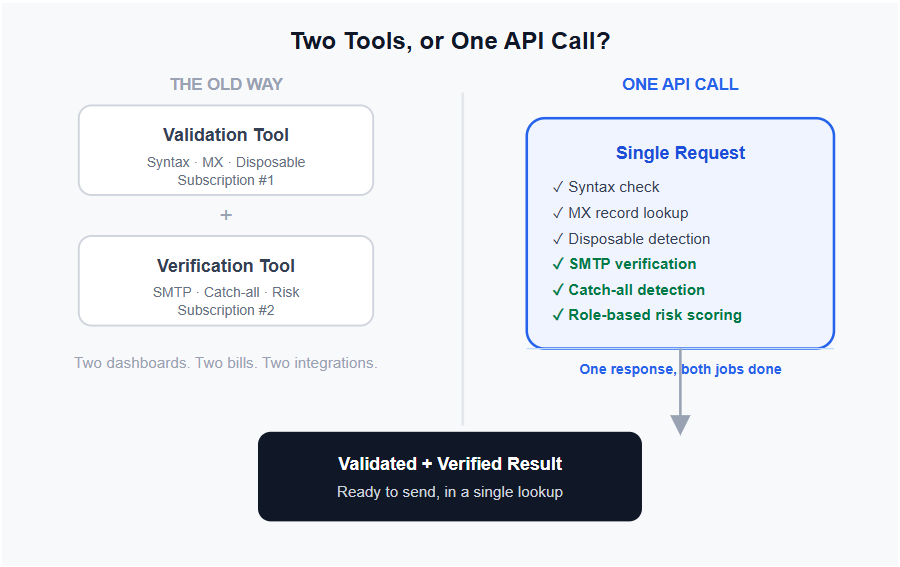
Whether you’re validating an address the moment someone signs up or verifying an entire list of 50,000 contacts before an outreach campaign, it’s the same API, the same accuracy standard, and the same bulk email validation workflow either way. If you want the specifics on how that accuracy is measured, we’ve published our full methodology rather than just quoting a number.
Is email validation the same as email verification?
No. Validation checks that an address is correctly formatted and its domain can theoretically receive mail. Verification goes further, checking in real time whether the specific mailbox exists and can actually receive a message.
Which one should I use before a cold email campaign?
Verification, not validation alone. A cold outreach list needs the SMTP-level check to catch dead mailboxes on otherwise valid domains this is exactly what protects your sender reputation before a bulk send.
Can a validated email address still bounce?
Yes. An address can pass every validation check correct syntax, live domain, not disposable, and still hard-bounce if the specific mailbox doesn’t exist.
What’s a catch-all domain, and why does it complicate verification?
A catch-all domain is configured to accept mail sent to any address at that domain, real or not. Good verification tools flag these separately rather than marking them a false positive.
Do I need separate tools for validation and verification?
Not necessarily. Some platforms, including Gamalogic, run both checks through a single API call, so you get syntax/MX validation and live SMTP verification in one pass instead of managing two tools.



The Marketer’s Handbook to Email List Hygiene & Growth explains how to clean email databases, reduce bounce rate, improve deliverability, and grow a high-quality subscriber list.



 No credit card required
Post your Comment.