 Sign In












 Email Marketing
 ABM
ABM  List Building
  Lead Generation
  Growth Hacker
  Digital Marketing
  Data Enrichment
  Software as a Service
  Data as a Service
  Waterfall Enrichment
  Startup
  Revenue Performance
  Job Change Tracking
  Customer Data Platform
  CRM
CRM 


 Knowledge Base
  Video Tutorials
  Help Center
  Tarpitting Scoring
  ROI Calculator
  About us
  Contact us
  Testimonials
  Automation
The Cold Email Quality Score: 7 Things to Check Before You Send

28 Aug 2026
Mohamed Ahmed
12 Minutes
Read

 Blog
FAQ
Case Studies
Knowledge Base
Video Tutorials
Help Center
SEG Validation
Tarpitting Scoring
ROI Calculator
About us
Contact us
Testimonials
Blog
FAQ
Case Studies
Knowledge Base
Video Tutorials
Help Center
SEG Validation
Tarpitting Scoring
ROI Calculator
About us
Contact us
Testimonials
A cold email can look perfect on the screen and still fail when you send it.
The subject line may be interesting. The copy may be personalized. The offer may be relevant. Yet the campaign can still produce disappointing results.
Why?
Because successful cold email isn’t determined by the message alone. Your results depend on everything surrounding that message—from the quality of your prospect list and the accuracy of your data to your targeting, personalization, deliverability, offer, and follow-up strategy.
Think of it as a cold email quality score.
Before you hit send, there are seven areas you should check. If even one is weak, it can affect the performance of the entire campaign.
Before worrying about your copy, look at your data.
An outdated prospect list can contain invalid addresses, disposable emails, inactive accounts, duplicates, catch-all addresses, and other risky contacts.
Sending campaigns to poor-quality addresses can increase bounces and make your campaign data harder to interpret. You may think your messaging isn’t working when the real problem is the quality of your audience.
This is why email verification should happen before your campaign reaches the sending stage.
Instead of asking only, “Do I have enough leads?”, ask:
“How many of these leads are actually reachable?”
A smaller list of accurate, verified prospects can be more valuable than a huge database filled with outdated information.
Quick check: Verify your prospect list before every major campaign, especially when the data is old or came from multiple sources.
A clean email address doesn’t automatically mean you have the right prospect.
You could have 10,000 valid addresses and still have a poor campaign if most recipients don’t need what you’re offering.
Your targeting should answer three questions:
For example, a company selling email verification software shouldn’t send the same message to a student, a consumer blogger, an HR executive, and a B2B sales director.
The sales director may care about bounce rates and prospecting data. The HR executive may have completely different priorities.
Quick check: Define your ideal customer profile before building the list, then segment prospects according to their needs.
“Hi {{FirstName}}” isn’t personalization.
Real personalization gives the recipient a reason to believe that the email was written specifically for them.
You might mention:
But personalization shouldn’t become an excuse to make your email longer.
One useful observation is usually better than five artificial compliments.
For example:
Weak:
“Hi John, I saw that you are the CEO of ABC Company. I really liked your website.”
Better:
“Noticed you’re expanding your outbound sales team. Are you currently verifying prospect emails before adding them to your sequences?”
The second opening connects the observation directly to the reason for the email.
Quick check: Remove every personalization line that doesn’t help explain why you’re contacting the prospect.
Your prospect doesn’t have time to decode your message.
If they need to read three paragraphs before understanding what you’re offering, you’ve already made the conversation harder than it needs to be.
A strong cold email should quickly communicate:
Problem → Value → Next step
For example:
“You’ve recently expanded your outbound team. That usually means more prospect data entering your campaigns. We help sales teams verify those addresses before they reach their sending platform. Worth showing you how it works?”
The message is short, but the recipient can immediately understand the context.
Avoid filling your first email with every feature your product offers.
Your goal isn’t to explain everything.
Your goal is to create enough relevance and curiosity for the prospect to respond.
Quick check: Can someone understand your value proposition in less than 10 seconds?
Even the best cold email won’t work if it doesn’t consistently reach the inbox.
Your sending infrastructure should be configured properly before you begin outreach.
That includes authentication such as:
You should also pay attention to sending volume, domain reputation, bounce rates, engagement, and overall sending behavior.
Gamalogic’s cold email infrastructure checklist covers the technical foundation you should review before launching a campaign.
The important point is simple:
Deliverability isn’t something you fix after a campaign fails.
It should be part of the campaign from the beginning.
Quick check: Make sure your authentication, domains, mailboxes, sending practices, and prospect data are ready before scaling outreach.
Your prospect has never spoken to you before.
So asking for a 30-minute meeting immediately may be too much.
Instead of:
“Are you available for a 30-minute demo next Tuesday?”
try:
“Would it be useful if I sent over a quick example?”
Or:
“Is this something your team is currently working on?”
The easier the question is to answer, the lower the psychological barrier to replying.
Once you’ve started a conversation, you can introduce a meeting or demonstration.
Quick check: Could your prospect answer your CTA with three words or fewer?
If not, simplify it.
A good first email doesn’t guarantee a response.
People get busy. Emails get buried. Prospects open messages and intend to respond later.
Then they forget.
That’s why your cold email strategy shouldn’t depend on one message.
A simple sequence might look like:
Email 1: Introduce the problem and your value.
Follow-up 1: Add a useful observation or insight.
Follow-up 2: Share a relevant resource, example, or result.
Final email: Give the prospect an easy way to close the conversation.
Avoid sending:
“Just following up.”
Instead, make every follow-up useful.
If the recipient doesn’t respond, don’t simply repeat the original pitch.
Give them another reason to reconsider.
Quick check: Does every follow-up add something new?
Before launching your next campaign, score each area from 0 to 10:
| Area | Score |
|---|---|
| Prospect data quality | /10 |
| Targeting | /10 |
| Personalization | /10 |
| Value proposition | /10 |
| Deliverability | /10 |
| Call to action | /10 |
| Follow-up strategy | /10 |
You don’t need a perfect score.
But if one category scores significantly lower than the others, that’s probably where you should focus your attention first.
For example, if your messaging scores 9/10 but your prospect data scores 4/10, rewriting the email probably isn’t your best next move.
Fix the data.
If your data is excellent but your CTA scores 4/10, test a lower-friction call to action.
This approach makes optimization much more systematic.
One of the easiest mistakes in cold email is assuming that more volume equals better results.
It doesn’t.
Sending more emails to the wrong people won’t fix targeting.
Sending more emails with poor-quality data won’t fix list hygiene.
Sending more emails with a weak offer won’t fix your messaging.
And sending more emails from poorly configured infrastructure can create even bigger problems.
The goal isn’t to send the maximum number of emails.
The goal is to send the right email to the right person using reliable data at the right time.
Email verification is only one part of a successful cold email campaign, but it’s an important one.
Before you invest time in personalization and campaign copy, make sure the addresses you’re targeting are worth sending to.
A simple workflow looks like this:
Build your list → Verify addresses → Segment prospects → Research → Personalize → Send → Follow up → Analyze → Improve
This process helps separate data problems from messaging problems.
With Gamalogic, businesses can verify prospect email addresses before using them in their outreach campaigns, helping create a cleaner foundation for cold email.
The best cold email campaigns aren’t built around one clever template.
They’re built around a repeatable system.
You start with good data.
You identify the right prospects.
You create relevant messaging.
You protect deliverability.
You make the response easy.
Then you measure what happens and improve the next campaign.
That is what separates random outreach from a predictable acquisition process.
Before you hit send on your next cold email campaign, don’t ask only whether the email sounds good.
Ask whether the entire campaign is ready.
Is your data clean? Are you targeting the right prospects? Is your personalization meaningful? Does your offer communicate value quickly? Is your infrastructure prepared? Is your CTA easy to answer? And do you have a thoughtful follow-up sequence?
When all seven pieces work together, your cold emails have a much stronger foundation.
Because successful cold email isn’t about sending more messages.
It’s about making every message more relevant, more reliable, and more worth responding to.


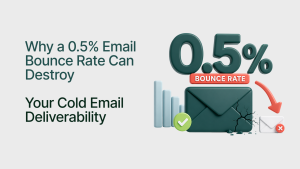
Learn why even a 0.5% email bounce rate can negatively impact cold email deliverability, damage sender reputation, and reduce inbox placement. Discover the hidden risks of stale email data and how proper email verification helps protect your outreach campaigns.
Even the most compelling email won't drive results if it never reaches the inbox—learn eight proven strategies to improve email deliverability, protect your sender reputation, and maximize campaign performance with Gamalogic.


 No credit card required
Post your Comment.