 Sign In














 Email Marketing
 ABM
ABM  List Building
  Lead Generation
  Growth Hacker
  Digital Marketing
  Data Enrichment
  Software as a Service
  Data as a Service
  Waterfall Enrichment
  Startup
  Revenue Performance
  Job Change Tracking
  Customer Data Platform
  CRM
CRM 


 Knowledge Base
  Video Tutorials
  Help Center
  Tarpitting Scoring
  ROI Calculator
  About us
  Contact us
  Testimonials
  Automation
What Makes an Accurate Email Validation Tool in 2026?

17 Jun 2026
Sreerag
12 Minutes
Read

 Blog
FAQ
Case Studies
Knowledge Base
Video Tutorials
Help Center
SEG Validation
Tarpitting Scoring
ROI Calculator
About us
Contact us
Testimonials
Blog
FAQ
Case Studies
Knowledge Base
Video Tutorials
Help Center
SEG Validation
Tarpitting Scoring
ROI Calculator
About us
Contact us
Testimonials
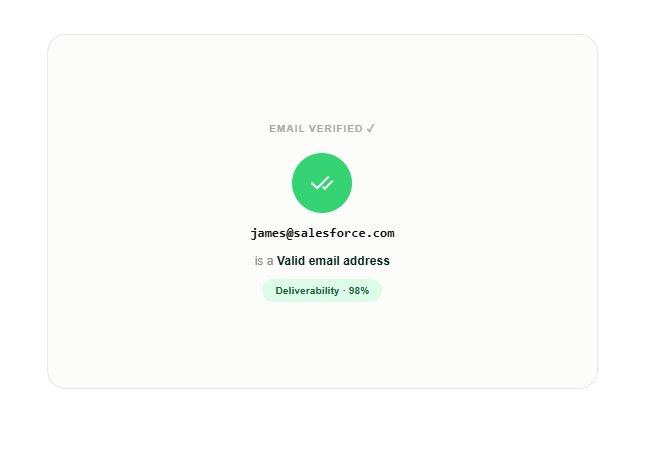
An accurate email validation tool does more than check whether an address looks correct. It combines syntax validation, domain and MX record verification, SMTP mailbox pings, catch-all detection, disposable email detection, spam trap identification, and risk scoring to determine whether an address can actually receive mail without ever sending a real message to it.
No single check is enough on its own. A domain can exist and still have no working mailbox. A syntactically perfect address can belong to a spam trap. Accuracy comes from how many of these layers a provider runs, and how well it interprets ambiguous results like catch-all domains and greylisted servers rather than just returning “unknown.”
Most businesses focus on growing their list size and overlook the quality of what they’re collecting. An inaccurate validator can quietly cause:
Whether you’re validating signups, cleaning a CRM, or running cold outreach, accuracy is the variable that determines whether validation actually helps or just adds a step.
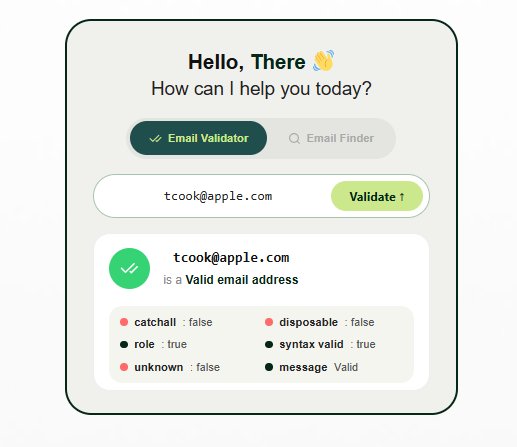
The first and weakest check: does the address follow standard formatting?
❌ john.gmail.com — missing @ ❌ john@@gmail.com — malformed ❌ john@gmail — no top-level domain ✅ john@gmail.com
This catches obvious typos but tells you nothing about whether the mailbox exists.
The validator checks whether the domain exists via DNS, then checks its MX (Mail Exchange) records to confirm the domain is actually configured to receive mail. A domain can resolve fine and still have no valid MX record which means nothing sent to it will ever arrive.
This is where real accuracy lives. The validator opens a connection to the recipient’s mail server and asks whether the specific mailbox exists, without sending an actual message. Responses typically fall into a few buckets: mailbox exists, mailbox doesn’t exist, mailbox temporarily unavailable, or the server accepts everything (catch-all). How a tool handles greylisting and ambiguous responses here is the biggest differentiator between providers — this is also the step most likely to be done poorly or skipped by low-end “format only” checkers.
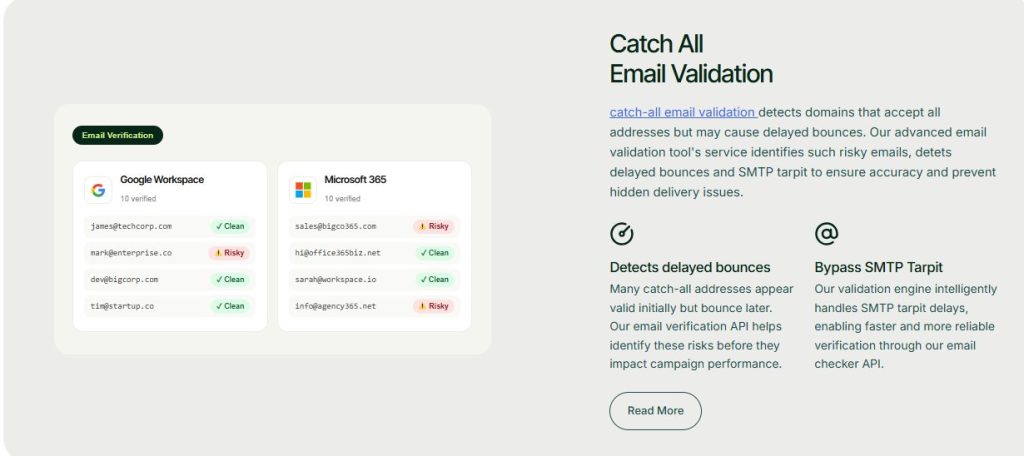
Catch-all domains accept mail to almost any address regardless of whether the mailbox is real, which makes them impossible to verify with certainty through SMTP alone. The best tools don’t just flag these as “unknown” they apply a risk score based on domain history and engagement signals, giving you something actionable instead of a dead end. If catch-all results are a recurring headache in your list, our dedicated breakdown of the catch-all problem and how to actually resolve it goes deeper than this overview can.
Temporary inboxes (Mailinator, 10MinuteMail, and similar) are used for free trial abuse, fake signups, and spam. Role-based addresses (info@, sales@, support@) belong to teams rather than individuals and tend to generate higher spam complaint rates because no single person consented to your emails. Accurate tools maintain continuously updated lists of both.
Spam traps are addresses planted by ISPs and anti-spam organizations specifically to catch senders with poor list hygiene. Hitting even a handful can damage sender reputation for weeks. Detecting them requires pattern recognition beyond basic syntax or SMTP checks typically a combination of domain reputation data and known trap signatures.
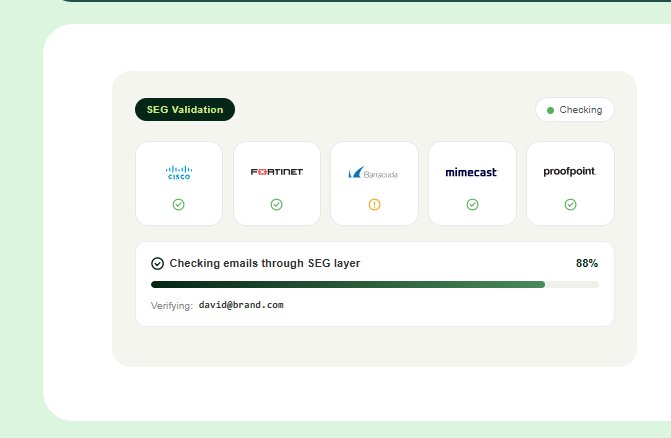
This is a factor most discussions of validation accuracy skip entirely. A meaningful share of Fortune 500 and S&P 500 companies route inbound mail through a Secure Email Gateway Cisco, Fortinet, Barracuda, Mimecast, Proofpoint, and similar before it ever reaches an employee’s actual inbox. These gateways sit in front of the mail server and can intercept the SMTP handshake a validator normally relies on, which means a genuinely valid mailbox can come back uncertain, or a legitimate send can get flagged before a human ever sees it.
For B2B lists with a meaningful share of enterprise domains, this matters more than it sounds: a validator that doesn’t specifically account for SEG behavior can misread otherwise-clean addresses, and a sender unaware of it can burn budget repeatedly emailing addresses the gateway is quietly absorbing rather than delivering.
Different providers emphasize different layers. Rather than ranking tools subjectively, here’s what to actually check when comparing options, using publicly stated capabilities as of late 2025/2026:
| Capability | What to look for | Why it matters |
|---|---|---|
| SMTP mailbox verification | Does it ping the actual mail server, or stop at MX records? | Without this, “valid domain” gets confused with “valid mailbox” |
| Catch-all handling | Risk score vs. blanket “unknown” | Blanket unknowns leave you guessing on a large share of B2B addresses |
| Disposable + role detection | Continuously updated domain lists | New disposable domains appear constantly; static lists go stale fast |
| Real-time API | Sub-second response at point of signup | Bulk-only tools can’t stop bad data from entering your system in the first place |
| Stated accuracy rate | Ask for the methodology behind the number, not just the percentage | Self-reported accuracy figures (most providers cite 95–99%+) measure different things depending on how “accuracy” is defined — get the definition, not just the headline number |
| Compliance | GDPR / SOC 2 / data retention policy disclosed publicly | You’re sending customer PII through this system; the policy should be easy to find, not buried |
Providers commonly cited for combining most of these layers include ZeroBounce, Verifalia, Clearout, and Bouncer each documents its verification methodology publicly, which is worth comparing directly against the criteria above rather than taking accuracy percentages at face value.
Gamalogic runs the same core layers SMTP-level mailbox checks, catch-all risk scoring, disposable and role detection, and a real-time API and publishes its methodology rather than leading with a bare percentage, on the view that the definition behind the number matters more than the number itself. For a deeper look at how those accuracy claims are actually measured and benchmarked across providers, see our full breakdown of email validation accuracy metrics.
Accuracy requirements differ depending on what you’re solving for. A quick way to scope it:
Validating at the point of signup (forms, checkout, account creation): You need a real-time API with low latency ideally returning a result in under a second, since this runs while the user is still on the page. Bulk-only tools won’t work here regardless of how accurate they are.
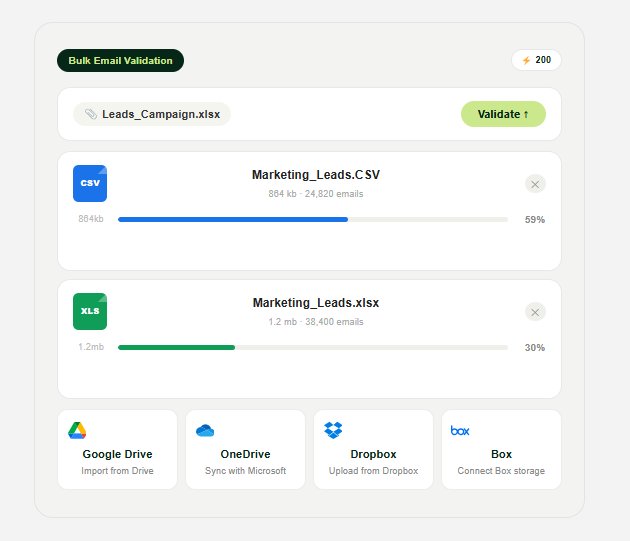
Cleaning an existing list before a campaign: You need bulk verification with detailed failure reasons (not just valid/invalid), so you can distinguish a hard bounce risk from a soft “mailbox full” result and decide what to suppress versus retry later.
Maintaining CRM or sales data over time: You need scheduled or ongoing re-verification, since roughly a fifth to a third of email addresses go stale annually as people change jobs or abandon inboxes. A one-time check loses value within months.
Fraud or trial-abuse prevention: Disposable and role-based detection matters more here than raw deliverability accuracy you’re optimizing to block bad actors, not maximize inbox placement.
If you’re unsure which applies, the honest answer is usually “more than one” most businesses need real-time validation at the point of capture and periodic bulk re-verification of what’s already in their database. Our full comparison of real-time vs. batch validation walks through the tradeoffs in more detail if you’re scoping this out for your own stack.
Treating “valid domain” as “valid mailbox.” These are different checks. A domain can have working MX records and still bounce on the specific address if the mailbox is full or has been deactivated.
Ignoring catch-all results entirely. Catch-all domains make up a meaningful share of B2B addresses. Discarding them outright throws away real leads; accepting them blindly reintroduces risk. Risk scoring is the middle path.
Validating once and never again. Email addresses decay continuously. A list verified a year ago is not a verified list today.
Confusing validation with deliverability. Validation tells you whether an address can technically receive mail. Deliverability whether your message actually lands in the inbox also depends on sender reputation, authentication (SPF/DKIM/DMARC), content, and engagement history. A perfectly validated list can still underperform if those other factors are weak.
Choosing a tool based on accuracy percentage alone. A stated “99% accuracy” figure is only meaningful alongside its definition. Ask what counts as a correct result and how it was measured.
These get conflated often enough that it’s worth separating clearly:
Validation accuracy measures whether the tool correctly identifies if an address is legitimate and can receive mail.
Deliverability measures whether your actual campaign lands in the inbox rather than spam or nowhere at all.
Validation improves deliverability by removing addresses that would bounce or trigger spam complaints, but it doesn’t replace the other fundamentals authentication setup, sending reputation, and content quality still do most of the remaining work.
A truly accurate email validation tool does far more than check whether an email address “looks valid.” It should analyze multiple deliverability signals to determine whether an email address is real, reachable, and safe to send to.
At a minimum, a modern email validator should detect:
✅ Syntax Validation – Identifies formatting errors, invalid characters, and common domain typos before they enter your database.
✅ DNS & Domain Validation – Verifies that the domain exists, is active, and can properly receive emails.
✅ MX Record Verification – Confirms that valid mail exchange (MX) records are configured to accept incoming messages.
✅ SMTP Mailbox Verification – Checks whether the mailbox actually exists without sending an email.
✅ Catch-All Email Detection – Identifies domains that accept all email addresses and provides risk scoring instead of returning inconclusive results.
✅ Secure Email Gateway (SEG) Detection – Detects enterprise email security systems that can mask mailbox status and create validation challenges.
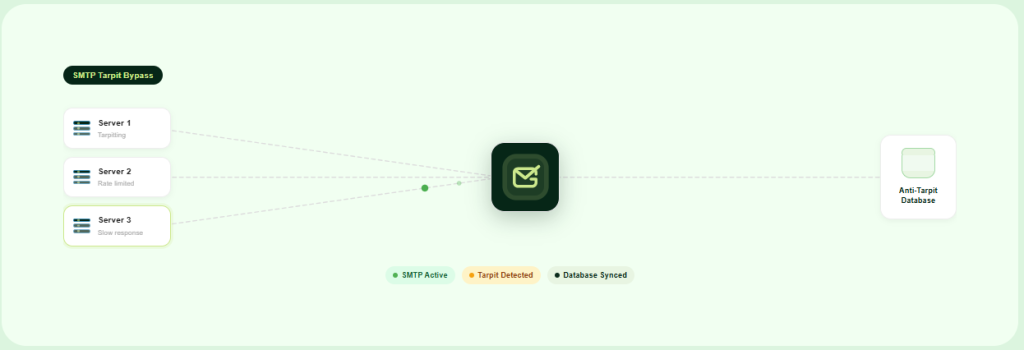
✅ SMTP Tarpit Detection – Identifies servers that intentionally delay SMTP responses to prevent automated verification.
✅ Accept-Now, Bounce-Later Analysis – Detects mail servers that initially accept messages but generate delivery failures later.
✅ Disposable Email Detection – Flags temporary and throwaway email addresses commonly used for fake signups.
✅ Role-Based Email Detection – Identifies addresses such as info@, sales@, support@, and admin@ that may not represent individual contacts.
✅ Spam Trap & Honeypot Detection – Helps protect sender reputation by identifying addresses associated with anti-spam monitoring networks.
✅ Free vs Business Email Classification – Distinguishes personal email providers such as Gmail, Yahoo Mail, and Outlook from business domains.
✅ Greylisting Detection – Recognizes temporary server restrictions and retries validation to reduce false negatives.
✅ Email Blacklist & Reputation Checks – Monitors signals that may impact inbox placement and email deliverability.
✅ Mailbox Quality & Deliverability Scoring – Generates a quality score based on validation results, helping prioritize high-value contacts.
✅ Bulk Email Validation Support – Validates large email lists while maintaining accuracy, speed, and deliverability insights.
The more of these validation layers a provider supports, the more reliable its accuracy claims become. If a platform only checks syntax, domains, and basic SMTP responses, it may miss many of the real-world factors that influence email deliverability, sender reputation, and campaign ROI.
If a provider is missing several of these verification layers, its “accuracy” claims may not tell the full story. True email validation accuracy depends on multiple factors, including mailbox verification, disposable email detection, catch-all analysis, and real-time validation infrastructure. To make a more informed decision when evaluating email verification services, explore our detailed guide: The Complete Guide to Email Validation APIs.
Different email validation providers use different methods to determine whether an email address is valid. This is one reason why accuracy claims can vary significantly between tools.
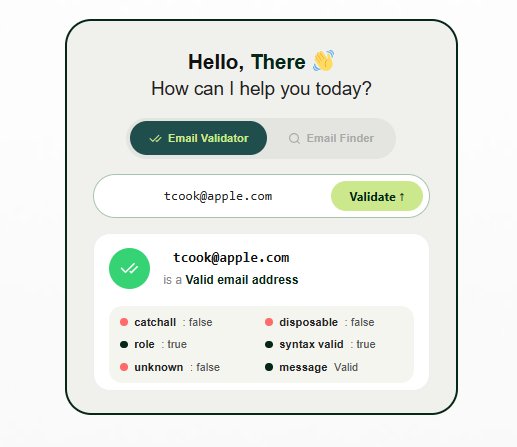
As an example, Gamalogic email validation api combines multiple validation layers, including syntax checks, domain validation, MX record verification, SMTP-level checks, disposable email detection, and role-based email identification. Additional signals such as catch-all domain behavior and mailbox availability may also be considered when evaluating deliverability risk.
The platform supports both real-time email validation for signup forms and bulk email verification for existing email lists. This reflects a broader industry trend where email validation is no longer limited to checking whether an address exists but also focuses on assessing overall email quality and deliverability potential.
What matters most is not whether a provider claims a specific accuracy percentage, but how that accuracy is achieved. Understanding the validation methods, data sources, and verification layers behind a result provides a more meaningful way to evaluate an email validation tool than relying on marketing claims alone.
There’s no single industry benchmark, but the more meaningful question is what the percentage is measuring. A provider that defines accuracy as “correctly classified syntax and domain checks” will report a much higher number than one measuring confirmed mailbox existence. Ask for the definition before comparing across providers.
A mailbox can pass validation and still bounce later due to a full inbox, a temporary server outage, the recipient’s own spam filtering, or a catch-all configuration that accepted the validation ping but rejects the actual campaign send.
It’s one of the strongest available methods because it queries the actual mail server rather than inferring from domain data alone. Its limitation is that some servers deliberately restrict or delay responses to prevent harvesting, which is part of why greylisting handling matters so much in provider quality.
Catch-all domains accept mail sent to any address at that domain, even ones that don’t correspond to a real mailbox. Because the server says “yes” to everything, SMTP verification alone can’t distinguish a real recipient from a nonexistent one this is where risk-scoring models add value beyond a binary check.
By maintaining and continuously updating a database of known temporary-email domains, supplemented by pattern detection for newly registered disposable services that haven’t been manually catalogued yet.
No. It removes a major risk factor invalid and risky addresses but deliverability also depends on sender authentication, IP and domain reputation, and recipient engagement. Validation is necessary but not sufficient on its own.
Given that a meaningful share of addresses go stale every year, quarterly re-verification is a reasonable default for active marketing lists, with more frequent checks for lists tied to sales or CRM workflows where data freshness directly affects outreach accuracy.
The most accurate email validation tool isn’t the one with the highest percentage on its homepage it’s the one that’s transparent about what that percentage measures and that runs enough verification layers (syntax, domain, MX, SMTP, catch-all risk scoring, disposable and role detection) to back the claim up. As acquisition costs rise, the cost of acting on bad data rises with them, which makes the methodology behind a validator’s accuracy claim worth checking before the number itself.



Discover how email validation API pricing works — from per-check costs to subscription models and hidden fees. Compare top providers and choose smartly.

The complete, capability-mapped list of 22+ ESPs, CRMs, and outreach tools that connect to Gamalogic, with connection type, validation depth, and setup links for each.
Still using RegEx to validate emails? It’s time to move on. While regular expressions may catch formatting issues, they miss the bigger picture—like whether the email actually exists. In this post, we’ll show you smarter, faster ways to validate emails in milliseconds without relying on outdated RegEx patterns.


 No credit card required
Post your Comment.