 Sign In














 Email Marketing
 ABM
ABM  List Building
  Lead Generation
  Growth Hacker
  Digital Marketing
  Data Enrichment
  Software as a Service
  Data as a Service
  Waterfall Enrichment
  Startup
  Revenue Performance
  Job Change Tracking
  Customer Data Platform
  CRM
CRM 


 Knowledge Base
  Video Tutorials
  Help Center
  Tarpitting Scoring
  ROI Calculator
  About us
  Contact us
  Testimonials
  Automation
Why Your Cold Emails Get Opens but No Replies: 9 Problems to Fix

23 Aug 2026
Mohamed Ahmed
12 Minutes
Read

 Blog
FAQ
Case Studies
Knowledge Base
Video Tutorials
Help Center
SEG Validation
Tarpitting Scoring
ROI Calculator
About us
Contact us
Testimonials
Blog
FAQ
Case Studies
Knowledge Base
Video Tutorials
Help Center
SEG Validation
Tarpitting Scoring
ROI Calculator
About us
Contact us
Testimonials
Your cold email campaign is getting a decent number of opens, so it might seem like everything is working as expected. But a high open rate doesn’t necessarily mean your campaign is successful. If prospects are opening your emails but rarely responding, the issue could be your targeting, offer, messaging, personalization, call to action, or even the quality of your prospect list. An open only shows that someone was interested enough to view your email, while a reply requires enough relevance and value to motivate them to take the next step.
If you’re wondering why your cold emails get opens but no replies, start by looking beyond the subject line. Here are nine common problems that could be limiting your response rate.
One of the most common cold email mistakes is talking too much about your company.
“We are a leading provider of AI-powered sales solutions helping businesses improve their revenue through advanced automation.”
This may explain what your company does, but it doesn’t give the recipient a compelling reason to respond.
A better approach is to connect your message to a problem the prospect may actually be experiencing.
“I noticed your sales team is expanding its outbound campaigns. Are you currently verifying prospect emails before adding them to your sequences?”
The second version immediately gives the recipient something relevant to consider.
Fix: Focus less on your company and more on the prospect’s problem, goal, or current situation.
Even excellent cold email copy will struggle when it is sent to the wrong audience.
A SaaS founder, sales manager, recruiter, and marketing agency may all use email outreach, but their needs are different.
Instead of sending the same message to everyone, divide your prospects into relevant segments based on factors such as industry, job role, company size, location, technology stack, or business problem.
For example, a campaign targeting B2B sales teams could focus on email verification and bounce reduction, while a campaign targeting marketers could focus more heavily on list hygiene and campaign performance.
Fix: Segment your audience before writing your email. The more relevant the audience, the easier it is to create a message that feels personal.
Adding a first name to an email doesn’t make it personalized.
“Hi John, hope you’re doing well” could be sent to thousands of people.
Effective personalization explains why you are contacting that particular person.
You could reference:
However, personalization doesn’t mean writing a completely different email for every prospect.
One relevant observation can be enough to make an email feel significantly more targeted.
Fix: Research your prospects and include one or two details that are genuinely relevant to your reason for reaching out.
Sometimes prospects understand your email perfectly but still don’t respond because the offer isn’t interesting enough.
Compare:
“We provide email verification software.”
with:
“We help sales teams identify risky email addresses before they enter a cold outreach campaign.”
The second version connects the product to a specific problem.
Your prospect should quickly understand what problem you solve and why solving it matters.
Fix: Lead with the problem and outcome instead of simply listing your product’s features.
A common cold email CTA looks like this:
“Would you be available for a 30-minute demo next Tuesday or Wednesday?”
For someone who has never interacted with your company, that can be a significant commitment.
Instead, make the first response easy.
Try:
“Is improving your email verification process something your team is currently looking at?”
Or:
“Would it be useful if I sent over a quick example?”
Your first objective isn’t necessarily to close the sale. It is to start a conversation.
Fix: Use a simple, low-friction CTA that a prospect can answer in a few seconds.
Cold prospects don’t owe you their attention.
A long email containing several paragraphs, multiple product features, customer stories, links, testimonials, and a calendar invitation can quickly become overwhelming.
A simple cold email structure is often more effective:
Keep the first message focused. You can provide additional information after the prospect shows interest.
Fix: Remove anything that doesn’t directly help the recipient understand why you’re contacting them.
Your cold email campaign can have excellent copy and targeting, but poor prospect data can still undermine the campaign.
Old databases can contain:
This is why email list hygiene should be part of your cold email strategy.
Before sending a campaign, verify the addresses in your database and identify contacts that may create unnecessary delivery problems.
A clean list also gives you more reliable campaign data. If you’re sending to a large number of invalid or outdated addresses, it becomes harder to understand whether poor campaign performance comes from your messaging or your data.
Fix: Verify your prospect list before sending and regularly clean older databases.
If you want to understand the difference between segmentation and validation, see our guide on Email List Segmentation vs. Email Validation.
Sometimes your first email isn’t the problem.
A prospect may open your email while busy, intend to respond later, and then forget.
That’s why a single-email approach can leave opportunities on the table.
But your follow-up shouldn’t simply say:
“Just following up.”
Give the prospect a new reason to engage.
For example:
First email: Introduce the problem.
Follow-up: Share a relevant observation or statistic.
Second follow-up: Provide a useful resource or example.
Final follow-up: Give the prospect an easy way to close the conversation.
Every follow-up should have a purpose.
Fix: Build a short sequence where each message adds something useful instead of repeating the same sales pitch. Even great email content can land in spam if your sender reputation, authentication, list quality, or engagement signals are weak—here’s what to check before your next campaign. Why Your Emails Go to Spam Even When the Content Is Good.
This may be the biggest mistake.
An open rate can tell you something about initial engagement, but it doesn’t tell you whether your campaign is generating meaningful conversations.
A campaign with fewer opens but a strong positive reply rate can be much more valuable than a campaign generating thousands of opens and almost no responses.
Track metrics such as:
Then optimize your campaign around the metric that actually matters to your business.
Fix: Treat opens as an intermediate metric, not the final goal.
If your emails are being opened but your overall campaign performance is poor, it’s still worth checking your email infrastructure.
Your sending domain, authentication, reputation, sending behavior, bounce rate, and list quality can all influence whether your emails consistently reach the inbox.
Make sure your domain has the appropriate authentication records, including SPF, DKIM, and DMARC.
You should also monitor bounce rates and remove problematic addresses from your database.
Email verification is another important part of this process. Removing invalid addresses before a campaign can reduce unnecessary bounces and help you maintain a healthier prospect database.
Don’t rewrite your entire campaign every time you see a disappointing result.
Instead, test individual elements.
For example, create two versions of the same campaign:
Version A: Product-focused messaging
Version B: Problem-focused messaging
Send them to comparable audience segments and measure the difference in positive replies.
You can repeat the process with:
This approach gives you actionable data instead of relying on assumptions.
If you’re building a long-term SEO strategy around cold email, don’t limit your content to conventional blog posts.
Create resources that other websites will genuinely want to reference.
For example, a Cold Email Statistics and Benchmarks report could collect original data around response rates, bounce rates, follow-up performance, and campaign trends.
You could also publish:
These resources can attract natural backlinks from sales, marketing, SaaS, and lead-generation websites.
For example, if you publish original research showing how email list quality affects bounce rates, another marketing website may reference your findings and link back to the original report.
That type of data-driven, linkable content can continue generating organic backlinks long after publication.
Creating useful content is only the first step.
Once you’ve published a genuinely valuable resource, identify websites that already cover related topics.
You can look for:
Another useful technique is broken-link building. If a relevant website links to an outdated email verification or cold email resource, you can suggest a current Gamalogic resource as a replacement when it genuinely fits.
You can also look for websites that mention Gamalogic without linking to it and request that the existing brand mention be linked.
Guest posting can work as well, but prioritize websites with genuine topical relevance and an audience that would benefit from your content rather than publishing articles simply to obtain a backlink.
If your cold emails are getting opened but not generating replies, it’s easy to focus entirely on subject lines, personalization, or your CTA.
But the quality of your prospect data deserves attention too.
A strong cold email workflow starts with reliable data:
Find prospects → Verify email addresses → Segment your audience → Personalize your message → Send → Follow up → Measure results
With Gamalogic, you can verify email addresses before they enter your campaigns and maintain better-quality prospect data throughout your outreach workflow.
The goal isn’t simply to send more emails. It’s to make sure you’re sending relevant messages to the right prospects using reliable data.
When your cold emails get opens but no replies, don’t immediately assume that your subject line is the problem.
Look at the entire campaign.
Are you targeting the right prospects? Is your message focused on their problem? Does your offer provide a clear reason to respond? Is your CTA easy to answer? Are you following up with something useful? And is your prospect data accurate and up to date?
Start with the fundamentals: target the right audience, personalize around real problems, keep your emails concise, make your CTA simple, follow up with value, and maintain a clean prospect list.
Then use campaign data to identify what needs improvement.
Most importantly, don’t optimize your cold email campaign simply to generate more opens.
Optimize for conversations.
An opened email means you’ve earned a moment of attention. A reply means you’ve given the prospect a reason to continue the conversation.
And that is where a cold email campaign starts creating real business opportunities.


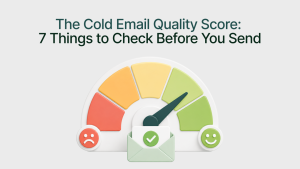
Your cold email can have a great subject line and still fail to generate replies. From poor-quality prospect data and weak targeting to ineffective personalization and high-friction CTAs, several factors can affect campaign performance. This guide covers seven essential checks to help you improve your cold email quality before you hit send.
Is this email real? Check format, domain, MX records and fake patterns by hand, see what manual checks miss, and verify a message you received.


 No credit card required
Post your Comment.