 Sign In














 Email Marketing
 ABM
ABM  List Building
  Lead Generation
  Growth Hacker
  Digital Marketing
  Data Enrichment
  Software as a Service
  Data as a Service
  Waterfall Enrichment
  Startup
  Revenue Performance
  Job Change Tracking
  Customer Data Platform
  CRM
CRM 


 Knowledge Base
  Video Tutorials
  Help Center
  Tarpitting Scoring
  ROI Calculator
  About us
  Contact us
  Testimonials
  Automation
Detecting Fake / Disposable Emails from Signups (Pre-Emptive Validation)

24 Feb 2026
Sreerag
12 Minutes
Read

 Blog
FAQ
Case Studies
Knowledge Base
Video Tutorials
Help Center
SEG Validation
Tarpitting Scoring
ROI Calculator
About us
Contact us
Testimonials
Blog
FAQ
Case Studies
Knowledge Base
Video Tutorials
Help Center
SEG Validation
Tarpitting Scoring
ROI Calculator
About us
Contact us
Testimonials
Building a high quality email list isn’t just about growth; it’s about protection.
Every time someone enters an address into your signup form, one critical question arises:
Is this a real subscriber or a fake, disposable, or temporary email address?
If you’re serious about email list hygiene, preventing bad data from entering your system is far more effective than cleaning it later. That’s where pre-emptive email validation comes in.
This guide explains how to detect fake emails in signup forms, block disposable addresses in real time, and build a clean email database that supports deliverability, engagement, and long term growth.
What Are Fake & Disposable Emails?
Before diving into solutions, let’s define the problem.
Bogus or mistyped emails entered intentionally or accidentally:
These damage your email list quality and increase bounce rates.
Temporary email services allow users to generate short lived inboxes to bypass registration requirements.
These are often used for:
Disposable emails directly harm onboarding and lifecycle marketing.
If your signup form allows:
Your domain reputation suffers.
Why Disposable Emails Hurt Deliverability & Customer Experience
Mailbox providers evaluate your sending behavior.
Platforms like Mailgun and SendGrid rely on sender reputation signals influenced by bounce rate and engagement.
When fake accounts enter your database, you risk:
This doesn’t just impact inbox placement, it disrupts the customer onboarding journey and damages the subscriber experience.
If you haven’t yet reviewed the broader hygiene strategy, read our pillar guide:
The Marketer’s Handbook to Email List Hygiene & Growth
How to Detect Fake Emails in Signup Forms
Modern signup form email validation goes far beyond checking for “@” symbols.
Here are the most effective detection methods:
1. Syntax Validation (Basic Layer)
Checks formatting rules:
⚠️ Limitation: This does NOT detect fake or disposable addresses.
2. DNS & MX Record Check
A DNS check for email domain verifies:
This filters obvious bogus email addresses.
3. SMTP Email Verification
Simulates server-level validation without sending an email.
Helps detect:
4. Disposable Email Detection
Identifies temporary email service providers.
This is essential for:
5. Spam Trap Detection
Advanced validation engines compare addresses against spam trap databases to protect sender reputation.
6. Role Based Email Detection
Flags addresses like:
These typically produce lower engagement and affect list performance.
Real-Time Email Validation vs Batch Cleaning
One of the biggest strategic questions:
Validation at signup vs post signup cleaning which is better?
✔ Stops fake signups instantly
✔ Blocks disposable emails
✔ Protects sender reputation
✔ Reduces bounce rate
✔ Improves email deliverability
✔ Cleans existing lists
✔ Useful for legacy databases
✖ Does not prevent fraud upfront
For marketing managers running acquisition funnels, real-time email validation is the smarter move.
To Know More Read: Real-Time vs Batch Email Validation: When to Use Each
API Based Email Validation: How It Works
A modern email verification API integrates directly into your signup form for email validation.
This includes:
Tools like:
offer real-time API to detect fake emails before submission is accepted.
This approach supports:
To know more about the email validation api read our detailed guide:
The Complete Guide to Email Validation APIs | Features, Benefits, How to integrate & Best Tools
How to Integrate an Email Validation API – A Developer’s Guide (Node.js / Python / cURL)
Integration with CRM & Marketing Automation
Pre-emptive validation becomes even more powerful when connected to:
With integration, you can:
This leads to:
For Deep Knowledge Red, the detailed Guide: How CRM Email Validation Improves Sales Pipeline Accuracy
Validation Best Practices for Marketing Teams
To implement a strong data hygiene strategy, follow these best practices:
Regex checks only validate format not legitimacy.
For best results, combine real-time validation with confirmation emails.
(See: Welcome Flows and Double Opt-in vs Single Opt-in: Pros/Cons)
Catch-all validation reduces unknown risk addresses.
Even with validation, data decays over time.
For confirmation email improvements, also read:
Confirmation Emails: Common Mistakes and How Validation Helps
Impact on Email List Quality & Engagement
When you prevent fake signups at the source:
This directly supports a high quality email list and protects domain authority.
Costs & ROI of Pre-Emptive Validation
Many marketers ask:
Is blocking emails worth the cost?
Consider the hidden expenses of fake signups:
Pre-emptive validation reduces these risks before they scale.
The ROI appears in:
Pros and Cons of Email Blocking
✔ Cleaner database
✔ Better deliverability
✔ Lower spam complaints
✔ Improved onboarding quality
✖ Slight friction in signup
✖ Possible false positives
When configured correctly, benefits far outweigh risks.
FAQ Section
A temporary email created through a short term email service to avoid using a primary inbox.
Use real-time email validation APIs with disposable email detection and SMTP verification.
Yes. Advanced tools compare domains against disposable provider databases.
Yes. They increase bounce rates and damage the sender reputation.
Implement pre-emptive validation, use double opt-in, audit regularly, and integrate validation with CRM systems.
Final Takeaway: Stop Cleaning, Start Preventing
Validation at signup is smarter than cleanup after damage.
If you want to:
Pre-emptive email validation is your first line of defense.
Ready to Strengthen Your Email List?
Try Free Email Validation API Now



Identify role-based, disposable, and catch-all email addresses to protect your sender reputation and improve sales email performance.

Vendor claims like "sub-second" hide what happens at p95, under load, or during a rate-limit spike. Learn what API latency and rate limits mean and how to test them before you integrate.
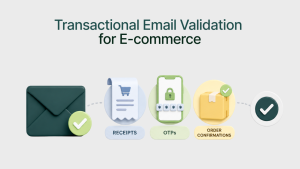
Improve transactional email validation for e-commerce with better OTP email delivery, receipt email deliverability, and order confirmation email optimization. Learn how email validation improves transactional email deliverability and customer communication workflows.


 No credit card required
Post your Comment.