 Sign In














 Email Marketing
 ABM
ABM  List Building
  Lead Generation
  Growth Hacker
  Digital Marketing
  Data Enrichment
  Software as a Service
  Data as a Service
  Waterfall Enrichment
  Startup
  Revenue Performance
  Job Change Tracking
  Customer Data Platform
  CRM
CRM 


 Knowledge Base
  Video Tutorials
  Help Center
  Tarpitting Scoring
  ROI Calculator
  About us
  Contact us
  Testimonials
  Automation
Email List Segmentation vs. Email Validation: What Marketers Get Wrong

12 Aug 2026
Sreerag
12 Minutes
Read

 Blog
FAQ
Case Studies
Knowledge Base
Video Tutorials
Help Center
SEG Validation
Tarpitting Scoring
ROI Calculator
About us
Contact us
Testimonials
Blog
FAQ
Case Studies
Knowledge Base
Video Tutorials
Help Center
SEG Validation
Tarpitting Scoring
ROI Calculator
About us
Contact us
Testimonials
Ask ten email marketers what “cleaning up the list” means before a campaign, and you’ll get ten different answers. Some mean removing bounced addresses. Others mean building a “highly engaged” segment. A few mean both, and assume they’re roughly the same task.
They aren’t.
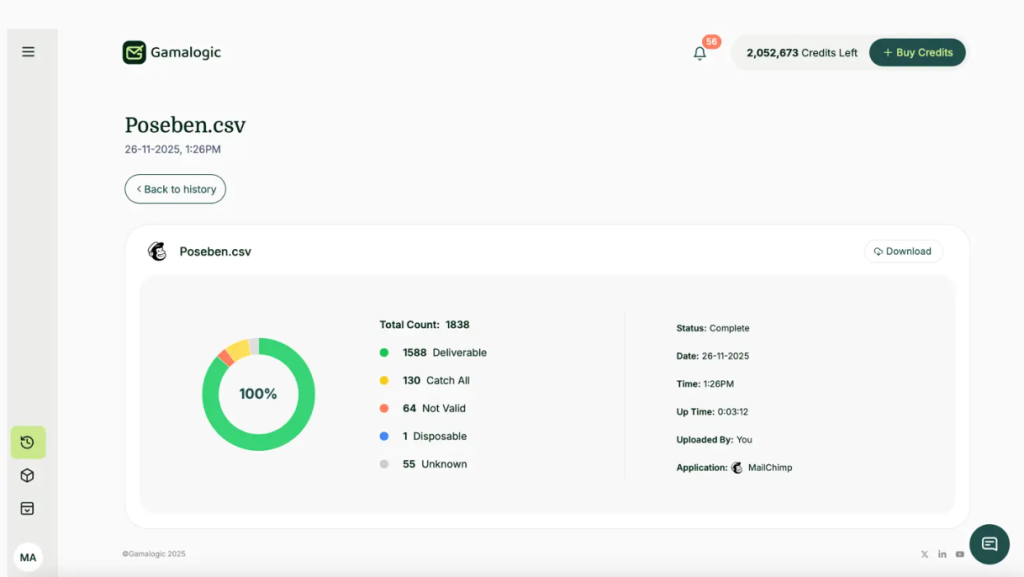
(A real Gamalogic validation pass on a 1,838-contact list this is the “status” every address gets assigned before segmentation logic should ever touch it.)
Email validation answers one question: does this address exist and can it receive mail? Email segmentation answers a completely different one: who, among the people who can receive mail, should get this specific message? Confusing the two or worse, doing segmentation as a substitute for validation is one of the most common and least discussed mistakes in email marketing. This guide clears up exactly where one ends and the other begins, why the order you run them in matters more than most teams realize, and how to fix a list that’s been segmented without ever being verified.
Email validation is a technical, address-level process. It doesn’t care who a subscriber is or what they’re interested in — it only cares whether the address itself is real and reachable. A modern validation pass typically runs through:
The output of validation is a status per address: valid, invalid, disposable, catch-all, or unknown. Nothing about interests, behavior, or lifecycle stage enters into it. You can read more about how each of these checks works on Gamalogic’s email validation platform.
Segmentation is a marketing-strategy process, not a technical one. It takes a pool of addresses that are already assumed to be deliverable and divides them into groups so each group gets a more relevant message. Common segmentation dimensions include:
None of these dimensions can be evaluated for an address that doesn’t exist. That’s the entire crux of the confusion: segmentation logic assumes a working mailbox on the other end, and validation is the only process that confirms one is actually there.
| Email Validation | Email Segmentation | |
|---|---|---|
| Question it answers | Does this address exist and accept mail? | Who should receive this specific message? |
| When it should run | Before every send, and on a recurring schedule | After the list is confirmed deliverable |
| What it evaluates | Syntax, DNS, MX, SMTP, catch-all, disposable status | Behavior, demographics, engagement, purchase history |
| Data source | The address itself and mail server responses | CRM/ESP activity data, forms, purchase records |
| Owner (typically) | Deliverability, data, or growth ops | Email marketing / lifecycle marketing |
| What it protects | Sender reputation, bounce rate, inbox placement | Relevance, engagement rate, revenue per send |
| Fails silently as | Rising bounce rate, blocked domains | Generic content everyone ignores |
Notice that these sit on different layers entirely. Validation is infrastructure. Segmentation is strategy built on top of that infrastructure. You need both but you need them in the right order, and one is not a substitute for the other.
The mix-up isn’t really about not knowing the definitions most marketers can define both terms correctly if asked directly. It happens because both tasks:
Because the workflows look similar from the outside filtering a list down to a smaller group it’s easy to assume that building an “engaged subscribers” segment and validating a list accomplish the same protective function. They don’t, and treating them as interchangeable is where the real damage happens.
Here’s the scenario that plays out constantly. A team imports a list from a CRM export, a co-marketing partnership, a lead magnet, or an enrichment tool and instead of validating it first, they go straight to building an “engagement-based” segment: active openers vs. non-openers over the last 90 days.
The problem is what invalid addresses do to that math. Say a 20,000-contact list has a realistic 12% share of dead, disposable, or never-valid addresses a very ordinary decay rate for a list that’s a year or two old, since B2B contact data degrades at roughly 20–25% annually as people change jobs and abandon inboxes. Those 2,400 addresses can never open an email, no matter how good the subject line is. They automatically land in the “non-engaged” segment, because a bounce or a non-delivery looks identical to silence in most ESP reporting.
That single mistake cascades in three directions:
None of this is a segmentation failure. The segmentation logic worked exactly as designed. The failure happened one step earlier, when nobody confirmed the underlying data was real before building strategy on top of it.
The mistake runs in the other direction too, and it’s worth naming directly: validating a list and stopping there isn’t a segmentation strategy. A perfectly clean, 100% deliverable list still needs to be divided by relevance, or every subscriber gets the same generic blast regardless of what they actually want from you. Segmented, targeted campaigns consistently outperform one-size-fits-all sends — industry benchmarks going back to DMA and Mailchimp’s own campaign data have repeatedly shown segmented sends earning meaningfully higher open and click rates than unsegmented ones. Validation earns you the right to send. Segmentation is what makes that send worth opening.
Think of it as two layers stacked in a fixed order, not two competing tactics to choose between.
Step 1 — Validate the full list. Run every address new imports and existing contacts alike through syntax, DNS, MX, and SMTP-level checks. Route disposable and clearly invalid addresses to permanent suppression.
Step 2 — Resolve the “unknown” middle ground. Catch-all and unverifiable addresses aren’t automatically bad, but they carry real uncertainty. Route them to lower-frequency, lower-risk sends rather than your primary campaign cadence until you have engagement evidence one way or the other.
Step 3 — Build your segments on what’s left. Only now should demographic, behavioral, engagement, and lifecycle segmentation logic run on a base you already know can physically receive the message.
Step 4 — Re-validate on a schedule, not just once. Lists decay continuously. Most senders should re-run validation every three to six months; high-volume senders should do it monthly, because a segment built on six-month-old validation data is quietly degrading in accuracy the entire time it’s in use.
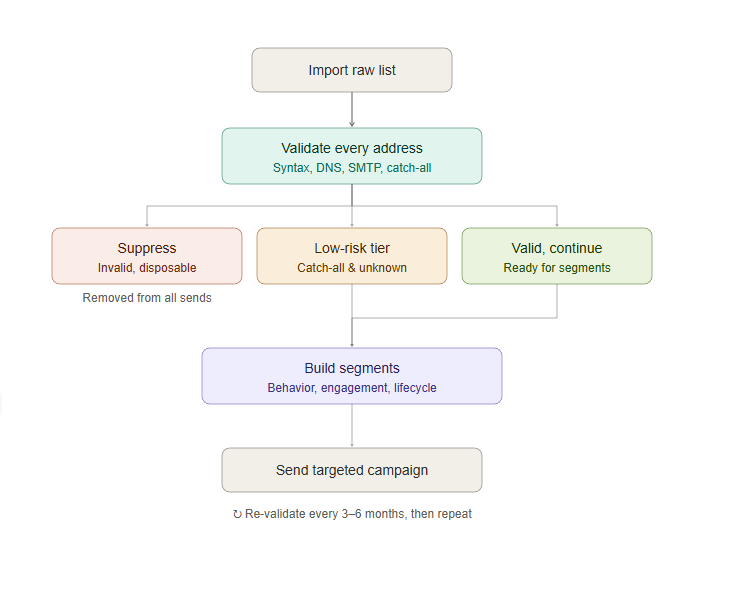
(A practical email list hygiene workflow: validate addresses first, separate invalid and risky contacts, build segments from verified data, and re-validate your list regularly.)
This is the same sequencing logic behind Gamalogic’s Mailchimp integration, which validates an audience and automatically unsubscribes invalid and disposable addresses before they can distort whatever segment logic you build in Mailchimp afterward. The same principle applies whether you’re working in Klaviyo, HubSpot, ActiveCampaign, or any of the 22+ platforms Gamalogic connects to validation is the gate every address passes through before it’s eligible for segment logic, not an occasional cleanup task run in parallel with it.
If your campaigns are underperforming, it’s worth diagnosing which layer is broken before changing your segmentation strategy:
Should I validate before or after I build my segments?
Before. Segments built on unverified data inherit every invalid, disposable, and catch-all address in the list, which distorts open rates, click rates, and segment size before you’ve sent a single campaign.
Is email validation a type of segmentation?
No. Validation produces a Email deliverability status (valid, invalid, disposable, catch-all, unknown) for an address. Segmentation groups already-deliverable addresses by who they are and how they behave. Validation status can inform a segment for example, routing catch-all addresses to a lower-risk sending tier but it isn’t itself a marketing segment.
How often should I re-validate a list I’ve already segmented?
Every three to six months for most senders, monthly for high-volume or transactional programs. Re-validating doesn’t erase your segments it keeps the addresses inside them accurate as the list naturally decays.
Can I skip validation if my list is only opt-in signups?
No. Opt-in forms still collect typos, abandoned accounts, and disposable addresses used to get past a gated download. Opt-in quality affects intent, not deliverability those are two different risks.
Does segmentation improve my sender reputation?
Only indirectly, by improving engagement signals over time. Validation is what directly protects sender reputation, since it’s the process that prevents hard bounces and spam-trap hits in the first place.
If you’re not sure how much of your current segmentation is being distorted by unverified addresses, running a validation pass against your existing audience is the fastest way to find out see how Gamalogic fits into an email marketing team’s full workflow, from list capture through campaign send, before you build (or rebuild) your next segment.


Still using RegEx to validate emails? It’s time to move on. While regular expressions may catch formatting issues, they miss the bigger picture—like whether the email actually exists. In this post, we’ll show you smarter, faster ways to validate emails in milliseconds without relying on outdated RegEx patterns.
A comprehensive guide on email hygiene best practices to help you maintain a clean, accurate, and engaged email list. Learn why email data quality matters, how to improve deliverability, boost engagement, and protect your sender reputation
Poor email data quality can quietly undermine even the most sophisticated outreach strategy. Invalid addresses, abandoned accounts, disposable emails, and risky contacts all contribute to lower deliverability, weaker sender reputation, and fewer responses.


 No credit card required
Post your Comment.