 Sign In














 Email Marketing
 ABM
ABM  List Building
  Lead Generation
  Growth Hacker
  Digital Marketing
  Data Enrichment
  Software as a Service
  Data as a Service
  Waterfall Enrichment
  Startup
  Revenue Performance
  Job Change Tracking
  Customer Data Platform
  CRM
CRM 


 Knowledge Base
  Video Tutorials
  Help Center
  Tarpitting Scoring
  ROI Calculator
  About us
  Contact us
  Testimonials
  Automation
Email Validation for B2B Sales: The 2026 Verification Checklist for SDR Teams

22 Mar 2025
Athika Jishida
12 Minutes
Read

 Blog
FAQ
Case Studies
Knowledge Base
Video Tutorials
Help Center
SEG Validation
Tarpitting Scoring
ROI Calculator
About us
Contact us
Testimonials
Blog
FAQ
Case Studies
Knowledge Base
Video Tutorials
Help Center
SEG Validation
Tarpitting Scoring
ROI Calculator
About us
Contact us
Testimonials

Email validation for B2B sales is the process of confirming before an outreach sequence ever fires, that a prospect’s email address is syntactically correct, hosted on an active domain, and able to receive mail. For SDR and RevOps teams running high-volume outbound, it’s the checkpoint that decides whether a list built from intent data and firmographics actually reaches inboxes, or quietly bounces its way into a damaged sending domain.
That distinction matters more in B2B than almost anywhere else. Consumer email lists are relatively stable; B2B contact data is not. People change roles, companies get acquired, domains get retired, and IT departments migrate mail systems without notice. A list that validated cleanly six months ago can already be stale.
Three forces compound against B2B sales data specifically:
The practical consequence: mailbox providers like Google Workspace and Microsoft 365, which host the large majority of business inboxes score sending domains on bounce behavior. Once a domain’s hard-bounce rate sustains above roughly 2%, providers begin routing even the sender’s valid mail to spam. Recovering from that typically takes weeks of clean sending, not a quick fix.
“Email validation” isn’t one check, it’s a stack, and skipping a layer is usually where the damage gets in.
For most consumer email, that four-layer stack is the whole story. For B2B lists, it isn’t, because two common configurations sit in front of step 3 and quietly break it.
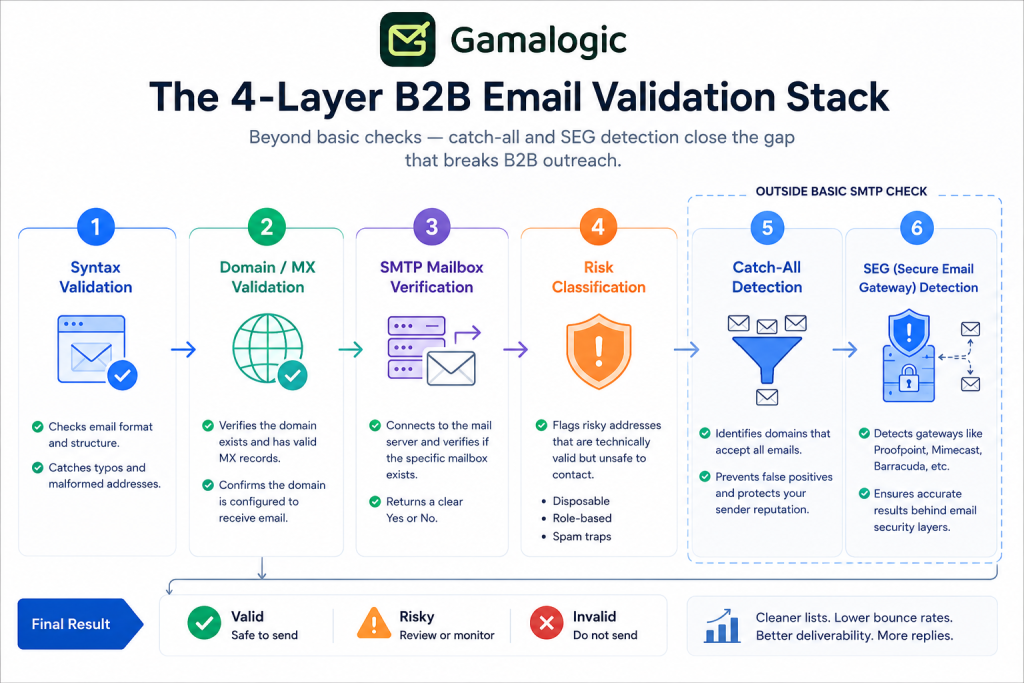
“Gamalogic’s four-layer verification stack, and where catch-all domains and SEGs sit outside a basic SMTP check.”
A catch-all domain is configured to accept mail for any address at that domain, whether or not the specific mailbox actually exists. To a standard SMTP check, every address at a catch-all domain looks valid including the ones that are pure guesses. A validator that doesn’t resolve catch-alls specifically will either quietly pass along a chunk of invalid addresses (inflating your bounce rate on send) or dump the whole batch into a vague “risky” bucket you still have to decide about manually.
Proofpoint, Mimecast, Barracuda, and similar gateways sit in front of a company’s actual mail servers and accept mail at the edge before filtering it internally. To a verification tool, an SEG-protected domain looks exactly like a catch-all domain, even when the real mailbox behind it is strict about who exists. Verifiers that can’t fingerprint the gateway will misclassify these addresses in both directions: rejecting good contacts, or passing bad ones through.
Between the two, a meaningful share of any B2B list, commonly cited in the 20–30% range across public benchmarks, sits in this ambiguous zone that basic SMTP checks simply can’t resolve on their own.
| Validation layer | What it catches | What it misses on its own |
|---|---|---|
| Syntax check | Typos, malformed addresses | Domain-level or mailbox-level problems |
| Domain / MX check | Dead domains, unregistered companies | Whether a specific mailbox exists |
| SMTP mailbox check | Confirms a specific mailbox on cleanly configured domains | Catch-all and SEG-protected domains (returns false positives) |
| Catch-all resolution | Ambiguous “accept-all” verdicts on catch-all domains | Nothing further this is the layer that closes the gap above |
| SEG fingerprinting | Distinguishes gateway-accepted mail from real mailbox existence | N/A purpose-built for this specific blind spot |
| Risk classification | Disposable domains, role-based addresses, known spam traps | Whether the address will actually engage, not just receive |
This is the layer most “email validation” tools stop short of and it’s the difference between a list that’s technically validated and one that’s actually safe to send at volume.
It’s a common mix-up: email validation confirms who you’re sending to is real. Email authentication SPF, DKIM, and DMARC confirms you are who you say you are to the receiving mail server. A perfectly validated list sent from a domain with broken SPF/DKIM/DMARC records will still land in spam, because authentication failures are one of the strongest negative signals mailbox providers use. Conversely, flawless authentication can’t rescue a list full of dead addresses. Treat the two as separate, sequential steps: authenticate the sending domain first, then validate the list you’re sending to it.
Most mature outbound stacks run both: real-time checks at the door, bulk cleaning on a recurring schedule for what’s already inside. Gamalogic supports both natively, with API-based real-time checks and bulk cleaning for existing databases, plus direct integrations into Salesforce, HubSpot, Outreach, and Salesloft, so verification runs inside the tools SDR teams already use instead of a separate manual step.
“The teams that get burned aren’t the ones without a validation tool they’re the ones who validate once at import and never touch the list again. B2B data doesn’t sit still long enough for a one-time scrub to hold.” Athika Jishida, B2B Sales Outreach & Lead Generation Strategist at Gamalogic
Gamalogic’s real-time and bulk verification returns 99.6% accuracy across syntax, domain, SMTP, and risk-classification checks.
Beyond that, here’s what the wider industry data shows about the cost of not validating:
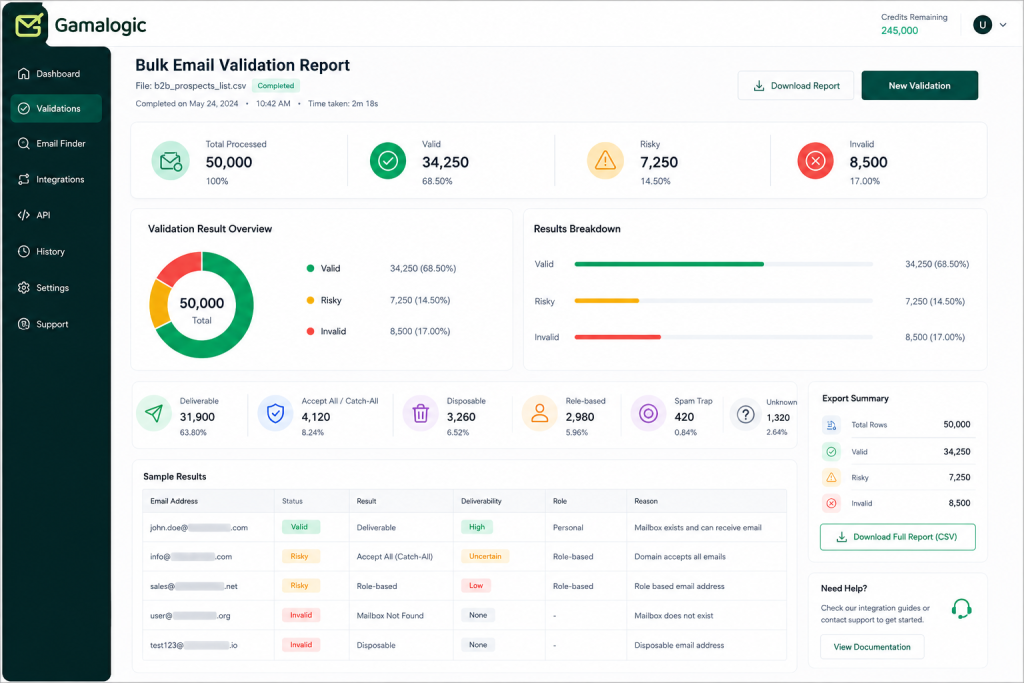
“A sample Gamalogic bulk-validation report, real output, client data redacted.”
| Factor | In-house scripts | Per-credit SaaS tools | Gamalogic |
|---|---|---|---|
| Catch-all / SEG resolution | Rare requires custom engineering | Varies widely by vendor | Included |
| Real-time API | Custom build required | Usually available, billed per check | Included |
| CRM/ESP integrations | Manual/custom | Partial, tool-dependent | 100+ native integrations |
| Cost model | High upfront, low marginal cost | Per-credit, scales with volume | See current plans |
| Best fit | Large teams with dedicated engineering | Low-to-mid volume, occasional cleaning | Teams running continuous, high-volume B2B outbound |
For a closer look at specific alternatives, see how Gamalogic compares to ZeroBounce, NeverBounce, Emailable, and MillionVerifier.
What is email validation for B2B sales?
It’s the process of confirming a business email address is correctly formatted, hosted on an active domain, and able to receive mail done before or during outbound campaigns to protect deliverability and sender reputation.
How often should B2B sales teams re-verify their list?
Validate every new list at the point of sourcing, and re-verify active segments every 60–90 days. High-priority segments open opportunities, target accounts warrant more frequent checks given how quickly B2B contacts change roles.
What’s a safe bounce rate for B2B outreach?
Keep hard bounces under 2%; treat anything sustained above that as an active signal to pause sending and re-verify. Mailbox providers typically begin filtering a domain within one to two weeks of sustained bounce rates above that threshold.
What’s the difference between email validation and email verification?
The terms are often used interchangeably. “Validation” typically refers to the full check stack syntax, domain, MX, risk scoring while “verification” more narrowly refers to confirming the specific mailbox exists. Most modern tools, including Gamalogic, do both.
Does email validation replace SPF, DKIM, and DMARC?
No. Validation confirms who you’re sending to; authentication confirms who you are to the receiving server. Both are necessary a validated list sent from a poorly authenticated domain will still struggle with deliverability.
Can catch-all domains be validated at all?
Not with a basic SMTP check alone that’s exactly where catch-all addresses look identical to real ones. Resolving them requires additional signals beyond a single mailbox ping, which is why catch-all handling is worth asking about directly when evaluating a validation vendor.
Ready to see where your list actually stands? Validate your first batch with Gamalogic, no credit card required.


Struggling to get responses from your cold emails? Learn 12 proven strategies to craft compelling messages that not only get opened but also drive real engagement and replies from your target audience.
Reduce fake signups and improve onboarding with email validation for SaaS. Explore tools, APIs, and strategies to scale your growth efficiently.

Identify role-based, disposable, and catch-all email addresses to protect your sender reputation and improve sales email performance.


 No credit card required
Post your Comment.