 Sign In














 Email Marketing
 ABM
ABM  List Building
  Lead Generation
  Growth Hacker
  Digital Marketing
  Data Enrichment
  Software as a Service
  Data as a Service
  Waterfall Enrichment
  Startup
  Revenue Performance
  Job Change Tracking
  Customer Data Platform
  CRM
CRM 


 Knowledge Base
  Video Tutorials
  Help Center
  Tarpitting Scoring
  ROI Calculator
  About us
  Contact us
  Testimonials
  Automation
Dominate Deliverability: Pro Email Validation Hacks and Strategies

28 Nov 2023
Mohamed Ahmed
12 Minutes
Read

 Blog
FAQ
Case Studies
Knowledge Base
Video Tutorials
Help Center
SEG Validation
Tarpitting Scoring
ROI Calculator
About us
Contact us
Testimonials
Blog
FAQ
Case Studies
Knowledge Base
Video Tutorials
Help Center
SEG Validation
Tarpitting Scoring
ROI Calculator
About us
Contact us
Testimonials
Email validation improves deliverability by removing invalid, disposable, and catch-all addresses before you send cutting bounce rates, avoiding spam traps, and protecting the sender reputation that Gmail and Microsoft now use to decide whether your mail gets delivered at all. For email marketers, deliverability is everything: you can craft the most compelling campaign, but none of it matters if your messages never reach subscribers’ inboxes.
The days of easy deliverability are gone. In 2026, Gmail moved from quietly spam-filtering non-compliant senders to permanently rejecting their mail outright, and Microsoft followed with its own strict enforcement wave in May 2025. Legitimate senders get caught in that crossfire unless their validation and authentication practices keep pace.
This guide covers the pro-level email validation hacks and strategies that actually hold up in 2026 not the basic regex checks most guides still recommend.
Major email providers assess your sender reputation based on:
What’s new for 2026: Google Postmaster Tools has moved to a v2 model that replaced the old, somewhat subjective reputation score with binary compliance checks you either meet the bar on authentication and complaint thresholds, or your mail gets rejected. There’s much less gray area than there used to be. Gmail also began routing filtering decisions through Gemini 3 as of January 2026, adding an AI layer that evaluates sender behavior patterns beyond the old rule-based signals.
If you fall into the high-risk category through excessive complaints, bounces, or too-rapid list growth, your emails now risk outright rejection rather than a spam-folder landing and recovering from that is significantly harder than climbing out of a spam folder used to be.
Comprehensive email validation improves deliverability and sender reputation in several ways:
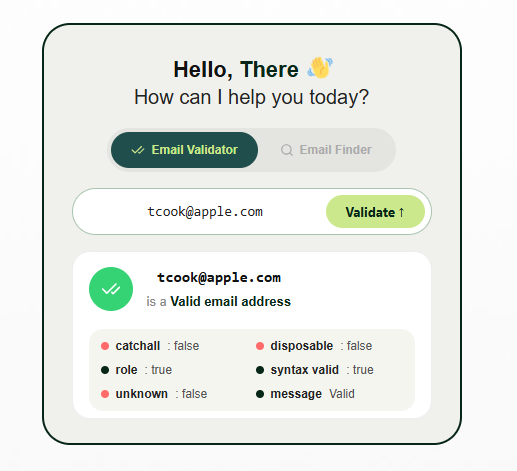
Double validation combining syntax and live mailbox checks identifies and removes invalid, misspelled, and inactive addresses before they ever hit “send.” This directly lowers hard and soft bounce rates. A hard bounce rate above roughly 2% is now considered problematic by most ISPs, and email databases naturally decay by an estimated 25% per year as people change jobs or abandon addresses meaning a list that was clean in January is meaningfully stale by December if it isn’t re-verified.
Verification detects decoy spam-trap addresses that providers plant to identify senders with sloppy list hygiene. Targeting even a small number of these can get an entire IP range flagged but not all traps are equal. Pristine traps are addresses that never belonged to a real person; recycled traps are dead addresses providers reactivated specifically to catch senders who never prune inactive contacts. Basic validation tools often only catch the first type.
Accurate addresses mean your emails reach real, active people who open and click rather than bounce which directly feeds the engagement signals that now weigh more heavily in Gmail and Microsoft’s filtering decisions than raw authentication compliance alone.
Ongoing validation keeps your list current. Set policies to re-verify addresses on a regular cadence and prune non-responsive contacts before they become a liability, not after a bounce spike forces your hand.
This is where most “basic” validation tools quietly fail. Catch-all domains accept mail for any address regardless of whether it’s real, making a standard SMTP check useless you get a false “valid” result. Secure Email Gateway (SEG) environments (Proofpoint, Mimecast, Barracuda) actively block verification attempts with tarpitting and delayed responses, which can cause naive validators to misclassify a real address as invalid.
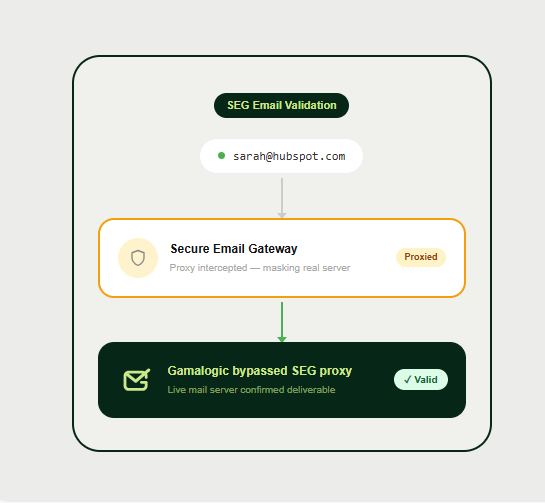
Gamalogic’s Catch-all Email Validation and SEG Validation tools are built specifically to resolve these two cases correctly instead of returning a coin-flip guess.
Full-service verification platforms provide aggregate reputation monitoring across major ISPs, so you see reputation drift developing before it becomes a rejection problem rather than after.
When launching with a new or existing list, run comprehensive validation across your entire subscriber base first. A cloud-based bulk verification service catches invalid syntax, catch-all and abuse accounts, disposable emails, incorrect domains, spam traps, and non-existent mailboxes far beyond what basic regex checks can do.
Pro Hack: Also run a tarpitting-aware pass if any part of your list sits behind corporate SEGs a plain SMTP check will misreport these as invalid roughly as often as it gets them right. Gamalogic’s Tarpitting scoring is built to handle exactly this.
Set policies to re-verify subscribers on a regular cadence quarterly at minimum, monthly if you’re sending high volume, given that ~25% of any list decays annually. Prune addresses that have gone dormant, and layer in domain-level usage statistics to flag risky domains with historically poor inbox placement before they drag down the rest of your list.
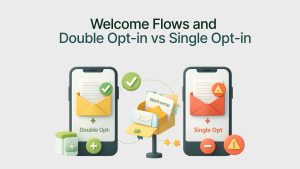
Pro Hack: Fix list quality at the source, not just after the fact. Use confirmed opt-in (COI/double opt-in) at signup the subscriber has to actively verify their address before joining your list. This single change dramatically cuts fake signups, abandoned inboxes, and spam-trap risk before validation even needs to catch it.
The highest-ROI validation happens right before send. This final pass removes any address that’s lapsed since your last campaign typos, bounced mailboxes, deactivated accounts and requires integration with your ESP to run automatically rather than manually.
Benchmark your status against aggregate reputation data across major ISPs, and treat Google Postmaster Tools v2’s binary compliance signals as a leading indicator, not a lagging report card. Because 2026-era filtering rejects rather than just deprioritizes non-compliant mail, catching a compliance drift early is the difference between a temporary dip and a full domain reputation reset.
A quick reference for anyone who last set this up in 2023 or earlier:
| Then (2023) | Now (2026) |
|---|---|
| Non-compliant mail got spam-filtered | Non-compliant mail gets permanently rejected by Gmail |
| Subjective sender reputation scores | Google Postmaster Tools v2 — binary compliance checks |
| Rule-based spam filtering | Gemini 3 embedded in Gmail’s filtering pipeline (Jan 2026) |
| Microsoft largely lagged Gmail on enforcement | Microsoft enforcement wave live since May 2025 |
| SPF alone was often “good enough” | SPF, DKIM, and DMARC alignment are baseline requirements, not best practice |
| Basic SMTP/syntax checks were standard | Catch-all and SEG-aware validation are now necessary for accurate results on a meaningful share of any B2B list |
When evaluating verification options, prioritize an enterprise-grade solution that offers:
How is 2026 email validation different from a basic regex or syntax check?
Regex only confirms an address is formatted correctly it can’t tell you if the mailbox exists, whether the domain is a catch-all, or whether it sits behind a SEG that will silently reject your send later. Full validation checks syntax, live mailbox status, catch-all behavior, and SEG-specific handling together.
Do I still need SPF, DKIM, and DMARC if I validate my list?
Yes — they solve different problems. Validation ensures the addresses on your list are real and reachable. Authentication (SPF/DKIM/DMARC) proves you are who you say you are to the receiving server. As of 2026, Gmail and Microsoft both require all three, correctly aligned, regardless of how clean your list is.
How often should I re-verify my list?
Quarterly at minimum, given that lists decay by roughly 25% a year. High-volume senders or anyone running frequent campaigns should verify per-send, not just on a fixed calendar cadence.
What’s the difference between a catch-all address and a normal invalid address?
An invalid address is rejected outright by the mail server. A catch-all domain accepts mail for any address at that domain regardless of whether it’s real so a basic validator will falsely mark a nonexistent catch-all address as “valid,” inflating your list with addresses that will still bounce or go nowhere.
Will Gmail’s 2026 enforcement changes affect small senders too, or just bulk senders?
Bulk-sender thresholds are still the trigger for the strictest requirements, but engagement and authentication signals now factor into filtering decisions for senders of all sizes smaller senders aren’t exempt from the underlying trust-scoring shift, just from the specific volume-based rules.
A strong sender reputation is still the foundation of email marketing success but the bar for what counts as “strong” moved considerably in 2026. Robust validation, proper authentication, confirmed opt-in at collection, and continuous reputation monitoring aren’t optional add-ons anymore; they’re what keeps you out of Gmail’s permanent-rejection lane and Microsoft’s enforcement queue.
Ready to see where your list actually stands? Explore Gamalogic’s email validation platform including catch-all and SEG-aware checks most competitors still can’t do accurately.


A practical guide to email validation for B2B, covering CRM email validation, sales email verification, bounce rate reduction, and better lead quality for revenue teams.
A comprehensive guide on email hygiene best practices to help you maintain a clean, accurate, and engaged email list. Learn why email data quality matters, how to improve deliverability, boost engagement, and protect your sender reputation


 No credit card required
Post your Comment.