 Sign In














 Email Marketing
 ABM
ABM  List Building
  Lead Generation
  Growth Hacker
  Digital Marketing
  Data Enrichment
  Software as a Service
  Data as a Service
  Waterfall Enrichment
  Startup
  Revenue Performance
  Job Change Tracking
  Customer Data Platform
  CRM
CRM 


 Knowledge Base
  Video Tutorials
  Help Center
  Tarpitting Scoring
  ROI Calculator
  About us
  Contact us
  Testimonials
  Automation
Email Sender Reputation: The Complete Guide to Sender Score, Deliverability, and Fixing a Bad Reputation

20 Dec 2023
Athika Jishida
12 Minutes
Read

 Blog
FAQ
Case Studies
Knowledge Base
Video Tutorials
Help Center
SEG Validation
Tarpitting Scoring
ROI Calculator
About us
Contact us
Testimonials
Blog
FAQ
Case Studies
Knowledge Base
Video Tutorials
Help Center
SEG Validation
Tarpitting Scoring
ROI Calculator
About us
Contact us
Testimonials
You send a campaign, check the numbers the next morning, and half your list never opened it. Not because the subject line was bad because the email never reached the inbox at all. That’s sender reputation at work, and it’s the single biggest lever most senders never actively manage.
This guide covers what sender reputation actually is, exactly what determines it, the tools you can use to check it right now, and a step-by-step process for fixing it if it’s already damaged.
Contents
Email sender reputation is the trust score that inbox service providers Gmail, Yahoo, Outlook, and others, assign to the domain and IP address you send email from. It’s calculated continuously, not once, and it directly decides whether your next message lands in the inbox, the spam folder, or gets blocked before it arrives at all.
Think of it as a credit score for your email program: every send, every complaint, every bounce adds or subtracts from it. A strong sender reputation compounds it earns you the benefit of the doubt with filters. A weak one compounds too, in the wrong direction, and becomes progressively harder to recover.
Providers never publish their exact scoring formulas. But independent tools like Sender Score (from Validity) and Google’s own Google Postmaster Tools give you a reasonable proxy, and the factors they evaluate are well understood — covered in detail below.
Sender reputation isn’t one number it’s really two, layered on top of each other.
yourcompany.com). Because IP addresses are cheap to spin up and abandon, most inbox providers have shifted to weighting domain reputation more heavily than IP reputation in recent years. This is a meaningful shift from a few years ago, when IP warm-up was the primary lever senders pulled.Practical takeaway: if you’re a smaller sender, a shared IP with a strong domain reputation will usually outperform a dedicated IP you haven’t warmed up yet. If you’re sending high volume consistently, a dedicated IP paired with strict domain practices gives you the most control long-term.
Providers don’t disclose their exact algorithms, but the inputs they evaluate are consistent across Gmail, Yahoo, and Outlook:
| Factor | Why it matters |
|---|---|
| Complaint rate | Every time a recipient hits “report spam,” it’s logged against your domain. This is the single most damaging signal a sender can generate. |
| Engagement metrics | Opens, clicks, and replies tell providers your mail is wanted. Low engagement signals irrelevance, even without a single complaint. |
| Bounce rate | A high rate of invalid addresses suggests a poorly maintained list — a strong proxy for spam behavior. |
| List sourcing | How addresses were acquired (opt-in forms vs. purchased lists vs. scraped data) is scrutinized, directly or indirectly. |
| Authentication setup | Missing or misconfigured SPF, DKIM, or DMARC records are treated as a legitimacy red flag by default. |
| Sending consistency | A sudden spike in volume from a previously quiet domain reads as suspicious, regardless of content quality. |
You control almost all of these directly. The two with the fastest payoff are usually list hygiene and authentication both are one-time technical fixes rather than ongoing behavioral changes.
Authentication records are how you prove you’re actually who you claim to be. Providers treat missing or broken authentication as an immediate legitimacy problem, no matter how good the rest of your sending practices are.
p=none — monitor only, take no action. Use this first to see what’s actually sending on your domain before enforcing anything.p=quarantine — failing mail gets sent to spam.p=reject — failing mail is rejected outright.none → quarantine → reject, tightening only once you’ve confirmed legitimate mail isn’t being caught in the process.quarantine or reject first, and it’s becoming a meaningful trust signal as adoption grows worth setting up once your DMARC policy is enforced.You don’t have to guess. These are the tools actually used to monitor sender and domain reputation:
Run through Google Postmaster Tools and Mail-Tester before every major campaign launch they’re free and take under five minutes.
Spam traps are addresses providers use specifically to catch senders with poor list practices. There are two kinds:
Related concept: honeypot addresses decoy addresses planted specifically to identify senders who scrape or buy contact data rather than collect it through consent.
Bounces matter beyond the headline rate the SMTP status code tells you why, and that determines what to do:
| Code | Type | Meaning | Action |
|---|---|---|---|
| 5.1.1 | Hard bounce | Mailbox doesn’t exist | Remove immediately |
| 5.2.1 | Hard bounce | Mailbox disabled or discontinued | Remove immediately |
| 4.2.2 | Soft bounce | Mailbox full | Retry later; monitor if recurring |
| 5.3.4 | Hard bounce | Message too large for server | Fix content/attachment size, don’t resend as-is |
Treating every bounce the same resending regardless of code is one of the fastest ways to damage domain reputation. Hard bounces should be suppressed permanently; soft bounces deserve a retry policy, not an immediate resend.
For deeper reference on address types that damage lists, see Gamalogic’s glossary on spam trap addresses, disposable/temporary addresses, role-based addresses, and greylisted addresses.
Inbox providers read recipient behavior on both sides of the ledger:
| Positive signals | Negative signals |
|---|---|
| Opens | Spam reports |
| Clicks | Quick deletes without opening |
| Replies | High bounce rate |
| Forwards | Filtering rules that skip the inbox |
| Adding sender to contacts | Marked “not important” |
The practical implication: chasing positive engagement (clear subject lines, relevant content, a visible reason to open) moves your reputation up faster than simply avoiding negative signals. A list with zero complaints but near-zero opens still reads as low-value to providers.
The three major providers have each published concrete, non-negotiable requirements for bulk senders in recent years:
If you’ve made every fix above and mail is still landing in spam with one specific provider, the last resort is a direct sender review request through that provider’s bulk sender support channel. These reviews are slow and sometimes require follow-up treat them as a last step after fixing the underlying issue, not a first step.
If you’re already seeing high spam-folder placement or a blocklist hit, work through this order sequence matters:
p=none, fix the underlying issue, then re-tighten.How do I check my sender reputation?
Use Google Postmaster Tools (for Gmail specifically), Sender Score for a general 0–100 score, and Mail-Tester for a quick per-message diagnostic. Cross-reference with Spamhaus to rule out a blocklist issue.
What’s a good sender reputation score?
On Sender Score’s 0–100 scale, most healthy senders sit at 90+. Scores below 70 typically correlate with visible deliverability problems.
How long does it take to fix a bad sender reputation?
Usually several weeks to a few months of consistent, clean sending — reputation is built on trend data, not a single fixed action. There’s no way to reset it instantly.
Can I use a shared IP address?
Yes, and for lower-volume senders it’s often the better choice you inherit the pooled reputation of everyone on that IP, which can work for or against you. Move to a dedicated IP once your volume is consistent enough to justify managing warm-up yourself.
Does list validation actually improve sender reputation?
Yes, directly it lowers your bounce rate and removes spam traps before they ever receive a message, which are two of the most heavily weighted factors providers evaluate.
Should I buy email lists?
No. Purchased lists aren’t opted in, carry a high risk of spam traps, and reliably produce high complaint rates the fastest way to damage a previously healthy domain.
Everything above depends on one input you fully control: the quality of the addresses you’re sending to. Email validation catches invalid, disposable, and role-based addresses, along with known spam traps and honeypots, before they ever touch your sending domain which means fewer hard bounces, fewer trap hits, and a cleaner engagement rate from the first send.
Gamalogic runs bulk and real-time validation with over 99% accuracy, checks against known spam trap and honeypot databases, and integrates directly into your sending workflow via API or automation so lists stay clean between campaigns rather than only at import.
If you’re evaluating validation providers, see how Gamalogic email validation api compares to ZeroBounce, NeverBounce, Kickbox, MillionVerifier, and Clearout.
Related reading:


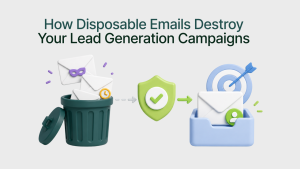
Disposable email addresses reduce lead quality, increase bounce rates, damage sender reputation, and waste marketing budget. Learn how to detect and block temporary emails.


If your automation sequences are built on unverified emails, you aren't just wasting budget; you’re actively damaging your sender reputation. This guide breaks down how to integrate verified email data via Gamalogic to eliminate bounces, bypass spam filters, and ensure your automation workflows reach real inboxes every single time.


 No credit card required
Post your Comment.