 Sign In














 Email Marketing

 ABM
 List Building
 Lead Generation
 Growth Hacker
 Digital Marketing
 Data Enrichment
 Software as a Service
 Data as a Service
 Waterfall Enrichment
 Startup
 Revenue Performance
 Job Change Tracking
 Customer Data Platform
 CRM



 Knowledge Base
 Video Tutorials
 Help Center
 Tarpitting Scoring
 ROI Calculator
 About us
 Contact us
 Testimonials
 Automation
NeverBounce Alternatives 5 Tools Compared on Catch-All Handling and Integrations.

25 Oct 2026
Sreerag
12 Minutes
Read

 Blog
FAQ
Case Studies
Knowledge Base
Video Tutorials
Help Center
SEG Validation
Tarpitting Scoring
ROI Calculator
About us
Contact us
Testimonials
NeverBounce’s documented result codes are valid, invalid, disposable, catchall and unknown, and we found no per-address score for catch-all addresses . Its pay-as-you-go credits expire 12 months after purchase. The five alternatives handle catch-all addresses differently:
| Tool | What it adds for catch-all addresses |
|---|---|
| Bouncer | “Risky” result, an accept-all flag and a 0 to 100 score |
| Emailable | “Risky” result, an accept-all flag and a 0 to 100 score |
| Gamalogic | Catch-all validation with pattern analysis and predictive scoring, included at one credit |
| Kickbox | “Risky” result, an accept-all flag and a 0 to 1 Sendex score |
| ZeroBounce | A “catch-all” status and a separate 0 to 10 score (extra credits) |
On price, most alternatives are not cheaper than NeverBounce. At 100,000 credits, Bouncer matches it, Emailable is 5% higher, Kickbox 25% higher and ZeroBounce 62% higher. Gamalogic is 62% lower on its published prices. On integrations, NeverBounce lists the most (80+), so check your own stack before you switch.
A catch-all email domain (or accept-all domain) is configured to accept emails sent to any address at that domain, including addresses that may not exist. A verifier typically checks whether the receiving mail server would accept a message for a particular address. On a catch-all domain, the server may accept every address, so a positive response does not confirm that the specific mailbox exists. Some messages may bounce later, creating the “accept now, bounce later” problem that makes catch-all addresses difficult to verify. Understanding why catch-all emails can lead to unexpected email bounces can help businesses make better decisions about list quality and email deliverability.
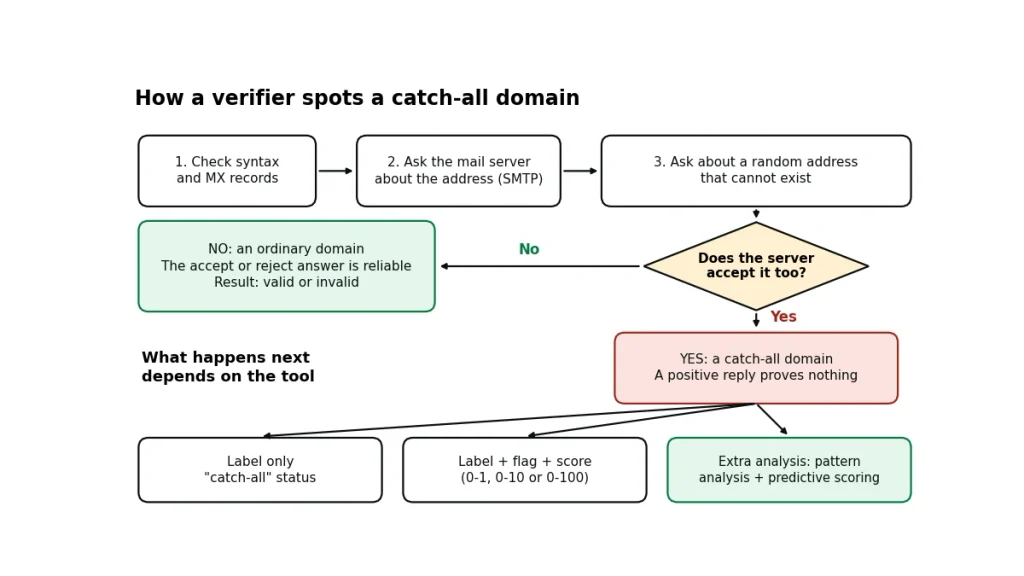
Verifiers detect a catch-all by also asking about a random address that cannot exist. If the server accepts that too, the domain is catch-all. After that, tools differ in what they do. Some label the address and stop. Some add a flag and a score. Some run extra analysis to estimate whether the mailbox is real. That difference is the main reason to compare tools.
Catch-all domains are common on business lists, especially lists built from email finder tools that guess address patterns. Estimates of the share on a B2B list range from about 10% to 40% in vendor articles, with no method given. Measure your own share (the test below shows how).
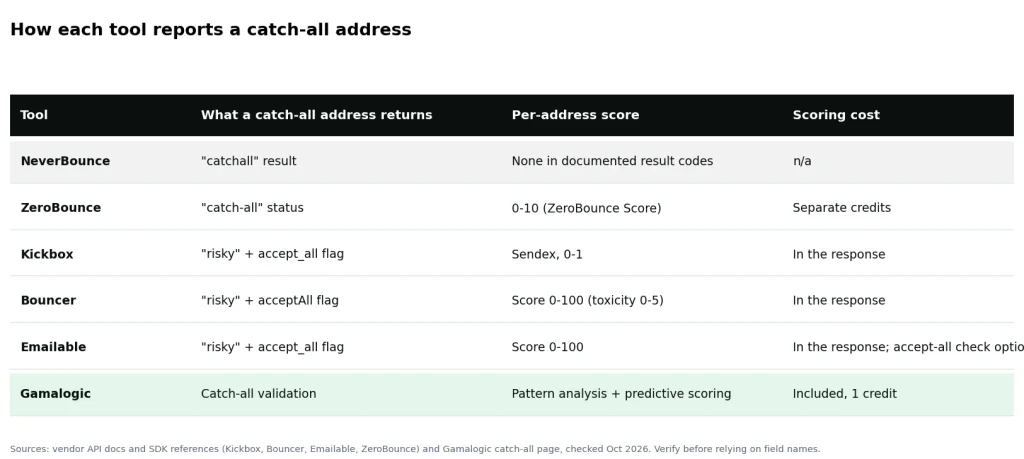
| Tool | Catch-all result | Score | Where the score lives | Source |
|---|---|---|---|---|
| NeverBounce | catchall result | None in documented result codes | n/a | NeverBounce result codes |
| ZeroBounce | catch-all status, with sub-statuses such as accept-all | 0 to 10 (ZeroBounce Score) | A separate AI scoring API, with its own credits | ZeroBounce docs |
| Kickbox | risky result plus an accept_all flag | Sendex, 0 to 1 | In the verification response | Kickbox SDK reference |
| Bouncer | risky result plus a domain acceptAll flag | Score 0 to 100, and toxicity 0 to 5 | In the verification response; toxicity is also a separate check | Bouncer API docs |
| Emailable | risky state plus an accept_all boolean | Score 0 to 100 | In the response; the accept-all check is optional and slows the response | Emailable API docs |
| Gamalogic | Catch-all validation (pattern analysis and predictive scoring) | Score 0 ti 100 | Included in one credit | Gamalogic catch-all page |
Three things this table shows:
risky result, an accept_all flag and a Sendex score. When it matters, read the docs and run a test.One API detail worth knowing for signup forms: Bouncer’s docs say its real-time API returns about 5% more “unknown” results than its batch API, because it must answer within its time limit (10 seconds by default, 30 at most).
Reported counts vary widely, even for the same tool:
| Tool | Reported native or listed integrations | What the numbers include |
|---|---|---|
| NeverBounce | 80+ listed by NeverBounce; 16 native ESP integrations, 14 with Sync (mailfloss); 18 ESPs for Sync (Modern Inbound); 10 on Capterra | “80+” counts CRMs, ESPs, forms and Zapier or n8n. The smaller numbers count native ESP or Sync connectors only |
| ZeroBounce | 45 to 49+ native (several 2026 reviews); Zapier reaches 2,000+ apps | Native connectors, plus Zapier |
| Emailable | “90+” in several reviews; one review counts 9 to 12 native | Probably native plus partner or Zapier-based connectors |
| Kickbox | 11 to 27, depending on the source | Varies by what each review counts |
| Bouncer | About 16 in one 2026 review | Native connectors |
| Gamalogic | 24 live on its Platform page, plus API, webhook and sync, a Google Sheets add-on and a website widget | Native connectors. HubSpot, Salesforce, Klaviyo and Zapier are listed |
Sources: NeverBounce and vendor pages via the reviews named; mailfloss, Modern Inbound, Sender, ZoomInfo and Capterra reviews; Gamalogic Platform page. Counts checked 22-10-2026.
Do not compare the totals. Ask five questions about the platforms you actually use:
For Gamalogic’s connectors, see the Platform list.
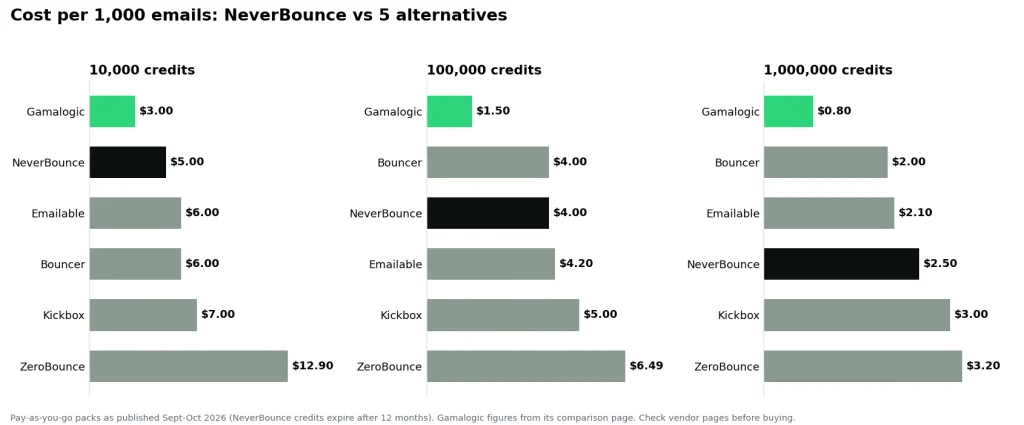
Pay-as-you-go packs, shown as cost per 1,000 emails with the pack price in brackets. The percentage is the difference from NeverBounce at the same volume.
| Tool | 10,000 credits | 100,000 credits | 1,000,000 credits | Smallest pack | Credits expire? | Unknown results |
|---|---|---|---|---|---|---|
| NeverBounce | $5.00 ($50) | $4.00 ($400) | $2.50 ($2,500) | 1,000 ($8) | After 12 months | Free |
| Bouncer | $6.00 ($60), +20% | $4.00 ($400), same | $2.00 ($2,000), −20% | 1,000 ($8) | Never | Free |
| Emailable | $6.00 ($60), +20% | $4.20 ($420), +5% | $2.10 ($2,100), −16% | 5,000 | Never | Refunded |
| Gamalogic | $3.00 ($30), −40% | $1.50 ($150), −62% | $0.80 ($800), −68% | 1,000 | Never | Free |
| Kickbox | $7.00 ($70), +40% | $5.00 ($500), +25% | $3.00 ($2,999), +20% | $5 for 500 verifications | After 12 months (reported) | Free |
| ZeroBounce | $12.90 ($129), +158% | $6.49 ($649), +62% | $3.20 ($3,199), +28% | 2,000 ($39) | Depends on plan | Free |
Sources (prices verified on [11/11/2026): Gamalogic. Policy details were cross-checked against Reoon’s September 2026 snapshot of vendor pricing pages. NeverBounce also sells a Growth plan at $49 a month for up to 10,000 emails.
What the numbers say: leaving NeverBounce for better catch-all handling usually does not save money. Bouncer and Emailable cost about the same, Kickbox and ZeroBounce cost more, and only Gamalogic is clearly lower on published prices. For a price-first comparison against ZeroBounce, see ZeroBounce alternatives compared by cost per 1,000 emails.
risky with an acceptAll flag and a 0 to 100 score. A separate toxicity score (0 to 5) estimates the chance an address is linked to breaches, spam traps or complaints, and Bouncer describes it as probabilistic. One 2026 review says Bouncer negotiates with Google Workspace and Microsoft 365 servers to resolve some catch-alls. We could not confirm that in its docs, so ask Bouncer.risky state, an accept_all boolean and a 0 to 100 score. In the API, the accept-all check is a parameter you enable, and Emailable’s docs say it noticeably increases response time. So choose per use: skip it at the form, enable it for list cleaning.risky, with accept_all set to true and a Sendex score from 0 to 1. Sendex is a quality score, not a probability of delivery, so combine it with your own history.catch-all status with sub-statuses (such as accept-all and role-based catch-all). The ZeroBounce Score rates catch-all addresses from 0 to 10, through a separate AI scoring API with its own credit cost.Tools name results differently. Map them before you change any automation or ESP rule.
| NeverBounce | ZeroBounce | Kickbox | Bouncer | Emailable |
|---|---|---|---|---|
| valid | valid | deliverable | deliverable | deliverable |
| invalid | invalid | undeliverable | undeliverable | undeliverable |
| catchall | catch-all | risky + accept_all | risky + acceptAll | risky + accept_all |
| disposable | do_not_mail (disposable sub-status) | risky (disposable flag) | risky (disposable) | check disposable and reason |
| unknown | unknown | unknown | unknown | unknown |
For Gamalogic’s status names, see the Gamalogic API docs .
Vendors’ catch-all claims are not comparable, and a small test on your data is worth more than any chart. All six tools offer free credits, so this costs nothing.
catchall.| Resolution rate | Keep rate (known-good) | Block rate (known-bad) | Unknowns | |
|---|---|---|---|---|
| Tool A | ||||
| Tool B |
This is a small sample. Treat it as a direction, not a benchmark.
What is the best NeverBounce alternative for catch-all emails?
It depends on your list and stack. Bouncer, Emailable and Kickbox add a flag and a score, ZeroBounce adds a separate score at extra cost, and Gamalogic includes catch-all validation in its one-credit price. Run the bake-off on your own addresses.
Does NeverBounce verify catch-all emails?
It detects them and returns a catchall result. We found no per-address catch-all score in its documented result codes, so the decision about what to send stays with you.
What is the difference between catch-all and accept-all?
Nothing. They are two names for a domain that accepts mail for any address.
Why can’t a verifier confirm a mailbox on a catch-all domain?
Because the server accepts every address, a positive reply carries no information. Tools use extra signals to estimate, and no method is certain.
What share of a business list is catch-all?
Vendor articles say anywhere from about 10% to 40%, without a method. Measure yours by verifying a sample of 1,000 addresses and counting the catch-all results.
Do NeverBounce credits expire?
Pay-as-you-go credits expire 12 months after purchase, according to its pricing page.
Is NeverBounce cheaper than ZeroBounce?
On the published pay-as-you-go prices here, yes: $5.00 against $12.90 per 1,000 at 10,000 credits, and $4.00 against $6.49 at 100,000.
Which alternative has the most integrations?
It depends on what you count. Reported totals range widely (ZeroBounce 45 to 49+, Emailable “90+”, Kickbox 11 to 27, Bouncer about 16, Gamalogic 24 live). Check the specific platforms and the connector type you need.
Are unknown results charged?
It varies. Per vendor pages, ZeroBounce, Bouncer and Kickbox do not charge for unknowns, and Emailable refunds them.
Should I email catch-all addresses?
Treat them as higher risk. Send to the ones with a strong score in small batches, suppress the weak ones, and watch bounce rate.
Can I test these tools for free?
Yes. Gamalogic gives 500 credits for 7 days, ZeroBounce 100 a month, and MillionVerifier and others offer free credits too. Check each vendor’s page.
NeverBounce is a solid tool with a wide connector library, but it stops at a catchall label and its credits expire. The alternatives differ most in what they do next: Bouncer, Emailable and Kickbox add a score, ZeroBounce scores catch-alls for extra credits, and Gamalogic includes catch-all validation in the price. Because scores are not comparable and integration counts are unreliable, the best test is your own: run the bake-off, check the connectors for your stack, then decide.
Try it on your own catch-all addresses: get 500 free credits for 7 days and run the bake-off above with Gamalogic alongside the other tools on your shortlist.
Disclosure: Gamalogic publishes this guide and is one of the five tools. To keep it fair, the tools are in alphabetical order, catch-all handling is compared from each vendor’s published docs, every price and count has a source, and each entry says where the tool is the weaker choice, including ours. See an error? Email info@gamalogic.com and we will correct it.


Discover What is Email Validation , why it matters, and how third-party tools help improve deliverability, sender reputation, and ROI.

Learn how email validation customer retention strategies improve ecommerce engagement, lifecycle email optimization, deliverability, repeat purchases, and Customer Lifetime Value (CLV) using clean email lists.


 No credit card required
Post your Comment.