 Sign In











 Email Marketing
 ABM
ABM  List Building
  Lead Generation
  Growth Hacker
  Digital Marketing
  Data Enrichment
  Software as a Service
  Data as a Service
  Waterfall Enrichment
  Startup
  Revenue Performance
  Job Change Tracking
  Customer Data Platform
  CRM
CRM 


 Knowledge Base
  Video Tutorials
  Help Center
  Tarpitting Scoring
  ROI Calculator
  About us
  Contact us
  Testimonials
  Automation
What Is a Cold Email? The Complete Guide to Meaning, Legality, and Best Practices (2026)

22 Oct 2025
Mohamed Ahmed
12 Minutes
Read

 Blog
FAQ
Case Studies
Knowledge Base
Video Tutorials
Help Center
SEG Validation
Tarpitting Scoring
ROI Calculator
About us
Contact us
Testimonials
Blog
FAQ
Case Studies
Knowledge Base
Video Tutorials
Help Center
SEG Validation
Tarpitting Scoring
ROI Calculator
About us
Contact us
Testimonials
TL;DR
A cold email is a message sent to someone who doesn’t yet know you or your brand a prospect, contact, or company with whom you have no prior relationship. It’s a targeted, one-to-one message written for a legitimate business purpose: starting a conversation, not just making a sale.
A few things worth stating plainly, since they come up constantly in how this term gets used:
Think of a cold email as a polite, professional introduction. You’re not shouting into the void you’re saying, “I think I have something valuable that you might find useful.”
These terms get used almost interchangeably, but they describe different things.
| Cold Email | Email Marketing | |
|---|---|---|
| Recipient relationship | No prior contact or opt-in | Subscribers who opted in |
| Format | Personalized, often one-to-one | Bulk campaigns to a list |
| Goal | Start a new conversation | Nurture an existing relationship |
| Consent basis | Legitimate business interest (varies by region) | Explicit opt-in |
| Typical volume per sender | Lower, more targeted | Higher, segmented by list |
Cold email is a subset of outbound outreach; email marketing is generally inbound-consent-based. A mature go-to-market motion often uses both cold email to generate new relationships, email marketing to nurture the list that results from them.
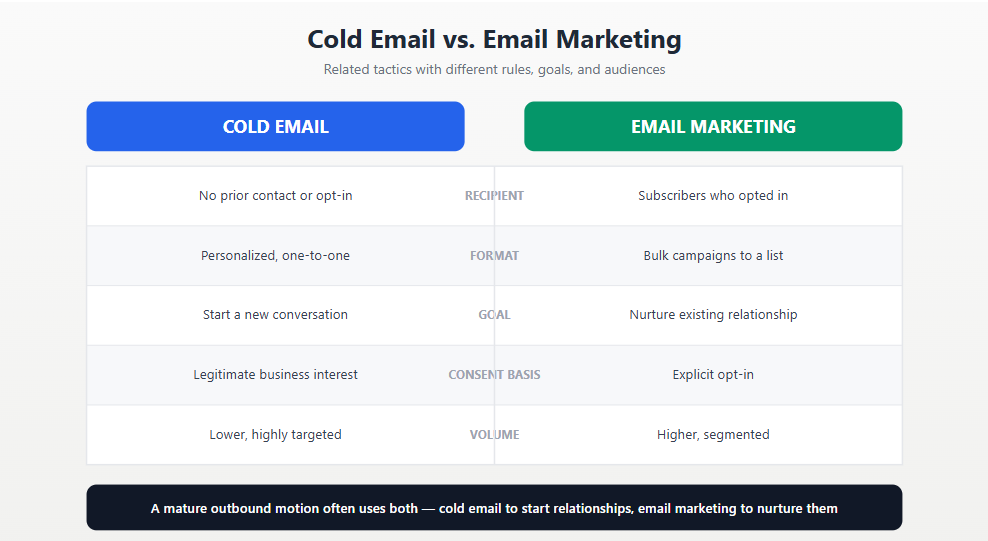
“Cold email and email marketing are related tactics, but they run on different consent rules and goals.”
Yes cold emailing is legal in the United States, including business-to-business outreach, as long as you follow the CAN-SPAM Act. This is one of the most searched, and most misunderstood, parts of this topic, so it’s worth being specific rather than vague.
According to the FTC, the CAN-SPAM Act:
Penalties are real: each individual email in violation can carry a civil penalty of up to $53,088, per the FTC’s most recent inflation-adjusted figure and non-compliance is assessed per email, not per campaign.
In the EU and UK, GDPR sets a stricter bar. For B2C outreach, explicit consent is generally required. For B2B outreach, many organizations rely on “legitimate interest” as a lawful basis, but this requires a genuine, relevant connection to the recipient’s professional role and an easy opt-out it isn’t a blanket exemption.
In Canada, Canada’s Anti-Spam Legislation (CASL) is stricter still, generally requiring express or implied consent even for many B2B contexts.
The practical takeaway: cold email is legal, but “legal” isn’t the same as “consequence-free if you get it wrong.” Compliance is about conduct honesty, traceability, and respect for opt-outs not about whether the recipient asked to hear from you first.
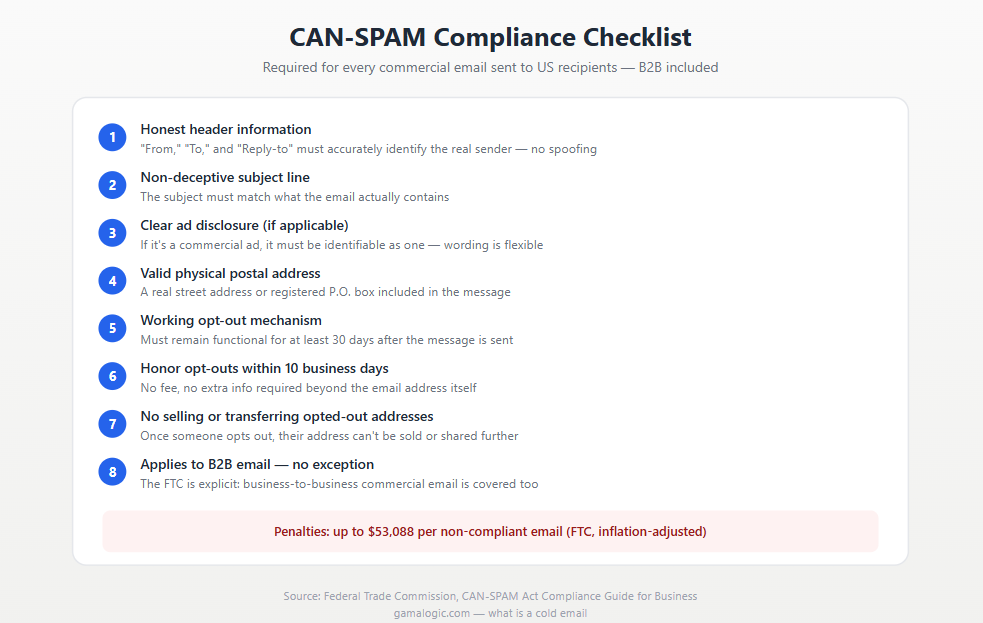
“The 8 CAN-SPAM requirements every commercial email including B2B cold email must meet.”
This is the most common misconception about cold email, and it’s worth being precise about, since the two get confused constantly.
A cold email is:
Spam, by contrast, typically:
The test isn’t “did they ask for this?” under CAN-SPAM, they don’t have to. The test is whether the email is honest, relevant, and respectful of the recipient’s right to stop hearing from you. If your email helps, informs, or solves a real problem for a specific person, it’s a cold email. If it’s mass, generic, and deceptive, it’s spam regardless of how you label it internally.
Despite the rise of social ads, chatbots, and instant messaging, cold emailing remains one of the highest-ROI outbound channels available. A few reasons why:
Direct access to decision-makers. A well-crafted cold email can reach a CEO, CMO, or founder directly, bypassing gatekeepers that other channels can’t.
Scalable but personal. With modern tools, you can reach thousands of recipients while keeping each message feeling individually written through merge fields, conditional content, and researched personalization.
Fully measurable. Every part of a cold email campaign opens, replies, bounces, conversions can be tracked, which makes it one of the most data-driven channels in outbound.
Cost-effective at any scale. Cold email requires minimal spend compared to paid ads or a dedicated SDR team cold-calling it’s accessible to solo founders and enterprise sales orgs alike.
Reply rates vary widely by industry, targeting quality, and personalization but a commonly cited industry range puts average cold email reply rates somewhere between 1% and 10%, with anything consistently above 5% considered a strong result. On the deliverability side, keeping your hard bounce rate under roughly 2-3% and your spam complaint rate under 0.1% is generally what protects the sender reputation your entire outreach program depends on cross either threshold consistently and mailbox providers start filtering your mail regardless of how good the copy is.
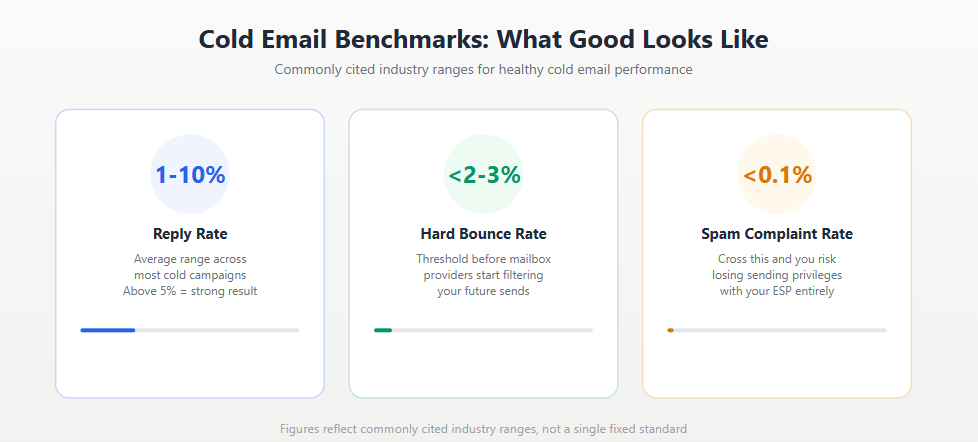
“What healthy cold email performance looks like, at a glance.”
A high-performing cold email tends to share five ingredients:
1. A clear, short subject line. Aim for roughly 6-10 words enough to communicate value or spark curiosity without reading as clickbait. “Quick idea for your Q4 campaign” or “Noticed something on your site” both work because they promise something specific and deliver on it.
2. A genuine, specific opening. Reference something real and researched about the recipient a recent post, a role change, a specific detail about their company not a generic compliment that could apply to anyone.
3. A value-focused message, not a features list. Say what’s in it for them, briefly. Skip the tour of your product; lead with the outcome.
4. A low-commitment call to action. Invite, don’t pressure. “Would you be open to a quick 10-minute call next week?” asks for far less than “Let’s schedule a demo.”
5. A clean, real signature. Full name, role, company, and real contact information this is also a CAN-SPAM requirement, not just good practice.
Subject: Quick idea for {{Company Name}}’s Q4 pipeline
Hi {{First Name}},
I noticed {{Company Name}} recently expanded into {{specific detail}} congrats on that.
We’ve helped a few teams in {{industry}} tighten their outbound process around exactly that kind of growth phase, usually cutting the manual list-building work down significantly.
Worth a quick 10-minute call to see if it’s relevant for your team?
Best, {{Your Name}} {{Title}}, {{Company}} {{Contact info}}
Beyond the five ingredients above, a few structural habits consistently separate cold emails that get replies from ones that get ignored:
Before any cold email goes out, the foundational question is simple: are you actually reaching a real, deliverable inbox? That’s where Gamalogic’s Email Finder and Email Validation come in.
Email Finder locates professional email addresses by name, company, or domain, so your list starts with actual decision-makers rather than dead ends.
Email Validation checks every address on your list confirming it’s active, correctly formatted, and free of disposable, role-based, or catch-all risk before it ever enters an active sequence. A cold email program built on unverified data will bleed reply rate and sender reputation regardless of how good the copywriting is; clean data is the foundation everything else depends on.
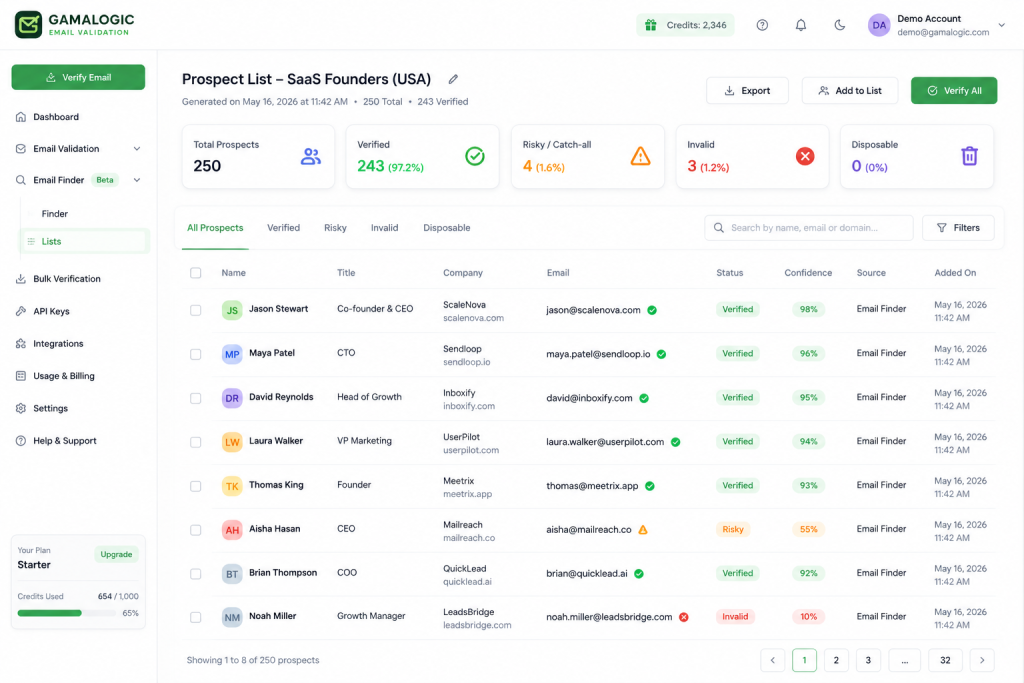
(Gamalogic verified prospect list showing email finder and validation results)
For teams building outbound lists at scale, it’s also worth learning to detect role-based, disposable, and catch-all addresses directly in your prospect list, and to understand why B2B email verification matters specifically for outbound sales motions.
Cold email has moved a long way past the mass-blast tactics of the early 2000s. Done well legally, personalized, and backed by verified data it remains one of the most direct, measurable, and cost-effective ways to start a real business conversation with someone who doesn’t know you yet.
What is a cold email?
A message sent to someone with no prior relationship or contact history, written for a legitimate business purpose distinct from spam because it’s personalized, relevant, and transparent.
What does “cold email” mean, exactly?
“Cold” refers to the lack of any existing relationship with the recipient you haven’t previously interacted, and they haven’t opted in specifically to hear from you, unlike a subscriber on an email marketing list.
Is cold email the same as cold email marketing?
Not quite. “Cold email” often describes a single, personalized message; “cold email marketing” describes the broader practice of sending cold emails at scale, usually with automation, personalization tooling, and sequences.
Is cold email legal?
Yes, in the US, under the CAN-SPAM Act including for B2B outreach, with no opt-in requirement, but with real requirements around honest headers, ad disclosure, and opt-outs. Rules are stricter in the EU (GDPR) and Canada (CASL).
Is cold email spam?
Not if it’s personalized, relevant, transparent about the sender, and compliant with an easy opt-out. Spam is defined by deception and irrelevance at scale, not simply by being unsolicited.
How do you write a cold email that gets replies?
Keep it under 150 words, make it specifically about the recipient rather than your company, use a clear low-commitment call to action, and follow up most replies come after the first message, not from it.
What’s a good cold email reply rate?
Industry benchmarks commonly cite a 1-10% range, with results consistently above 5% considered strong though this varies significantly by targeting quality, industry, and personalization depth.


Reaching high-value prospects today takes more than polished templates. AI-powered personalization helps you cut through inbox noise by tailoring each message to a prospect’s role, intent, and priorities at scale. This blog explores how to use AI thoughtfully to craft cold emails that feel relevant, human, and worth replying to.
Identify role-based, disposable, and catch-all email addresses to protect your sender reputation and improve sales email performance.


 No credit card required
Post your Comment.