 Sign In














 Email Marketing
 ABM
ABM  List Building
  Lead Generation
  Growth Hacker
  Digital Marketing
  Data Enrichment
  Software as a Service
  Data as a Service
  Waterfall Enrichment
  Startup
  Revenue Performance
  Job Change Tracking
  Customer Data Platform
  CRM
CRM 


 Knowledge Base
  Video Tutorials
  Help Center
  Tarpitting Scoring
  ROI Calculator
  About us
  Contact us
  Testimonials
  Automation
How Disposable Emails Destroy Your Lead Generation Campaigns (And How to Stop Them)

18 Jun 2026
Sreerag
12 Minutes
Read

 Blog
FAQ
Case Studies
Knowledge Base
Video Tutorials
Help Center
SEG Validation
Tarpitting Scoring
ROI Calculator
About us
Contact us
Testimonials
Blog
FAQ
Case Studies
Knowledge Base
Video Tutorials
Help Center
SEG Validation
Tarpitting Scoring
ROI Calculator
About us
Contact us
Testimonials
Disposable email addresses are one of the most overlooked threats to lead generation. They create fake signups, damage your sender reputation, increase email bounce rates, inflate your marketing platform costs, distort your analytics, and waste your sales team’s time. Businesses running lead capture forms, SaaS free trials, newsletters, or paid ad campaigns should use real-time email verification and disposable email detection to stop invalid leads from entering their CRM.
You launch a campaign. Signups roll in. Your dashboard looks great.
Then reality hits:
Half the leads never reply. Trial users disappear after five minutes. Your sales team says the leads are junk. Newsletter engagement tanks. And your paid ads are spending real money on contacts that never had any intention of buying.
The culprit is often not your offer, your copy, or your funnel.
It is disposable email addresses quietly entering your system.
In this guide, we will cover exactly what disposable emails are, why people use them, the full range of damage they cause across lead generation, SaaS, and deliverability, and how to stop them with the right verification approach.
A disposable email address is a temporary email account designed to receive messages for a short period before the inbox expires or is abandoned. Users can create one in seconds, use it to pass a signup form, and never open it again.
Popular disposable email services include Temp Mail, Guerrilla Mail, 10 Minute Mail, Mailinator, ThrowAwayMail, and YOPmail.
Beyond standard throwaway accounts, there are also burner and forwarding services like 33Mail and Blur (formerly DoNotTrackMe). These create forwarding addresses that redirect to a real inbox, but allow the user to cut off communication instantly with a single click. They are harder to detect and pose a different kind of risk because they can appear to deliver successfully in your CRM while the user has already disconnected them.
Understanding the difference matters because each type requires a slightly different detection approach.
Not everyone using a disposable email has bad intentions. Understanding the reasons helps you choose the right response.
From a business perspective, the intent behind the signup does not change the outcome. A lead that cannot receive future communications is almost never a valuable lead.
This is the most serious and least talked about consequence of disposable emails entering your list.
Think of your sender reputation like a credit score for email. Internet service providers (ISPs) like Gmail, Outlook, and Yahoo use it to decide whether your emails land in the primary inbox, the spam folder, or get blocked entirely.
When disposable email addresses expire and go inactive, your messages bounce. When users abandon their throwaway inboxes and stop opening your emails, your engagement rate falls. ISPs interpret both signals the same way: they conclude that you are sending emails nobody wants, which is a signal associated with spam.
Your emails begin landing in spam folders instead of the inbox.
Spam folder placement reduces visibility and engagement.
ISPs begin routing more of your mail to spam by default.
In severe cases, your sending domain can be added to industry blacklists.
Email platforms may suspend your account if bounce rates remain elevated.
Preventing disposable emails from entering your list in the first place is dramatically easier than repairing a damaged sender reputation after the fact, which is why many organizations implement email validation API checks during signup.
Most articles treat all disposable emails as one thing. They are not. There are three distinct categories, and each behaves differently in your CRM and email platform.
These are the most common. Services like 10 Minute Mail and Temp Mail generate a random inbox that exists for a fixed period, sometimes as short as ten minutes. After expiration, any emails sent to that address bounce. These are easiest to detect because they use known disposable domains.
Some users create email aliases through their own email provider. These aliases appear as a legitimate email address, often even passing basic domain checks, but they sit outside the user’s primary inbox. Your welcome email may technically deliver, but the user never sees it in a normal email environment and has no intent to engage further. Aliases are harder to detect because the domain itself is legitimate.
Services like 33Mail and Blur create forwarding addresses that redirect to the user’s real inbox. They look completely legitimate. But the user can disable the forwarding address at any moment with a single click, cutting off all future communication instantly. These require behavioral analysis and risk scoring to detect reliably.
Knowing which type of temporary address you are dealing with helps you configure your verification tool correctly and choose the right response for each category.
Every lead generation campaign aims to collect genuine prospects. When temporary email addresses enter your forms, your CRM fills with contacts that never engage, never convert, and never become customers. This creates a false picture of campaign success.
A campaign may appear to generate 1,000 leads. But if 20 percent are disposable emails, your actual qualified lead volume is significantly lower. Worse, your optimization decisions are being made using inaccurate data.
Real-world example: A SaaS company runs a paid advertising campaign and collects 5,000 registrations. After implementing disposable email detection, the results show 742 signups were temporary emails and 319 were invalid addresses. That means 1,061 of the 5,000 signups were junk. The company had been spending ad budget and sales resources based on numbers that were inflated by more than 20 percent.
For sales teams, this creates a specific frustration. When sales reps repeatedly call and email contacts that cannot be reached, they stop trusting inbound leads entirely. That breakdown between marketing and sales is expensive to repair and entirely avoidable.
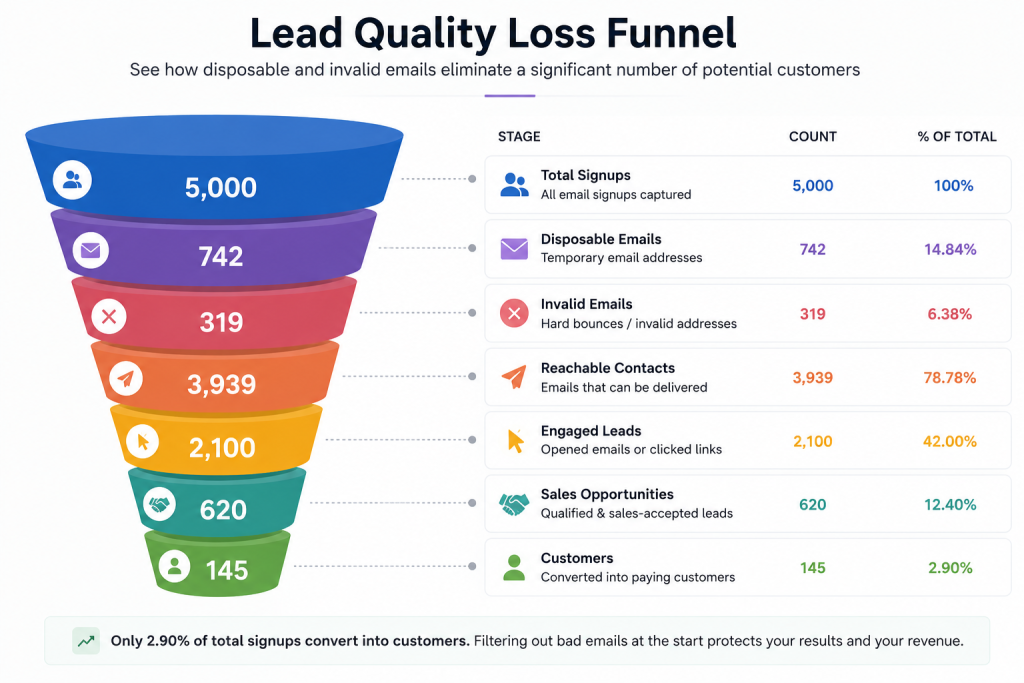
[ Real-world example: A SaaS company runs a paid advertising campaign and collects 5,000 registrations. After implementing disposable email detection, the results show 742 signups were temporary emails and 319 were invalid addresses. That means 1,061 of the 5,000 signups were junk. The company had been spending ad budget and sales resources based on numbers that were inflated by more than 20 percent.]
For SaaS businesses, disposable emails create problems that go beyond lead generation and into your core product data.
Free trial abuse is one of the most direct impacts. When your product has usage limits, a freemium tier, or a free trial period, disposable emails allow bad actors to create multiple accounts indefinitely, bypassing limits you set deliberately to protect conversion rates and server costs.
Beyond abuse, disposable signups make your product analytics unreliable. If a large portion of your trial signups are throwaway accounts, your data will suggest:
All of those conclusions lead to bad product decisions. Teams redesign onboarding flows, rewrite email sequences, and adjust pricing all because the underlying data was contaminated by accounts that were never real users.
Specific SaaS metrics that disposable emails distort:
Fake signups produce inaccurate reporting across your entire marketing stack:
Poor data drives poor decisions. Many businesses optimize their campaigns and product using metrics that are quietly distorted by disposable email traffic they never knew was there.
Most businesses only notice the visible symptoms. The real cost runs much deeper.
Email marketing platforms like Mailchimp, Klaviyo, HubSpot, and ActiveCampaign charge based on your total subscriber count. When disposable emails sit in your list, you are literally paying a monthly fee to store contacts that have zero chance of converting.
As your list grows with junk, so does your platform bill. These are dollars being spent directly on dead weight.
When you run paid ads and a portion of the signups that result are disposable emails, your cost-per-qualified-lead is higher than your reported cost-per-lead suggests.
You are paying the same acquisition cost for a throwaway email as you are for a genuine prospect.
If 15 percent of your paid signups are disposable, your real cost of acquiring a viable lead is roughly 18 percent higher than you think.
Sales representatives spend valuable time researching, calling, and emailing prospects who either cannot be reached or never intended to engage.
Every hour spent on an unreachable lead is an hour not spent on a real opportunity.
At scale, this is a significant productivity tax on your sales organization.
Many disposable email users create temporary accounts that generate support tickets, spam reports, and moderation issues despite having no long-term value to the business.
Understanding the difference in behavior between real and disposable emails helps teams prioritize list quality.
Personal emails reflect genuine contact information. Disposable emails are designed for temporary use with no intent to maintain the relationship.
Personal email users engage consistently over time. Disposable email inboxes are rarely checked after the initial signup.
Personal emails on a clean list bounce rarely. Disposable emails expire and produce hard bounces as soon as the inbox closes.
Personal email subscribers expect your communication. Disposable email users often forget they signed up and mark messages as spam when they do encounter them.
Personal email subscribers reflect genuine interest and buying intent. Disposable email signups are rarely connected to any purchase intent.
Personal emails on an engaged list improve your sender reputation. Disposable emails damage it through bounces, low engagement, and spam reports.
Even if the harm starts small, it compounds.
As more disposable email addresses expire and produce bounces, your bounce rate climbs. As abandoned inboxes stop opening your emails, your engagement rate falls. Email providers track both signals continuously.
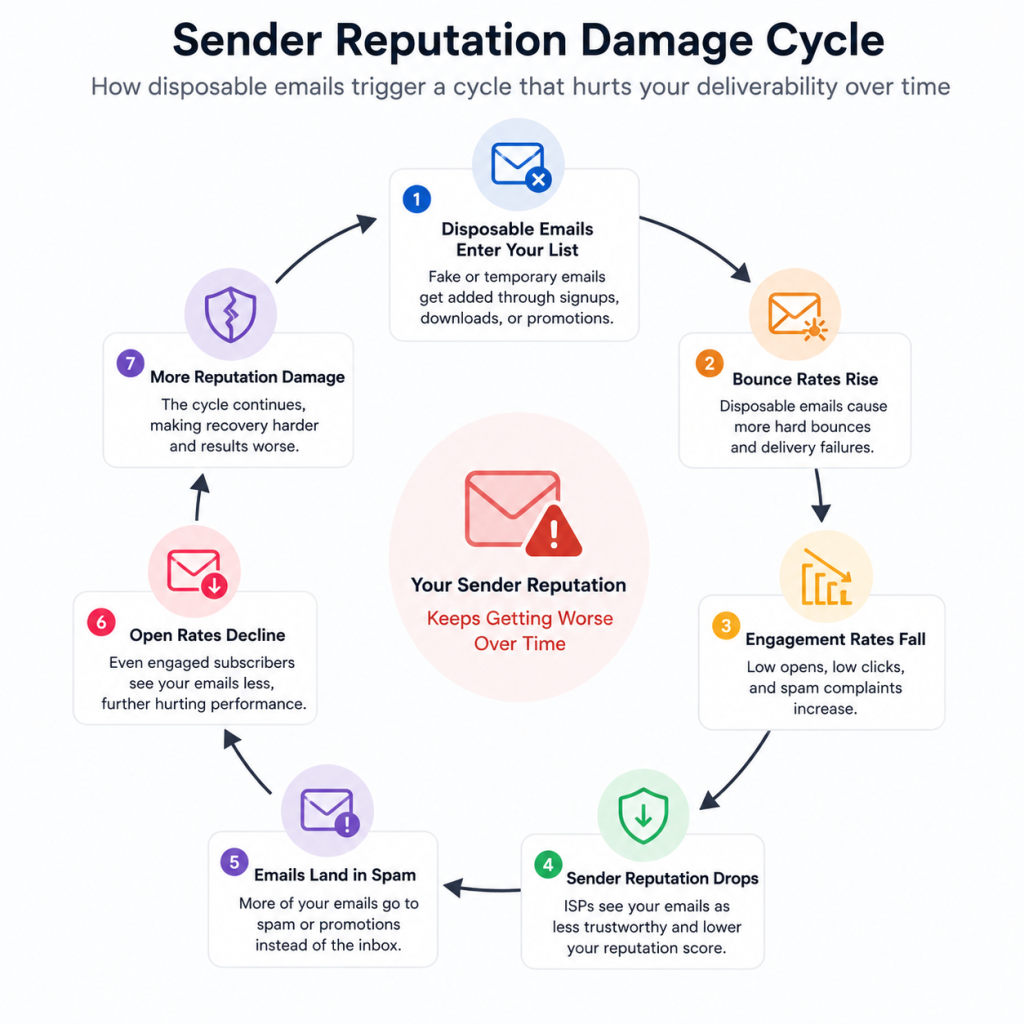
The result is a gradual decline in inbox placement. Your emails start landing in promotions or spam tabs more often. Your open rates fall further because spam placement reduces visibility.
Which causes even lower engagement.
Which further damages your reputation.
It is a self-reinforcing cycle.
Businesses that regularly clean their email lists and use real-time verification at signup maintain healthier sender reputations and consistently stronger inbox placement.
If you want to understand exactly how email validation protects your deliverability, email validation best practices for deliverability covers the full technical picture, including SPF, DKIM, and DMARC alignment in combination with list hygiene.
Modern email validation tools use several overlapping techniques to identify temporary email providers.
Validation systems maintain continuously updated databases of known disposable email domains.
When a user enters an address at a known throwaway domain, it is flagged instantly.
Checks whether the email domain is legitimate, properly registered, and has a history consistent with genuine business or personal use.
Verifies whether the domain has valid mail exchange records that can properly receive email.
Many throwaway domains have incomplete or non-existent MX records.
Many disposable email services use newly registered domains.
Flagging domains registered fewer than 30 days ago can help catch emerging providers that are not yet in known domain databases.
Provides mailbox-level verification signals to check whether the specific address is likely to receive mail.
Combines multiple factors — domain age, behavior patterns, engagement history, and domain reputation — to assign a risk score that helps you decide how to handle borderline cases.
Detects common patterns in disposable addresses such as randomly generated usernames, unusual syntax, or naming conventions associated with automated account creation.
These verification layers work together to catch disposable emails that would pass a basic format check.
Knowing what makes one validation tool more accurate than another will help you choose the right solution.
If you want to go deeper on what separates a reliable email validation tool from a basic one, understanding what makes an accurate email validation tool in 2026 will help you evaluate verification providers more effectively.
The most effective strategy is prevention.
Stopping bad data before it enters your system is always easier and cheaper than cleaning it up after the fact.
Integrate real-time email verification directly into your registration forms, free trial signup pages, lead generation landing pages, and newsletter subscription forms.
When a user submits a disposable email address, show a friendly inline message asking them to use a permanent address.
Keep the check fast under one second so it does not slow down your form experience.
Double opt-in requires users to confirm access to their inbox by clicking a link in a confirmation email before their registration is complete.
This does not catch every disposable email some throwaway inboxes can receive and display a confirmation email but it significantly raises the bar.
Users who are not genuinely interested in your product rarely complete the extra step.
Double opt-in is especially valuable for newsletter lists where long-term engagement matters most.
Maintain and update a blacklist of known disposable email domains.
Most enterprise-grade email verification APIs handle this automatically with continuously updated domain databases, but you can supplement with manual additions of domains you identify through your own signup data.
Set up monthly reviews of your bounce rate, spam complaint rate, and list engagement.
If bounce rates climb above 1 to 2 percent, investigate whether disposable or invalid emails are entering your list through a specific form or campaign source.
Catching problems early protects your sender reputation before the damage escalates.
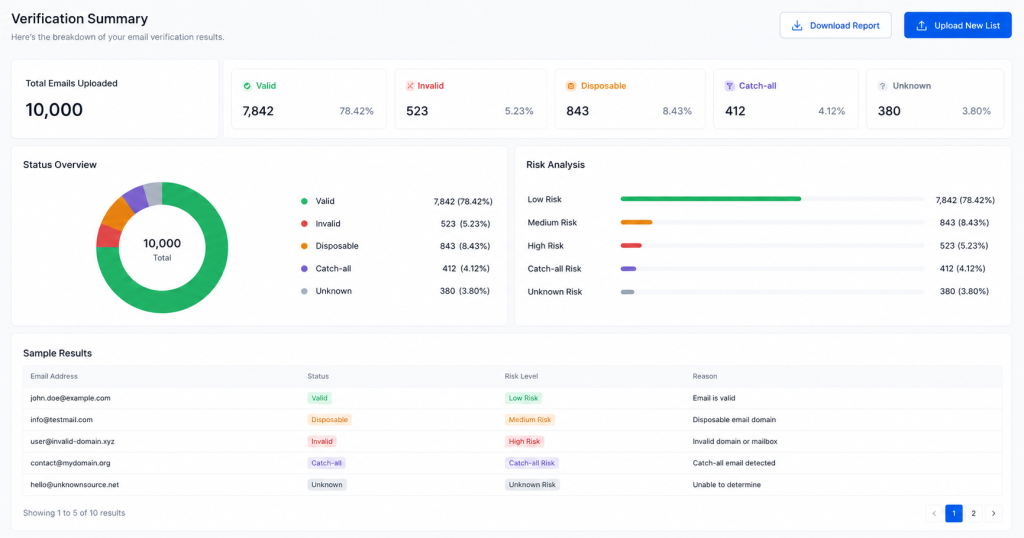
(A typical bulk verification report of gamalogic email validation tool source showing disposable, invalid, and risky email addresses before campaign launch.)If you already have disposable emails in your database, the fastest cleanup is bulk email verification.
Upload your list, get a full categorization of results, and segment accordingly:
Automated API-level detection ensures temporary email addresses are blocked instantly during account creation without any manual effort.
A good detection API should support real-time queries, return results fast enough for inline form validation, and update its domain databases continuously.
For a full guide on how to check whether an email address is valid before you spend budget reaching out, learning how to check if an email address is valid for free can help you identify invalid, risky, and disposable addresses before they enter your database.
If you want a simple starting policy that works for most SaaS and lead generation teams, here is a framework you can adapt:
Applying this framework consistently keeps your list cleaner over time instead of forcing you into periodic large-scale cleanups that disrupt your campaigns.
When evaluating providers, look for:
A disposable email address is a temporary email account designed to receive messages for a short period before expiring or being abandoned. Users create them in seconds without any registration and use them to bypass signup requirements without sharing their real contact information. They have no long-term relationship with your business and typically cannot be reached through future email communications.
Disposable emails create fake signups that look real but behave like dead ends. They reduce your actual qualified lead count, distort campaign analytics, waste paid advertising budget, consume sales team time, inflate your email platform costs, and damage your sender reputation through high bounce rates and low engagement. Specifically, they push bounce rates above the 2 percent threshold that causes email platforms to flag or suspend accounts.
No. Some users genuinely prefer privacy and do not want marketing emails in their primary inbox. Others are just testing your product with no immediate buying intent. The business problem is the same regardless of intent: a lead that cannot receive future communications rarely generates value for your company.
Businesses use email validation tools that identify known temporary email domains through domain intelligence databases, MX record validation, SMTP verification, domain age checks, and risk scoring. The most effective tools update their databases continuously as new disposable email providers appear and flag all three types of temporary email — throwaway accounts, aliases, and forwarding services.
It reduces raw signup counts, but it increases lead quality. Most businesses find that their downstream metrics — sales reply rates, trial-to-paid conversion, engagement rates, and revenue per lead — improve after implementing disposable email blocking, because fewer junk entries are distorting their results and consuming their team’s time.
In most cases, yes. Blocking disposable emails helps reduce free trial abuse, protects activation and retention metrics, improves onboarding data quality, and maintains accurate customer data for product decisions. If privacy is a core part of your brand promise, you can take a more flexible approach allow users with disposable emails to access limited features but require a verified permanent email to unlock the full product experience.
Run a bulk email verification on your full list and segment the results. Suppress all disposable addresses from your campaigns immediately. Remove hard bounces. Then add real-time validation at your signup forms so the problem does not reappear. Plan to re-verify your older segments every 90 days.
Email verification significantly reduces the volume of disposable emails entering your system. No tool can guarantee 100 percent coverage permanently because new disposable email providers launch regularly. The goal is practical prevention that catches the vast majority of throwaway addresses in real time, keeping your list clean and your sender reputation protected.
Disposable email addresses are more than a deliverability problem. They are a lead quality problem, a revenue problem, a CRM integrity problem, and a sales productivity problem all at once.
Whether you run paid lead generation campaigns, SaaS free trial flows, ecommerce registrations, or newsletter programs, temporary email addresses quietly undermine performance across your entire business. They inflate numbers that should drive your decisions, waste resources that should go toward real prospects, and erode the technical foundation your email program depends on.
By combining real-time email verification, disposable email detection, double opt-in, and regular email hygiene, your business can improve lead quality, reduce fake signups, protect your sender reputation, lower your real customer acquisition costs, and build a healthier database that supports accurate decisions over the long term.
If you are evaluating verification tools, understanding what separates an accurate email validation solution from a basic one is an important step before committing.


Poor email hygiene can lead to bounced messages, damaged sender reputations, and missed business opportunities. In this guide, we uncover practical tips and strategies to help you maintain a spotless email list, improve deliverability, and ensure your communications always hit the mark.

The Marketer’s Handbook to Email List Hygiene & Growth explains how to clean email databases, reduce bounce rate, improve deliverability, and grow a high-quality subscriber list.
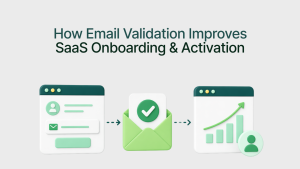
Struggling with low SaaS activation rates? Learn How Email Validation Improves SaaS Onboarding & Activation Rates, reduces fake users, and drives higher retention and growth.


 No credit card required
Post your Comment.