 Sign In












 Email Marketing
 ABM
ABM  List Building
  Lead Generation
  Growth Hacker
  Digital Marketing
  Data Enrichment
  Software as a Service
  Data as a Service
  Waterfall Enrichment
  Startup
  Revenue Performance
  Job Change Tracking
  Customer Data Platform
  CRM
CRM 


 Knowledge Base
  Video Tutorials
  Help Center
  Tarpitting Scoring
  ROI Calculator
  About us
  Contact us
  Testimonials
  Automation
What Is Email Hygiene? A Complete Guide to Email list Hygiene Best Practices in 2026

01 May 2024
Athika Jishida
12 Minutes
Read

 Blog
FAQ
Case Studies
Knowledge Base
Video Tutorials
Help Center
SEG Validation
Tarpitting Scoring
ROI Calculator
About us
Contact us
Testimonials
Blog
FAQ
Case Studies
Knowledge Base
Video Tutorials
Help Center
SEG Validation
Tarpitting Scoring
ROI Calculator
About us
Contact us
Testimonials
Email hygiene is the keeping your email database accurate, permission-based, and free of addresses that put your deliverability and sender reputation at risk.
On average, 20–30% of any email database decays every year people change jobs, abandon inboxes, mistype addresses, or use disposable emails to get past a signup form. If you’re not actively managing that decay, you’re not just losing subscribers. You’re actively damaging your ability to reach the inboxes you have left.
That’s what email list hygiene is about and it’s different from simply “cleaning your list,” though the two get used interchangeably.
This guide explains what email hygiene actually means, why it matters more than ever heading into 2026, the core practices that protect your sender reputation, and where to go for deeper, execution-level guides once you understand the fundamentals.
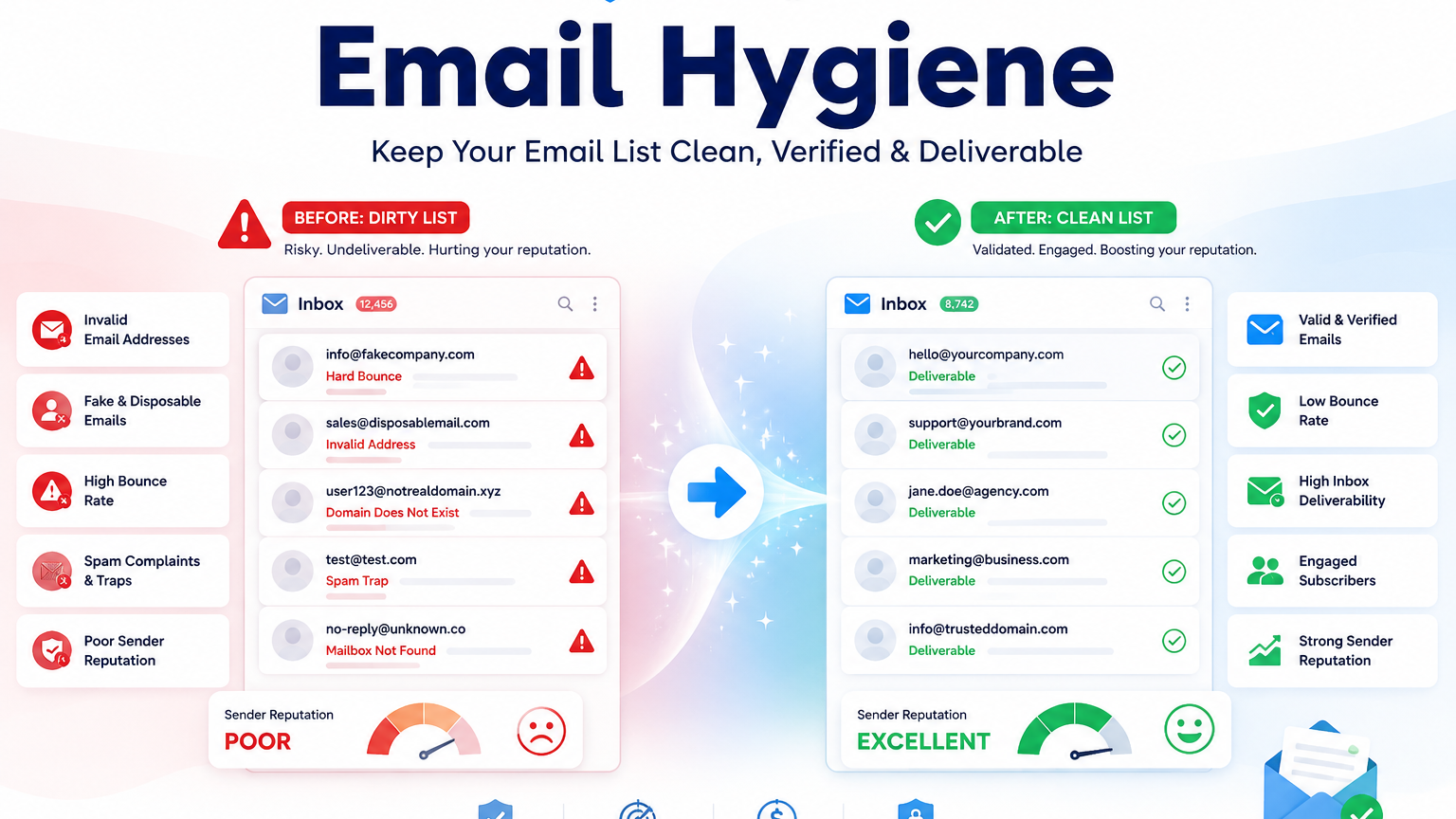
Email hygiene is the ongoing discipline of keeping your email database accurate, permission based, and free of addresses that put your deliverability and sender reputation at risk. It’s not a single task. It’s a continuous practice that spans how you acquire emails, how you validate them, how you monitor engagement, and how you retire addresses that go cold.
Mailbox providers like Gmail, Yahoo, and Outlook evaluate every sender continuously. They look at your bounce rate, spam complaint rate, and engagement patterns to decide whether your next email lands in the inbox, the promotions tab, or spam. Email hygiene is the practice that keeps those signals healthy.
These terms are often used interchangeably, but they mean slightly different things:
Think of it this way: cleaning and scrubbing are actions you take periodically. Hygiene is the system that determines how often and how well you take them.
Poor hygiene doesn’t just mean a smaller list. It actively works against you.
The scale of the problem:
What poor hygiene actually costs you:
Good email hygiene isn’t one action. It’s five practices working together.
Every address on your list should have opted in explicitly. Purchased or scraped lists are the single biggest hygiene risk you can introduce, because they arrive already containing invalid addresses and spam traps.
Real time validation at the point of signup blocks bad data before it ever enters your database. Bulk validation periodically re-checks your existing list to catch addresses that have gone stale since they were added. Most mature senders run both. Validation is a foundational input to hygiene, not a replacement for it, and the mechanics of how to validate an email address are worth understanding before building a hygiene process around it.
SPF, DKIM, and DMARC verify that you’re actually authorized to send from your domain. Without them, even a perfectly clean list can land in spam, because mailbox providers can’t confirm your identity. Getting SPF, DKIM, and DMARC set up correctly is a one-time technical fix that pays off on every send afterward.
Bounce rate and spam complaints are lagging indicators. By the time they spike, damage is already done. Tracking opens, clicks, and disengagement trends lets you catch decay early and act before it hurts your sender reputation, since how mailbox providers actually score sender reputation depends heavily on exactly these engagement patterns.
Rather than deleting inactive contacts immediately, most hygiene programs suppress them, attempt a re-engagement campaign, and only remove those who remain unresponsive. This is often called a sunset policy.
Crafting a genuinely clean, deliverable email database takes a multifaceted approach. These are the seven practice areas every strong hygiene program covers.
Every address on your list should come from explicit opt-in consent, not a purchased, rented, or scraped source. Purchased lists arrive already loaded with invalid addresses and spam traps, which means you’re paying to damage your own reputation. During signup, clearly state what subscribers will receive and how often, since mismatched expectations are one of the fastest routes to spam complaints.
Real time validation at signup blocks invalid, disposable, and malformed addresses before they ever enter your database. Bulk validation applies the same logic to your existing list on a recurring schedule, checking syntax, domain existence, and mailbox level deliverability. Together, these two layers stop bad data from getting in and catch data that has gone stale since it was added.
A clean list still underperforms if it’s treated as one undifferentiated group. Segment by engagement level, behavior, and lifecycle stage, then personalize subject lines and content accordingly. Relevant, targeted sends generate fewer spam complaints and stronger engagement signals, both of which feed directly back into your sender reputation.
Bounce rate and complaint rate are lagging indicators. Open rate, click rate, and disengagement trends are leading ones. Tracking engagement continuously lets you catch decline early, run a re-engagement campaign, and act before it shows up as a reputation problem.
Suppress hard bounces immediately. Monitor soft bounces for repeat failures before suppressing those too. For subscribers who go quiet rather than bounce, use a sunset policy: attempt re-engagement first, and only remove contacts who remain unresponsive after that attempt.
Implement SPF, DKIM, and DMARC so mailbox providers can verify you’re authorized to send from your domain. Monitor sender and domain reputation on an ongoing basis rather than only after a problem appears. Avoid spam trigger language and keep a healthy balance between text and images in your email design.
Stay current with CAN-SPAM and GDPR requirements. Every send needs a clear, one click unsubscribe option, and every opt-out request should be honored promptly and recorded. Compliance isn’t just a legal safeguard. It’s also a hygiene safeguard, since respecting preferences keeps your list built entirely on genuine consent.
For tool-by-tool execution steps and timelines covering acquisition through ongoing maintenance, the Marketer’s Handbook picks up where the principles above leave off. If you’re running cold outreach specifically, a tactical, campaign-ready hygiene workflow is what the 7-Step process walks through.
| Metric | Healthy Benchmark | Why It Matters |
|---|---|---|
| Bounce rate | Under 2% | Above 2% signals list decay; above 5% risks throttling |
| Spam complaint rate | Under 0.1 to 0.3% | Gmail/Yahoo bulk sender thresholds treat 0.3%+ as high risk |
| List decay (annual) | 20 to 30% is typical | Informs how often you need to validate and clean |
| Engagement rate | Varies by list, but a declining trend is a warning sign | Early indicator of hygiene issues, before bounces spike |
Hygiene itself is continuous, but the cleaning action within it should happen on a schedule that matches your list size and sending frequency. Active senders should validate quarterly. Smaller or slower growing lists can work on a six month cycle at minimum, and the right cleaning cadence by list size and trigger event is covered in full detail on its own.
Businesses that neglect hygiene typically see the same pattern play out. Bounce rates creep upward, engagement quietly declines, and then a campaign suddenly underperforms with no obvious content or timing explanation. By the time it’s visible in open rates, sender reputation has often already taken weeks to damage, and reputation recovery is significantly slower than reputation loss.
Every practice above depends on one foundation: knowing which addresses in your database are actually real. That’s the piece Gamalogic handles automatically.
With clean data feeding every send, the rest of your hygiene program (segmentation, engagement monitoring, authentication) works the way it’s supposed to.
Get 500 free verification credits, no credit card required →
What is the difference between email hygiene and email validation?
Email validation is a technical check that confirms whether a specific address is real and deliverable. Email hygiene is the broader, ongoing practice that includes validation alongside permission based acquisition, engagement monitoring, authentication, and scheduled maintenance.
How often should I practice email hygiene?
Hygiene itself never stops, but list cleaning cycles within it typically run quarterly for active senders and at minimum every six months for smaller lists.
Does email hygiene affect sender reputation?
Yes. Bounce rate, spam complaints, and engagement are the primary signals mailbox providers use to calculate sender and domain reputation, and all three are directly shaped by how well you maintain hygiene.
Can I just delete inactive subscribers instead of maintaining hygiene?
Deleting inactive contacts is one part of hygiene, but without addressing acquisition quality and validation, your list will simply decay again at the same rate.


Your email list isn’t just for marketing—it holds untapped SEO potential. Discover how clean, engaged email data can boost your search visibility and drive organic growth.
Increasingly aggressive email filtering by major providers makes reaching inboxes quite difficult these days. However, there are steps you can take as an email sender to boost your credibility, increasing the chances of bypassing filters so your messages get to inboxes consistently over time. This article will help understand and manage your sender reputation.
Want to take your email marketing to the next level? Discover 5 essential tools that streamline your workflow, boost deliverability, and drive better results—whether you're building campaigns or optimizing performance.


 No credit card required
Post your Comment.