 Sign In














 Email Marketing
 ABM
ABM  List Building
  Lead Generation
  Growth Hacker
  Digital Marketing
  Data Enrichment
  Software as a Service
  Data as a Service
  Waterfall Enrichment
  Startup
  Revenue Performance
  Job Change Tracking
  Customer Data Platform
  CRM
CRM 


 Knowledge Base
  Video Tutorials
  Help Center
  Tarpitting Scoring
  ROI Calculator
  About us
  Contact us
  Testimonials
  Automation
Free Email Checker Tools Compared: Real Bounce-Rate Benchmark Data

08 Sep 2026
Sreerag
12 Minutes
Read

 Blog
FAQ
Case Studies
Knowledge Base
Video Tutorials
Help Center
SEG Validation
Tarpitting Scoring
ROI Calculator
About us
Contact us
Testimonials
Blog
FAQ
Case Studies
Knowledge Base
Video Tutorials
Help Center
SEG Validation
Tarpitting Scoring
ROI Calculator
About us
Contact us
Testimonials
Every “free” email checker promises the same two things: paste an address, get an answer, pay nothing. What the label doesn’t tell you is how each tool arrives at that answer, or what happens the moment your list grows past whatever “free” was quietly capped at.
Most comparisons stop at feature lists and pricing pages. We didn’t. Our in-house team ran the same 1,000 real-world emails, sourced from Apollo, through five five free email checkers Gamalogic free email address validator , ZeroBounce, Hunter.io, Verifalia, and Debounce. what they actually check, how generous their free tier really is, and where each one is structurally likely to leave gaps. If you want to understand why two tools can both say “valid” and only one of them is right, keep reading.
Free email checkers ( validators ) help to check if an email address is valid for freeEvery checker in this category runs some combination of six layers, and the free tier you get access to almost always determines how many of them actually run:
@, a valid domain, no illegal characters)?info@?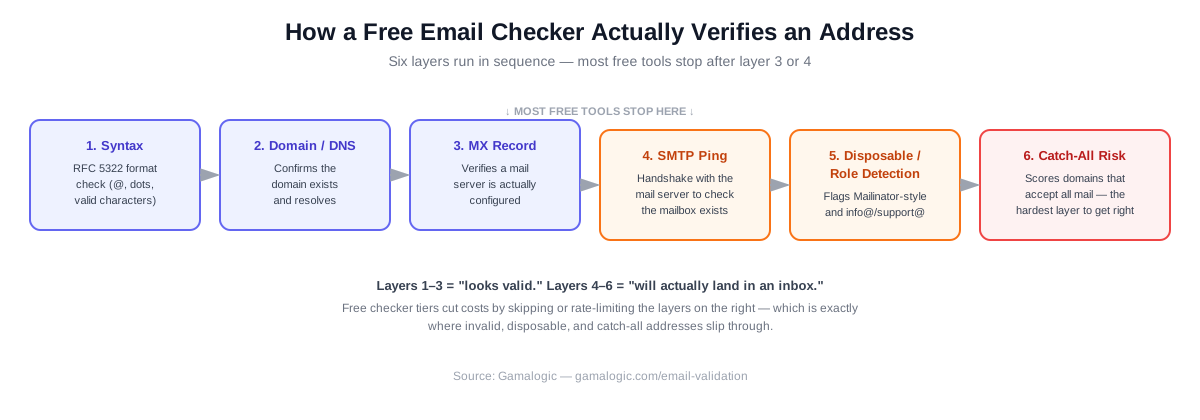
Layers 1–3 are cheap to run, which is why almost every free tool on the market includes them. Layers 4–6 are where the actual cost sits, SMTP handshakes take server infrastructure, and catch-all scoring takes ongoing pattern analysis, which is exactly why they’re the first thing a free tier limits, rate-limits, or removes. An address that clears syntax, domain, and MX checks can still bounce the moment it reaches a real send, because nothing so far has confirmed the mailbox itself exists. If you want the deeper mechanics of why catch-all detection specifically can never be fully certain, we’ve broken that down separately.
We took a single list of 1,000 real-world contact emails sourced from Apollo, ran it through five verification providers with no other changes to the list, and then sent to every address each tool marked “valid.” “Real bounce rate” below is the share of each provider’s own valid pool that hard-bounced on that send — not a marketing number, an outcome.
| Provider | Valid (of 1,000) | Real bounce rate | Notes |
|---|---|---|---|
| Gamalogic | 852 | 0.60% | Resolved all detected catch-all addresses to a firm valid/invalid, no ambiguous middle bucket |
| ZeroBounce | 885 | 3.70% | Approved the most emails of any tool tested, but bounced roughly 6x more often than the low-bounce group |
| Hunter.io | 822 | 0.90% | Closest to Gamalogic on the bounce-rate-to-valid-pool trade-off |
| Verifalia | 713 | 0.60% | Matches Gamalogic on bounce rate, but gets there by rejecting ~140 more addresses as invalid |
| Debounce | 670 | 0.10% | The lowest bounce rate in the group but hands back a usable verdict for only 670 of the 1,000 emails |
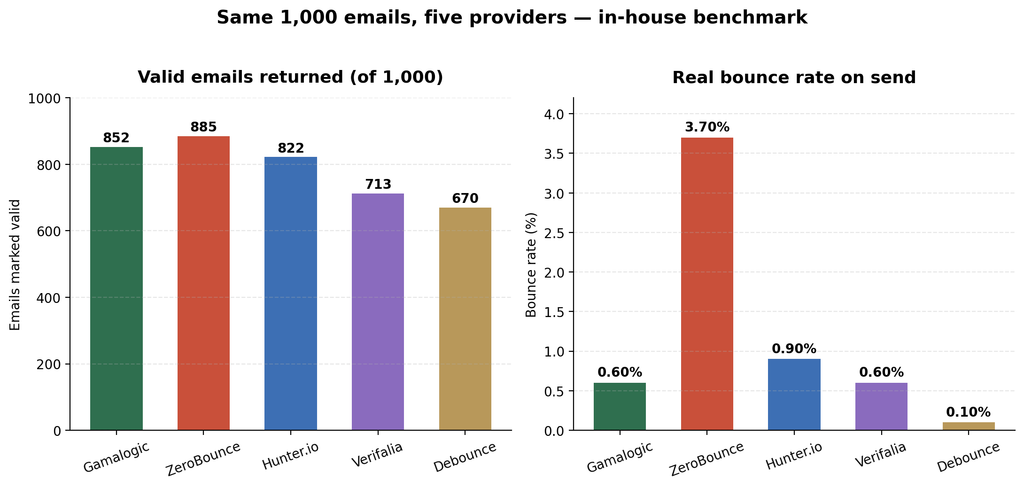
Two providers tie on bounce rate, Gamalogic and Verifalia, both at 0.60%, but Gamalogic gets there while returning 852 valid addresses against Verifalia’s 713. Put differently: Verifalia reaches the same safety level by throwing out roughly 140 more addresses that Gamalogic was willing to call valid and back up. That’s the coverage-to-risk trade-off in one comparison.
ZeroBounce sits at the opposite end of that same trade-off. It approved more addresses than any other tool (885), but at a bounce rate more than six times higher than the low-bounce group. If your goal is maximum list size, that’s the tool that gets you there at the cost of a meaningfully dirtier send.
Debounce is the outlier worth flagging separately, because its 0.10% bounce rate looks like the best result in the table until you notice the coverage number next to it. It only returned a usable verdict for 670 of the 1,000 addresses, the remaining 330 weren’t necessarily bad emails, just addresses the tool declined to commit an answer on. A 0.10% bounce rate on two-thirds of a list isn’t directly comparable to a bounce rate calculated on 85% of the same list; it’s a different, more conservative product decision, and it leaves you needing a second pass to resolve the rest.
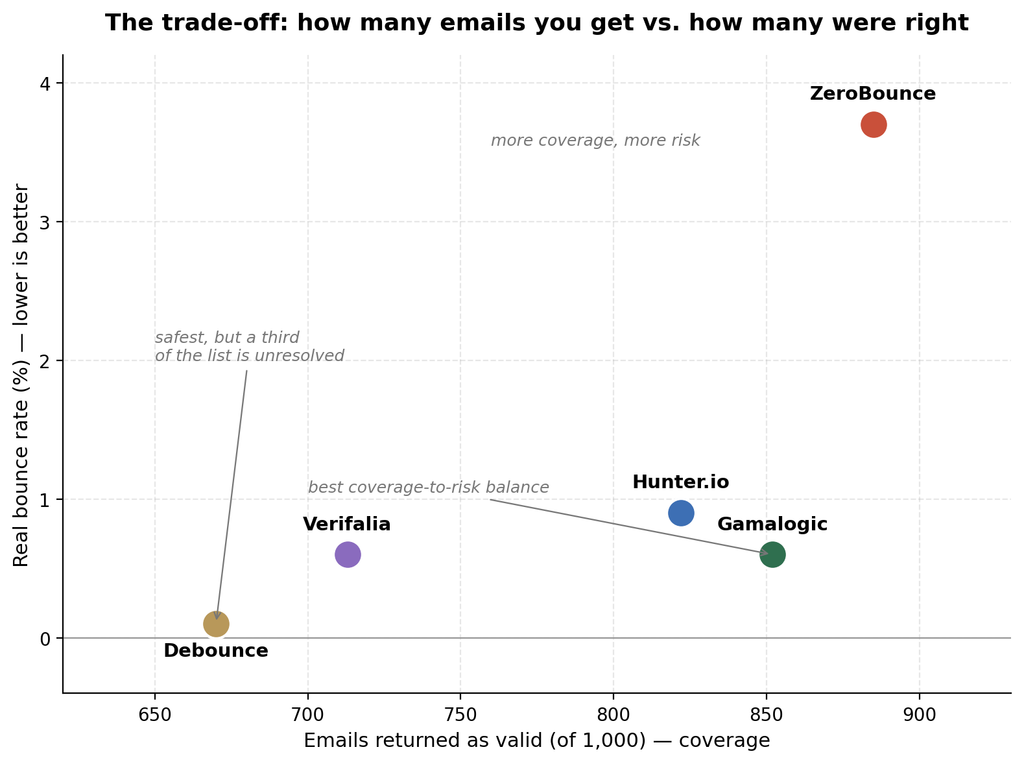
To make the risk concrete: if you mailed every address each tool marked valid, here’s roughly how many hard bounces you’d be looking at, out of that same 1,000-email list.
| Provider | Valid addresses mailed | Approx. bounces at that rate |
|---|---|---|
| Gamalogic | 852 | ~5 |
| ZeroBounce | 885 | ~33 |
| Hunter.io | 822 | ~7 |
| Verifalia | 713 | ~4 |
| Debounce | 670 | <1 |
(For the underlying methodology on why catch-all detection specifically can never be fully certain for any provider we’ve broken that down separately.)
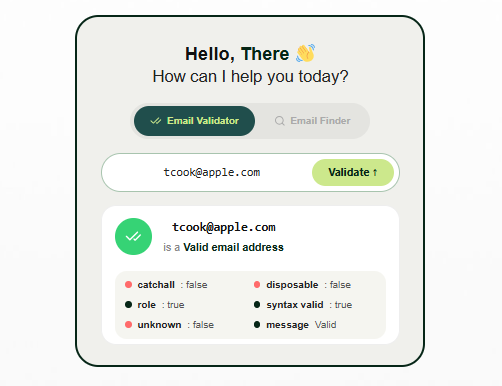
Gamalogic’s free tier gives new accounts 500 verification credits, with no credit card required to start, and the credits don’t expire there’s no countdown pushing you toward a plan before you’re ready. A few things worth calling out specifically, since they’re the details that usually decide whether a free tier is actually usable or just a trial wrapper:
Free limit: 500 credits on signup, credits never expire Signup required: Yes SMTP-level check: Yes Catch-all detection: Yes, plus SEG validation Best for: Anyone who wants the same detection logic on the free tier as the paid API useful if you’re testing accuracy before committing to a plan, since there’s no feature gap to account for once you upgrade.
(For a deeper look at how Gamalogic and other providers stack up specifically on accuracy, feature depth, and real not list-price pricing, see Best Email Validation Tools: Compared by Accuracy, Features, and Real Pricing.)
Hunter is primarily an email-finding tool for B2B sales, and its verifier is a companion feature rather than a standalone product. The free plan includes 50 monthly credits, shared from the same pool used for email discovery so a month spent finding prospect addresses leaves fewer credits for verifying them. It checks syntax, MX records, SMTP status, and disposable addresses, and connects tightly with Hunter’s own finder and a Google Sheets add-on.
Free limit: 50 credits/month (shared with email finding) Signup required: Yes SMTP-level check: Yes Catch-all detection: Not a dedicated feature Best for: Teams already using Hunter to find prospect emails who want verification in the same workflow not a fit if you need a dedicated, high-volume checker.
ZeroBounce offers 100 free validations per month with an account. Beyond basic validity, it’s known for email activity scoring and data append (adding approximate name, location, and gender to a verified address) features aimed more at sales enrichment than pure list hygiene. Spam trap detection is included even on the free tier, which isn’t universal in this category.
Free limit: 100 validations/month Signup required: Yes SMTP-level check: Yes Catch-all detection: Yes Best for: Small prospect lists where enrichment (not just validity) adds value less suited to bulk list cleaning at volume.
Verifalia’s free tier is unusual in this group: no signup required, but capped at 25 checks per day. It’s popular with developers for its detailed result codes (valid, invalid, catch-all, risky, undeliverable rather than a flat pass/fail) and open-source SDKs across .NET, Java, PHP, Node.js, Ruby, Go, and JavaScript.
Free limit: 25 checks/day, resets daily Signup required: No SMTP-level check: Yes Catch-all detection: Yes, with detailed result classification Best for: Developers who want to test integration logic against nuanced result codes before committing to a paid SDK plan.
Bouncer offers 100 free credits at signup, runs the full syntax/MX/SMTP/disposable/catch-all stack, and is notable for GDPR compliance with an EU data residency option relevant if your list includes European contacts and your legal team cares where the data physically sits during a check. Its paid tier adds Bouncer Shield, a real-time form-protection layer, and AutoClean, an automated re-verification workflow.
Free limit: 100 credits at signup (one-time) Signup required: Yes SMTP-level check: Yes Catch-all detection: Yes Best for: EU-based teams or anyone who needs a documented data-residency answer before uploading a list.
| Tool | Free limit | Signup required | SMTP check | Catch-all detection | Free limit type |
|---|---|---|---|---|---|
| Gamalogic | 500 credits | Yes | Yes | Yes | One-time credit grant |
| Hunter.io | 50/month | Yes | Yes | Not dedicated | Recurring, shared with email finder |
| ZeroBounce | 100/month | Yes | Yes | Yes | Recurring monthly |
| Verifalia | 25/day | No | Yes | Yes, detailed | Recurring daily |
| Bouncer | 100 credits | Yes | Yes | Yes | One-time credit grant |
(Free-tier limits reflect each provider’s publicly stated terms as of September 2026 and are subject to change always confirm current limits on the provider’s own pricing page before relying on them for a real project.)
If you want the deeper benchmarking methodology behind accuracy claims generally (not just this free-tool test), that’s covered in Email Validation Accuracy: Benchmarks, Metrics & Best Practices.
Notice the last column above, that split matters more than the raw number. Recurring-quota tools (ZeroBounce, Verifalia, Hunter) reset on a schedule, so they’re viable as an ongoing, if limited, part of your process. One-time credit grants (Gamalogic, Bouncer) give you a larger initial allowance but are designed as an on-ramp to a paid plan once you exhaust them, not a permanent free workflow.
Neither type is “better”, they solve different problems. A recurring daily or monthly quota suits someone checking a handful of new signups by hand every week indefinitely. A larger one-time grant suits someone validating an existing list once, or testing a tool’s accuracy in bulk before deciding whether to subscribe.
The comparison table above tells you the limit. It doesn’t tell you what happens when you hit it. This is the part every “best free tools” roundup skips, and it’s the part that actually determines whether a free tool is safe to build a process around.
A hard, visible stop a clear “quota reached” message with a count of how many addresses were and weren’t checked, is something you can plan a workflow around. A silent stop, where a batch simply ends partway through with no clear indication in the results that anything was cut off, is the failure mode that actually damages a list: you assume the whole file was checked, ship it, and the unchecked tail bounces exactly like it would have with no validation at all. Before running a real list through any free tool’s bulk or batch feature, confirm which behavior it has, most provider documentation states this, but it’s rarely surfaced in marketing copy.
This is also the practical ceiling on free tools generally: none of the five above are built to validate inline, at the moment someone submits a signup or checkout form. That’s a different job, running on a different kind of infrastructure, a real-time validation API that returns a result in under a second while the user is still on the page, rather than a dashboard you paste addresses into after the fact. If you’re validating at the point of collection rather than cleaning a list after it’s already built, none of the free tools compared here are the right tool regardless of their limits see Real-Time vs Batch Email Validation: When to Use Each for that distinction in full.
A single manual check of one address carries essentially no risk. Uploading a spreadsheet of real customer or prospect emails is a different decision, and it’s worth three questions before you do it with any provider, free or paid:
Gamalogic publishes its Data Processing Agreement directly, above supports EU-relevant compliance needs; it’s worth the two minutes to read whichever policy applies to the tool you choose, since the answers genuinely differ by provider.
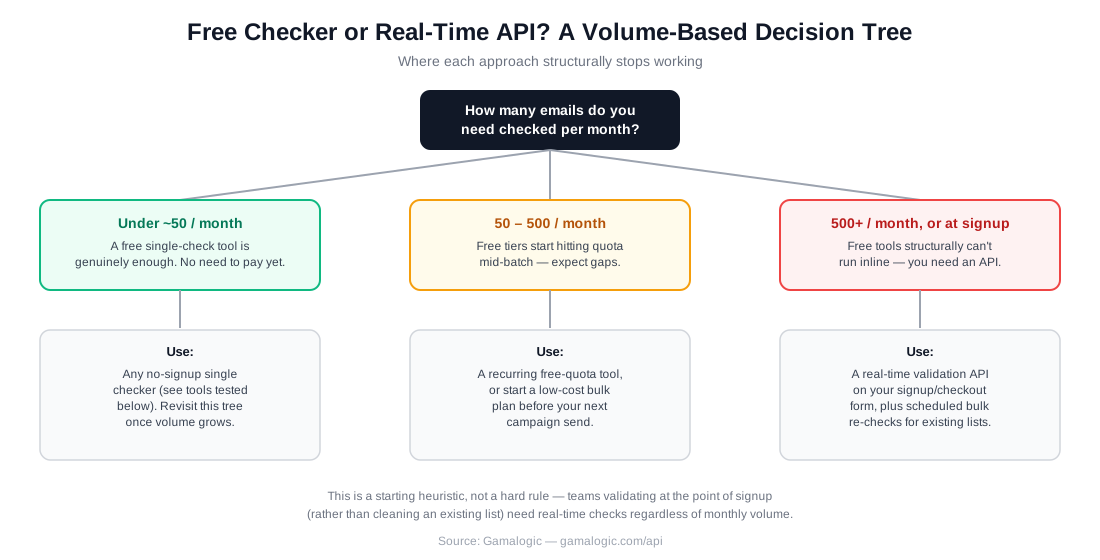
This is a starting heuristic, not a hard rule, a team validating 20 signups a month still needs a real-time check if those 20 happen at the moment of account creation rather than in a batch you control.
Are free email checker tools accurate enough for a real campaign?
For a single high-value email, generally yes even basic free tools catch obvious syntax and domain errors. For a full campaign list, accuracy depends on whether the tool runs SMTP-level and catch-all checks, which as the comparison above shows several free tiers limit or skip entirely.
Why did my free checker say “valid” but the email still bounced?
Most likely it completed syntax, domain, and MX checks but not an SMTP-level mailbox check the address looked correctly formatted and pointed to a real mail server, but nothing confirmed the specific mailbox exists. See what makes an email validation tool accurate for the full breakdown of each layer.
Is it safe to upload my email list to a free checker?
It depends on the provider’s stated retention policy and whether verification is their core business or a funnel into a different product. Check for an actual data-processing agreement before uploading a real customer or prospect list.
What’s the difference between a free email checker and a real-time email validation API?
A free checker is built for occasional, manual, one-address-at-a-time use. A real-time API runs inline on a signup or checkout form and returns a result in under a second, so invalid addresses never enter your database in the first place. They solve different problems at different volumes.
Do free email checkers detect catch-all domains?
It varies Gamalogic, ZeroBounce, Verifalia, all include catch-all detection on their free tiers; Hunter’s verifier does not treat it as a dedicated feature. Catch-all is one of the more resource-intensive layers to run accurately, which is why it’s often the first thing a free tier limits.
How often should I re-check a list I validated for free?
Email lists decay over time regardless of how they were originally validated, commonly cited industry estimates put this around 20–25% per year. If you validated a list for free months ago, treat it as due for a re-check before your next major send. See how often you should clean your email list for a schedule by list type.


Learn how email validation strengthens account-based marketing by verifying decision-maker emails, improving deliverability, reducing risk, and increasing ABM ROI.

AI is great for structure, grammar, and speeding up drafts but it can’t replace your unique voice. Think of it as an assistant that helps polish and streamline your writing, while you provide the personal touch that makes emails authentic and impactful; explore the blog to know more about striking this balance.
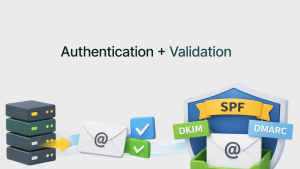
Learn how SPF, DKIM, DMARC, and email validation reduce bounce rate, protect sender reputation, and boost inbox placement in 2026. Essential guide for marketers.


 No credit card required
Post your Comment.