Self-Hosted vs API-Based Email Validation: Which Fits Your Infrastructure
27 Sep 2026
Sreerag
12 MinutesRead
Contents
Every “self-hosted vs. API” comparison in this space is written by an API vendor, and it shows: a few paragraphs on open-source tools, then a hard pivot into “just buy us.” That’s not a decision framework, it’s a sales page wearing a comparison-post costume.
This post goes one level deeper: what self-hosted email verification actually costs in engineering time, when a real-time email verification API genuinely wins, and when on-premise validation is the correct choice, not just the cheap one.
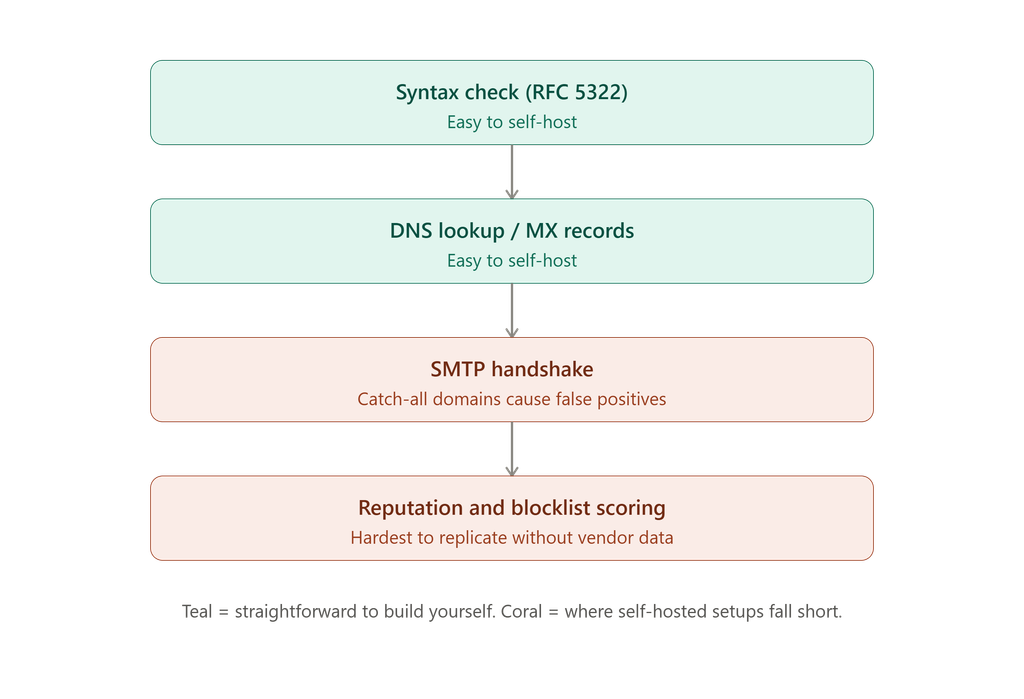
The four layers every email validator runs. The first two are straightforward to build yourself, the last two are where most self-hosted projects fall short.
What “Self-Hosted” and “API-Based” Actually Mean
An email verification API is a hosted service you call over HTTPS. You send an address, it runs checks against its own infrastructure, DNS lookups, live mail-server connections, proprietary reputation data, and returns a verdict.
Self-hosted / on-premise email validation means you run the verification logic yourself, using either a custom build or an open source email verifier library (Python’s py3-validate-email, Node’s deep-email-validator, or Rust’s Reacher/check-if-email-exists are the three most actively maintained as of 2026).
What an Email Validator Actually Checks (Either Way)
Syntax validation — RFC 5322 format compliance. Trivial to self-host.
DNS lookup / MX Records — confirms the domain has a mail exchanger configured. Also easy to self-host.
SMTP Handshake — your server opens a connection to the recipient’s mail server and reads the response code without sending a real message. A 250 OK doesn’t reliably mean the mailbox exists, catch-all domains return 250 for any address, real or not, the single biggest source of false positives in self-hosted and cheap API tools alike. (For the SMTP mechanics behind exactly why no validator can ever be fully certain here, we broke down the math in a dedicated post.)
Disposable Email Address (DEA) detection — checking the domain against a maintained throwaway-provider list. Self-hosted setups need a continuously updated feed; most open-source libraries ship a static list that goes stale within months.
Role-account and reputation signals — flagging info@, admin@, and checking domain/IP reputation against spam trap and blacklist databases. This is the layer that’s genuinely hard to replicate without a data-aggregation pipeline.
Per-check cost drops sharply if IP reputation is already solved
Scales linearly, cheaper in engineering hours
Bar chart comparing monthly cost of self-hosted versus API-based email validation at 10,000 and 1,000,000+ verifications per month, showing self-hosted costing more at low volume and less at very high volume.
The honest crossover point: self-hosting rarely wins on total cost below roughly 500K–1M verifications/month once engineering time is priced in.
Where Self-Hosting Actually Wins
1. Data Residency and Compliance
If you’re validating emails tied to regulated data, health records under HIPAA, EU personal data under GDPR, California consumer data under CCPA, sending that data to a third-party API means it leaves your infrastructure. For organizations with strict residency requirements, self-hosted validation is sometimes the only compliant option. If you go the API route instead, confirm data-handling terms directly, Gamalogic’s own Data Processing Agreement and Trust Center are the kind of documentation worth checking on any vendor you’re evaluating.
2. Rate Limiting and Throttling You Actually Control
APIs impose their own rate limits. If your signup flow spikes unpredictably, you’re capped by your plan tier. Self-hosted validation, deployed via Docker containers on your own infrastructure, lets you set your own throughput ceiling at the cost of managing that scaling yourself.
3. No Per-Check Cost at Extreme Volume
For a narrow set of genuinely high-volume operations, per-check API cost eventually exceeds infrastructure cost real but rare, and worth requesting custom volume pricing to check where that crossover actually sits for your numbers before assuming you’re past it.
The Hybrid Approach
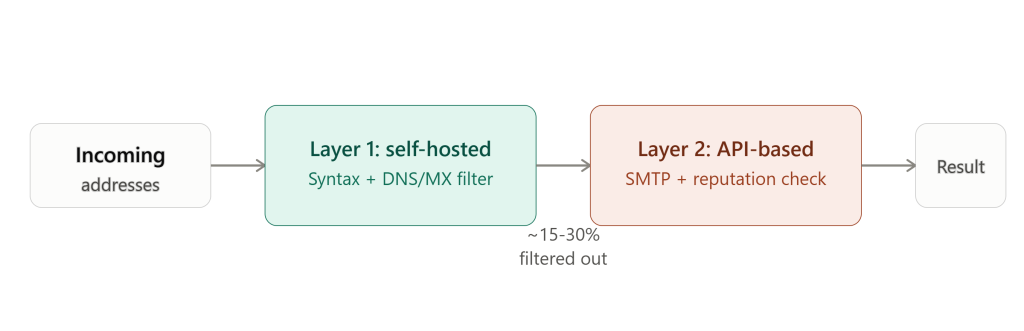
The false binary in most comparisons is “self-host everything” vs. “API everything.” In practice, a layered architecture is common at scale:
A hybrid pipeline filters out 15–30% of bad addresses in-house before the costly SMTP-level check ever runs.
Layer 2 (API, for the hard part): SMTP-level mailbox confirmation, catch-all resolution, and reputation scoring, routed only to addresses that pass Layer 1
This typically filters out 15–30% of submitted addresses before they ever need a paid check. It’s effectively the same principle behind dropping a live checker directly on a signup form cheap checks run inline first, the expensive check only fires on what’s left.
Decision Tree: Which Fits Your Infrastructure
Under 50K verifications/month, no dedicated infra time → API-based.
Regulated data (HIPAA/GDPR/CCPA) → self-hosted, or a vendor with confirmed data handling and a signed DPA.
1M+ verifications/month with existing infra → hybrid: self-host the filtering layer, route the rest to an API.
Real-time validation on a signup form, latency-sensitive → API-based precisely the workflow developers wiring validation directly into a product flow are usually solving for, where a sub-second response matters more than marginal accuracy gains.
Building this into a product you plan to resell → self-hosted, or a pay-as-you-go API with usage-based pricing so third-party markup doesn’t erode your margin at scale.
Security Considerations Either Way
TLS/SSL encryption on every call, self-hosted or not.
IP reputation isolation run verification traffic from IPs separate from your sending domain.
Audit trail log what was checked and when; this fits naturally into webhook-based sync workflows if you need results delivered to downstream systems automatically.
FAQ
Is there a good open source email verifier that’s actually production-ready? check-if-email-exists (Reacher, Rust) is the most actively maintained as of 2026, but still lacks proprietary reputation/blocklist data.
How do I build an email verification system without an existing library? Start with syntax validation, then DNS MX lookup, then an SMTP handshake with proper timeout and retry handling. Budget 6–8 weeks minimum to handle catch-all and greylisting correctly.
Can I reduce email bounce rates programmatically without a paid API? Partially syntax and DNS/MX checks catch a meaningful share of invalid addresses, but catch-all and mailbox-existence accuracy genuinely requires either a self-maintained SMTP pipeline or a paid verification layer.
Does self-hosting mean I don’t need to worry about GDPR at all? No you still process personal data and need a lawful basis and appropriate security; you’re just not transferring it to a third-party processor.
Conclusion
There’s no universally right answer here, only what fits your volume, your compliance obligations, and how much engineering time you’re willing to spend maintaining infrastructure instead of building product. Under roughly 500K verifications a month, an API almost always wins on total cost once you price in engineering hours. Above that, or the moment regulated data enters the picture, self-hosting, or a hybrid pipeline that filters cheaply in-house before paying for the hard SMTP-level check, starts to make real sense.
The mistake every other comparison on this topic makes is treating it as binary. It isn’t. Start by mapping your own volume and compliance requirements against the decision tree above, and revisit the choice as your volume changes, the right answer at 10,000 checks a month is often the wrong one at 10 million.
If you land on API-based validation, Gamalogic’s real-time API runs the full syntax-to-reputation pipeline described above in a single call, including the SEG and catch-all handling this post covers in detail.
Sreerag
Sreerag P is a seasoned Email Marketing Specialist with over 10 years of experience in digital communication, deliverability optimization, and campaign performance analytics. At Gamalogic, he shares expert insights on improving inbox reach, data hygiene, and API-driven email validation strategies that empower businesses to build trusted customer connections.
Stop fake SaaS signups and trial abuse with email verification. Learn How to Prevent Free Trial Abuse in SaaS Using Email Verification, reduce fraud, and improve user quality from signup.
Learn how SPF, DKIM, DMARC, and email validation reduce bounce rate, protect sender reputation, and boost inbox placement in 2026. Essential guide for marketers.
Discover how email validation API pricing works — from per-check costs to subscription models and hidden fees. Compare top providers and choose smartly.
 Sign In














 Email Marketing
 ABM
ABM  List Building
  Lead Generation
  Growth Hacker
  Digital Marketing
  Data Enrichment
  Software as a Service
  Data as a Service
  Waterfall Enrichment
  Startup
  Revenue Performance
  Job Change Tracking
  Customer Data Platform
  CRM
CRM 


 Knowledge Base
  Video Tutorials
  Help Center
  Tarpitting Scoring
  ROI Calculator
  About us
  Contact us
  Testimonials
  Automation

 Blog
Blog






 No credit card required
Post your Comment.