 Sign In













 Email Marketing
 ABM
ABM  List Building
  Lead Generation
  Growth Hacker
  Digital Marketing
  Data Enrichment
  Software as a Service
  Data as a Service
  Waterfall Enrichment
  Startup
  Revenue Performance
  Job Change Tracking
  Customer Data Platform
  CRM
CRM 


 Knowledge Base
  Video Tutorials
  Help Center
  Tarpitting Scoring
  ROI Calculator
  About us
  Contact us
  Testimonials
  Automation
ActiveCampaign vs Mailchimp Deliverability: Which Needs List Cleaning?

12 Aug 2026
Sreerag
12 Minutes
Read

 Blog
FAQ
Case Studies
Knowledge Base
Video Tutorials
Help Center
SEG Validation
Tarpitting Scoring
ROI Calculator
About us
Contact us
Testimonials
Blog
FAQ
Case Studies
Knowledge Base
Video Tutorials
Help Center
SEG Validation
Tarpitting Scoring
ROI Calculator
About us
Contact us
Testimonials
Neither ActiveCampaign nor Mailchimp checks whether an address is real before you hit send. Both platforms only react after a bounce they don’t prevent one. That single fact is the actual answer to “which platform needs list cleaning more,” and it’s the answer almost none of the dozens of ActiveCampaign-vs-Mailchimp comparisons already ranking for this query bother to give, because they’re built around automation depth and pricing tiers, not what happens to a list with dead weight in it.
What’s changed is that the consequences of that shared design flaw stopped being identical. A billing policy update in November 2025 quietly closed the gap between the two platforms and to see exactly how close, we ran two real lists, one sourced from each platform, through the same validation engine and compared the wreckage.
Mailchimp marks an address “cleaned” after one hard bounce, or after roughly seven consecutive soft bounces. Cleaned contacts stop receiving sends automatically, but they keep counting toward your billed audience size until you manually archive them. You can be paying monthly for names you’re technically barred from ever emailing again.
ActiveCampaign auto-suppresses hard bounces immediately and ships a List Cleanup tool plus Engagement Management settings for building sunset policies on inactive contacts. Tellingly, ActiveCampaign’s own list-cleaning documentation recommends pairing this with a third-party verification integration to catch bad addresses before a campaign goes out — which is the platform admitting, in its own help docs, that its native tools don’t validate in advance.
Neither system prevents the first bounce. It just decides what to do after it’s already happened.
To see what “unvalidated” costs in practice, we pulled a live 1,838-contact list straight from a Mailchimp audience and ran it through Gamalogic’s validator with no prior cleanup. It came back with 130 catch-all addresses, 64 outright invalid, and 55 stuck as unresolved “unknown” 249 contacts, about 13.5% of the list, sitting in risk territory that Mailchimp’s own tools wouldn’t have flagged until at least one of them actually bounced.
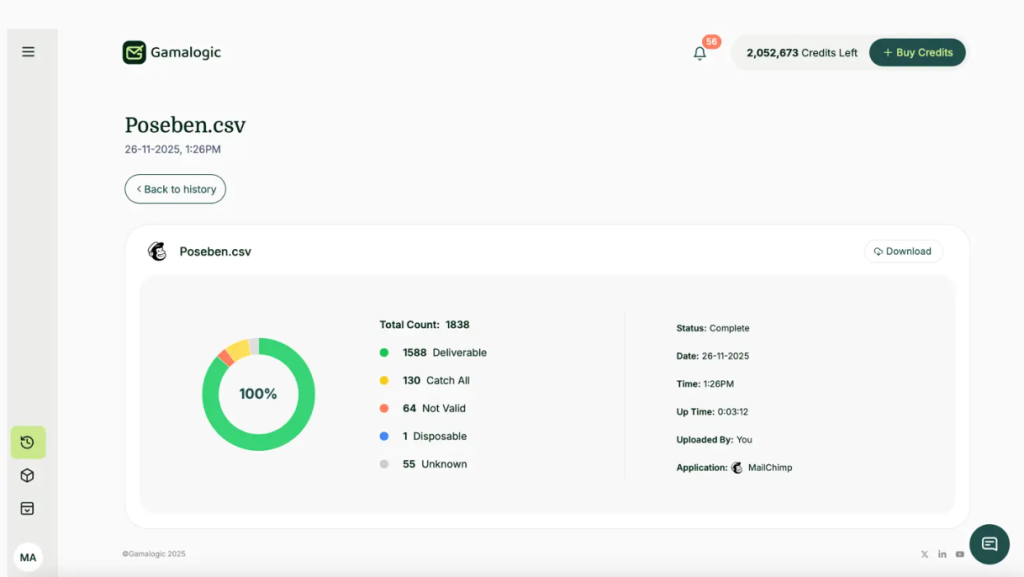
(A live Mailchimp-sourced list (1,838 contacts), validated with no prior cleanup. 130 catch-all and 64 not-valid addresses were sitting in the audience with zero native pre-send warning.)
| Mailchimp | ActiveCampaign | |
|---|---|---|
| Pre-send validation | None native | None native; docs recommend a third-party verification integration |
| Hard bounce handling | Auto-marked “cleaned,” removed from sends | Auto-suppressed, removed from sends |
| Soft bounce handling | Retried; converted to hard bounce after ~7 failed sends | Retried; escalates to suppression after repeated failures |
| Sending infrastructure | Shared IP on lower plans | Shared IP by default; dedicated IP on Enterprise |
| Bounce rate enforcement | Recommends staying under 5%, best practice under 2% | Flags accounts above 2%, can restrict or suspend above 5% |
| Billing on dead contacts | Cleaned and unsubscribed contacts count toward your bill until archived | Accounts created after Nov 3, 2025 are billed for every contact — active, unsubscribed, bounced, unconfirmed |
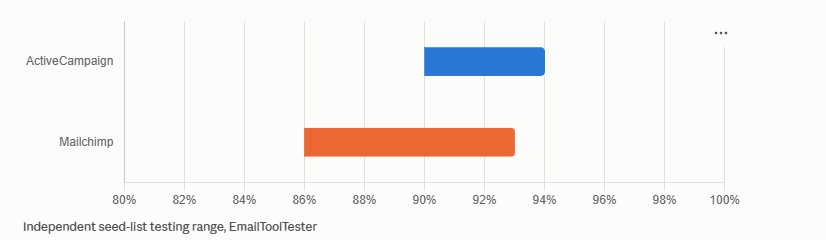
| Independent deliverability testing | ~86–93% inbox placement (EmailToolTester) | ~90–94% inbox placement (EmailToolTester) |
Treat those deliverability percentages as directional, not gospel they’re EmailToolTester’s periodic seed-list results, and any individual sender’s real-world placement is shaped far more by their own authentication setup and list quality than by which ESP they picked. The enforcement mechanics and billing rules in that same table, though, are platform policy, not testing methodology and that’s where “who actually needs list cleaning more” gets decided.
Mailchimp’s habit of billing for “cleaned” and unsubscribed contacts until you manually archived them has been one of the platform’s most-cited complaints for years. A marketer who never actively pruned their list was quietly paying for names that could never receive another email again.
As of November 3, 2025, ActiveCampaign adopted a functionally identical policy for new accounts: every contact counts toward your billable total, including unsubscribed, bounced, and unconfirmed ones. Accounts opened before that date are grandfathered onto the old active-only billing but anyone signing up today inherits the same economics Mailchimp has run for years.
“We’ve had accounts come in where a third of the billed contact count turned out to be dead, unsubscribed, bounced, sitting there for months doing nothing but running up the invoice. Nobody notices until they actually go looking, because neither platform puts that number in front of you.” – Mohammed, Gamalogic customer success lead at Gamalogic
To test how much dead weight actually rides along in a real ActiveCampaign account, we ran a second, independent list — 1,830 contacts, pulled directly from an ActiveCampaign audience — through the same validator. It came back with 150 catch-all addresses, 55 not-valid, and 31 unresolved as unknown: 236 contacts, roughly 12.9% of the list, that would enter ActiveCampaign’s billed contact count under the new policy with no native pre-send warning at all.
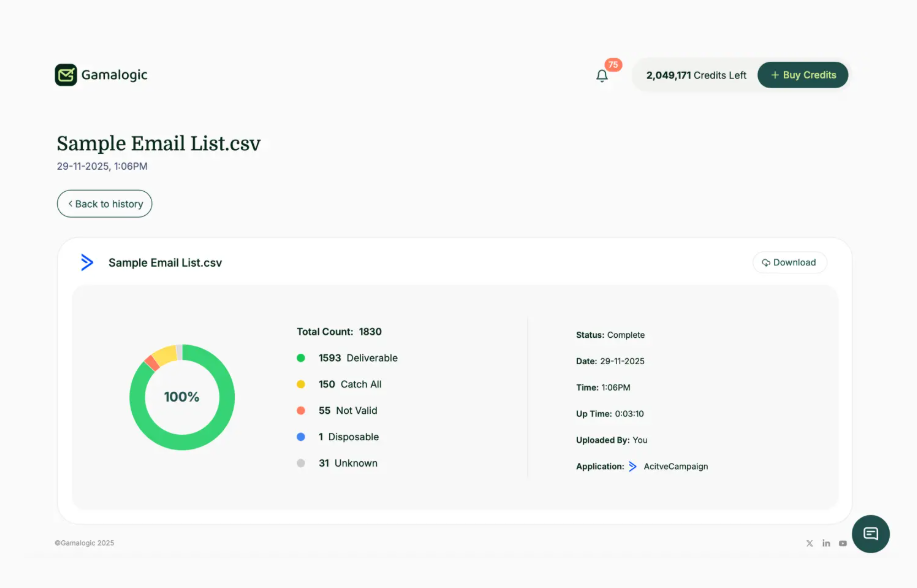
( A live ActiveCampaign-sourced list (1,830 contacts), same validator, same no-prior-cleanup conditions. Under the post-November-2025 billing policy, all 236 flagged contacts count toward the bill until manually removed.)
Line the two runs up and the overlap is the finding: 13.5% of the Mailchimp list and 12.9% of the ActiveCampaign list landed in catch-all, invalid, or unknown territory, a one-point spread on lists pulled from platforms with entirely different bounce-handling architecture. List decay doesn’t check which ESP you picked. Neither platform’s native tooling caught it before the first send.
Billing has converged. The type of pain a dirty list causes hasn’t, and that difference is what should actually set your urgency.
On ActiveCampaign, the consequence arrives fast, because sending runs on shared IP infrastructure by default. A bounce-rate spike doesn’t stay contained to your account: ActiveCampaign flags accounts crossing roughly 2%, and can restrict or suspend sending outright above 5%. One bad import can trigger a sending restriction inside a single campaign.
On Mailchimp, the consequence is slower and more diffuse. A bad list degrades engagement metrics and inbox placement gradually rather than triggering an abrupt suspension, the immediate cost shows up first as inflated billing tiers from uncleaned “cleaned” contacts, with deliverability damage compounding over subsequent sends.
Named plainly: a dirty list on ActiveCampaign is more likely to get you locked out of sending. A dirty list on Mailchimp is more likely to quietly drain your budget and erode inbox placement over months. Neither failure mode is milder than the other — they’re just different shapes of the same root cause, and both are prevented the same way: validate before import, not after a bounce report.
Neither ActiveCampaign nor Mailchimp validates addresses before a send. That means the only way to get ahead of either platform’s enforcement — suspension risk on ActiveCampaign, billing and deliverability creep on Mailchimp — is validating the list before it reaches either ESP.
Gamalogic’s email validation API connects to both through a no-code OAuth or API-key integration. It checks every contact for syntax, DNS, MX, and SMTP-level validity, flags catch-all and disposable addresses, and auto-unsubscribes anything invalid — before it can turn into a bounce, a suspension, or a contact you’re billed for but can’t email.
Setting it up:
Both integrations run on the same status model — valid / not_valid / is_disposable / is_catchall / is_unknown, the one Gamalogic uses across every ESP it supports. That consistency matters if you’re running both platforms in parallel (a common split: Mailchimp for newsletters, ActiveCampaign for automation), since it means one hygiene standard instead of reconciling two different bounce-report formats.
One thing to know before you connect either: the two authenticate differently.
| Mailchimp | ActiveCampaign | |
|---|---|---|
| Method | OAuth2 | API key + API URL |
| How it works | Redirected to Mailchimp’s login to grant access | Generated manually from Settings → Developer → API Access, then pasted in |
| Credentials | Never pass through Gamalogic | Gamalogic doesn’t store them either |
| Setup effort | One-click authorization | Requires locating your API credentials first |
Neither is harder, exactly, Mailchimp’s is faster to click through, ActiveCampaign’s takes one extra step to find the credentials.
Once connected, both report the same fields after a run, validation success rate, percentage of invalid emails found, disposable-email patterns by source, deliverability improvement over time, visible from either platform’s dashboard alongside Gamalogic’s own history log.
Does ActiveCampaign or Mailchimp have better deliverability?
EmailToolTester’s independent seed-list testing has shown ActiveCampaign in the roughly 90–94% inbox placement range and Mailchimp in the 86–93% range, with ActiveCampaign generally testing slightly ahead. In practice, list quality and authentication setup affect an individual sender’s results more than either platform’s baseline infrastructure, our own two validation runs, at 13.5% and 12.9% flagged respectively, suggest list hygiene is doing more work than platform choice in either direction.
Do I need a third-party validation tool if I already use ActiveCampaign or Mailchimp?
Yes, if you want to catch invalid addresses before they cause a bounce rather than after. Both platforms clean up addresses that have already bounced neither validates a list before you hit send.
Does ActiveCampaign really charge for unsubscribed and bounced contacts now?
For accounts created on or after November 3, 2025, yes every contact counts toward your billed total regardless of status, unless archived. Accounts created before that date stay on the older active-contact-only billing.
Which platform is riskier for a dirty list?
ActiveCampaign’s shared-IP enforcement thresholds (2% flagged, 5% can suspend sending) mean the consequence arrives faster and can interrupt sending outright. Mailchimp’s consequence is slower inflated billing and gradually declining inbox placement but no less costly over time.
Can I validate a list before importing it into either platform?
Yes. Running a list through Gamalogic’s validation before import strips invalid and disposable addresses ahead of time, so they never enter either platform’s billed contact count or bounce-tracking system in the first place. In two separate live-list test runs one sourced from Mailchimp, one from ActiveCampaign roughly 13% of each list fell into catch-all, invalid, or unknown status before validation ever touched either platform’s own bounce system.
If your team runs email marketing through ActiveCampaign, Mailchimp, or both, see how Gamalogic fits into a full email marketing workflow, from list capture through validation to campaign send so list cleaning happens before it costs you a suspension or a billing tier, not after.



Cold email for recruitment agencies is often written off as spammy, outdated, or ineffective—usually by agencies that never built the right systems to support it. In reality, cold email still works exceptionally well when it’s done with intention, relevance, and solid infrastructure. This article breaks down what actually works in recruitment cold email, based on real-world outreach experience and proven recruitment strategies.
Check any email address for free in under 5 seconds. Verify syntax, domain, MX records, SMTP, and disposable email status — without sending a message. Try Gamalogic free.

Master the art of combining smart automation with genuine human connection in your AI-powered email campaigns. Learn how to balance efficiency and empathy to boost engagement, build trust, and drive better results.


 No credit card required
Post your Comment.