Email Verification Security: The Complete Guide to Fraud Prevention, Compliance & Scalable Email Systems

21 Mar 2026
Sreerag
12 Minutes
Read
Email verification is no longer just a deliverability tool it is the foundation of modern digital security, fraud prevention, and compliance frameworks.
Every email address collected today plays a role in:
If your system allows fake, disposable, or unverified emails, you are exposing your business to:
This guide covers how email verification security works across:
Email addresses are the first layer of digital identity in most systems.
Before phone numbers, documents, or biometrics email is used to:
This makes email validation fraud prevention a critical step.
Without proper validation:
A strong email verification security strategy ensures:
In industries like FinTech, SaaS, and banking, Know Your Customer (KYC) and Know Your Business (KYB) processes rely heavily on accurate data.
Email verification acts as the first checkpoint in identity verification systems.
If email validation fails at this stage, it opens the door to:
A robust system uses a multi-layer approach:
1. Syntax Validation
Checks format and structure of the email address.
2. Domain & MX Record Validation
Verifies DNS configuration and active mail servers.
3. Mailbox Verification (SMTP)
Confirms mailbox existence via SMTP protocol.
4. Intelligence & Risk Scoring
Detects:
This layered system enables real-time email verification KYC workflows and strengthens fraud detection.
Beyond technical validation, double opt-in adds a human verification layer.
It ensures:
An email address is classified as Personally Identifiable Information (PII) under regulations like:
This makes GDPR email validation and data protection email verification essential.
To ensure email verification compliance, systems must follow:
Improper handling can result in:
A deeper Understanding Read: Privacy & Compliance: Handling PII when Validating Email Addresses, where secure data processing becomes part of the validation workflow.
To maintain compliance:
When implemented correctly, data protection becomes a natural outcome of proper email verification security.
Modern email systems rely on advanced anti-spam mechanisms to detect abuse.
One of the most powerful among them is SMTP tarpitting anti-spam.
SMTP tarpitting is a defensive technique that:
It is designed to:
Email providers like enterprise systems evaluate:
If your system sends poor-quality data, delays are triggered automatically.
Even a 5-second delay can:
This makes tarpitting a cost-effective anti-spam solution.
Email validation plays a critical role in email abuse prevention by:
It improves:
For large-scale systems, enterprise email verification requires more than validation it needs secure infrastructure.
Modern systems use webhooks for real-time processing.
Security requirements include:
Email verification audit logs are critical for:
They track:
A secure system must include:
Rate-limiting email validation APIs Tools prevent:
Enterprise systems must implement:
Together, these ensure:
A SaaS company managing user onboarding faced:
After implementing a structured email validation API workflow:
This shows that email verification is not just validation—it is a core security layer.
To build a scalable system:
Prevent fake emails before they enter your database.
Integrate with:
Perform regular email list cleaning and monitoring.
Use:
These protect domain reputation and ensure email authenticity.
Track:
Follow:
Email verification security is a connected ecosystem:
Each layer strengthens the others.
Email verification security is no longer optional.
It directly impacts:
Ignoring it leads to:
Implementing a strong system ensures:
Start with:
Because in modern digital systems, security begins with data and email is the first line of defense.


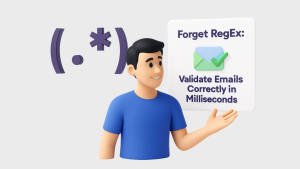
Still using RegEx to validate emails? It’s time to move on. While regular expressions may catch formatting issues, they miss the bigger picture—like whether the email actually exists. In this post, we’ll show you smarter, faster ways to validate emails in milliseconds without relying on outdated RegEx patterns.

Master email deliverability by implementing proper email authentication protocols like SPF, DKIM, and DMARC. These tools not only protect your domain but also ensure your emails reach inboxes—safely and reliably.
Dominate deliverability with proven email validation hacks and strategies that keep your campaigns out of spam folders and in front of the right audience. Discover how to clean your lists, boost sender reputation, and ensure every email hits the inbox.




 No credit card required





Post your Comment.