 Sign In














 Email Marketing
 ABM
ABM  List Building
  Lead Generation
  Growth Hacker
  Digital Marketing
  Data Enrichment
  Software as a Service
  Data as a Service
  Waterfall Enrichment
  Startup
  Revenue Performance
  Job Change Tracking
  Customer Data Platform
  CRM
CRM 


 Knowledge Base
  Video Tutorials
  Help Center
  Tarpitting Scoring
  ROI Calculator
  About us
  Contact us
  Testimonials
  Automation
Why No Email Validator Can Be 100% Sure About a Catch-All Domain (The SMTP Math Behind It)

24 Sep 2026
Sreerag
12 Minutes
Read

 Blog
FAQ
Case Studies
Knowledge Base
Video Tutorials
Help Center
SEG Validation
Tarpitting Scoring
ROI Calculator
About us
Contact us
Testimonials
Blog
FAQ
Case Studies
Knowledge Base
Video Tutorials
Help Center
SEG Validation
Tarpitting Scoring
ROI Calculator
About us
Contact us
Testimonials
No email validator can confirm with certainty that a specific address on a catch-all domain is real, not because of a gap in any one tool, but because a catch-all domain breaks the core signal SMTP verification depends on.
A catch-all domain accepts mail for every address sent to it, real or invented. That means the SMTP response a validator normally uses to tell a genuine mailbox from a fake one stops varying, and a response that never varies carries no information at all.
That’s a structural limit in the protocol itself, not a shortfall in any particular product, which is why a “valid” result on a catch-all domain deserves to be read as a probability rather than a fact.
Here’s the actual mechanism behind that limit, and what a validator can do instead of guessing.
A catch-all domain is a domain whose mail server accepts a message addressed to any username at that domain, whether or not a real mailbox exists behind it. Send something to a genuine employee and it arrives. Send the same message to a string of random characters at that domain, and, because the server doesn’t reject it arrives too, or at least isn’t bounced back immediately. Businesses configure this deliberately, often to avoid losing mail to typos or retired aliases, and it’s especially common on domains sitting behind enterprise mail security layers like Proofpoint, Mimecast, or Microsoft 365’s protection stack, where accepting broadly and filtering afterward is the standard pattern.
For anyone validating a list, this turns a normally reliable check into a dead end, and it’s common enough on B2B domains specifically that it’s worth planning for as a default case, not an edge case.
Email verification, absent the catch-all problem, works by starting, but never finishing, a real SMTP verification conversation. Per RFC 5321, the exchange runs roughly like this: the verifying server introduces itself (EHLO), states who the message is nominally from (MAIL FROM), then asks whether a specific mailbox will accept mail (RCPT TO). The receiving server answers with a status code, 250 means yes, 550 typically means no such user, and the conversation ends there. The DATA command, the step where a message body actually transmits, is never sent. Nothing lands in anyone’s inbox, and the recipient’s server has no way to know the check happened.
On a normal domain, this works cleanly because the response changes depending on what’s asked: a real mailbox returns 250, an invented one returns 550. That difference is the entire mechanism, it’s what lets a validator tell them apart.
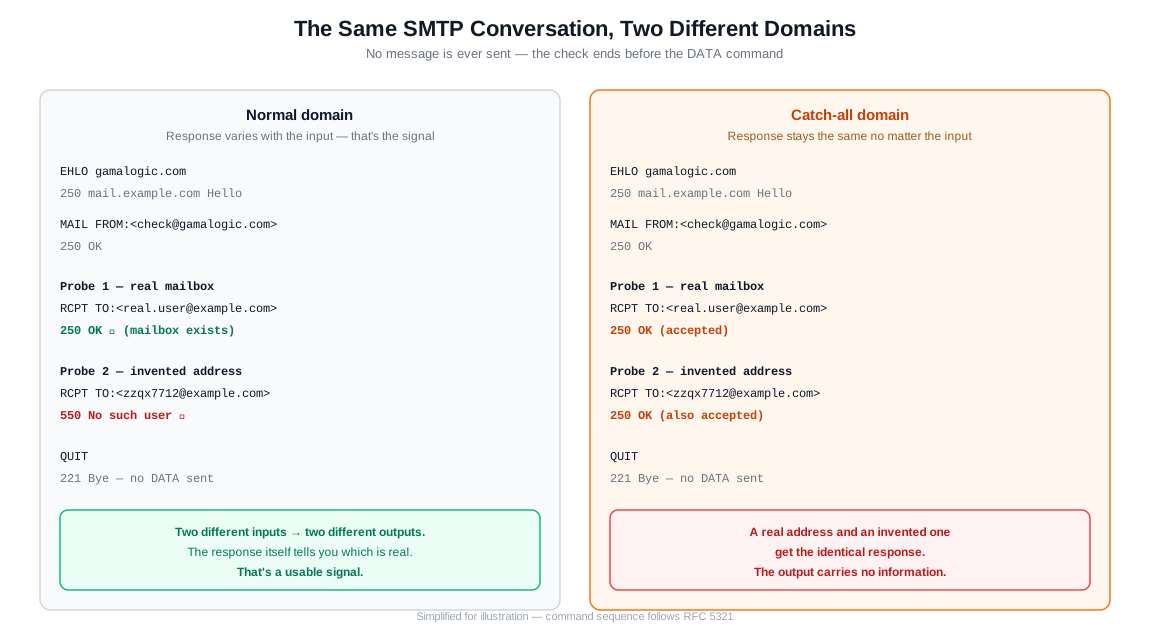
On a catch-all domain, that difference disappears. Every RCPT TO, real address or invented one, comes back 250. The protocol isn’t broken; the receiving server is doing exactly what it’s configured to do. But from the validator’s side, the one piece of information it needs, does this specific mailbox exist, never arrives.
This is the part worth being precise about, because it isn’t a hand-wavy limitation, it’s closer to a basic fact about how information works. A response only tells you something if it varies depending on what you asked. If two different inputs, a real address and a random string, reliably produce the same output, that output carries zero information about which one was real. It’s the equivalent of a thermometer stuck at the same reading regardless of the actual temperature: still producing a number, just not one that means anything.
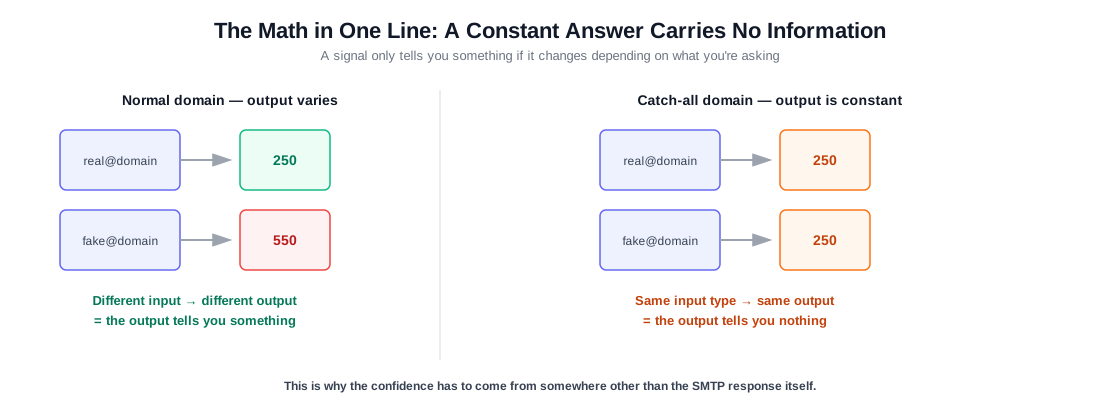
This is also why “just check harder” isn’t a real fix. Retrying the same RCPT TO probe against a catch-all server never produces a different answer, because the server’s behavior isn’t uncertain, it’s deterministic, and it’s set to always say yes. The gap isn’t a measurement problem a better validator can measure around. The specific measurement being taken (does this exact mailbox exist) has no channel to travel back through.
The standard method is a second probe: generate a random, almost certainly nonexistent address at the same domain and send an RCPT TO for it. If that also comes back 250, the domain is accepting everything, and the original address’s own result is now known to be uninformative. This is a deliberate, repeatable test, not a guess, and it’s what turns “this looks weird” into a confirmed catch-all classification.
It’s also worth knowing that a small number of major providers, historically including some Yahoo, AOL, and Microsoft-hosted domains, respond cautiously to probing in general, independent of whether they’re technically catch-all. A validator has to treat that adversarial pattern differently from a genuine accept-all configuration, even though both can produce a similarly unhelpful response on the surface.
Once a domain is confirmed catch-all, a validator built for this doesn’t stop at “unknown”, but it also can’t hand back a clean yes. What it can do is bring in signals from outside the SMTP handshake itself:
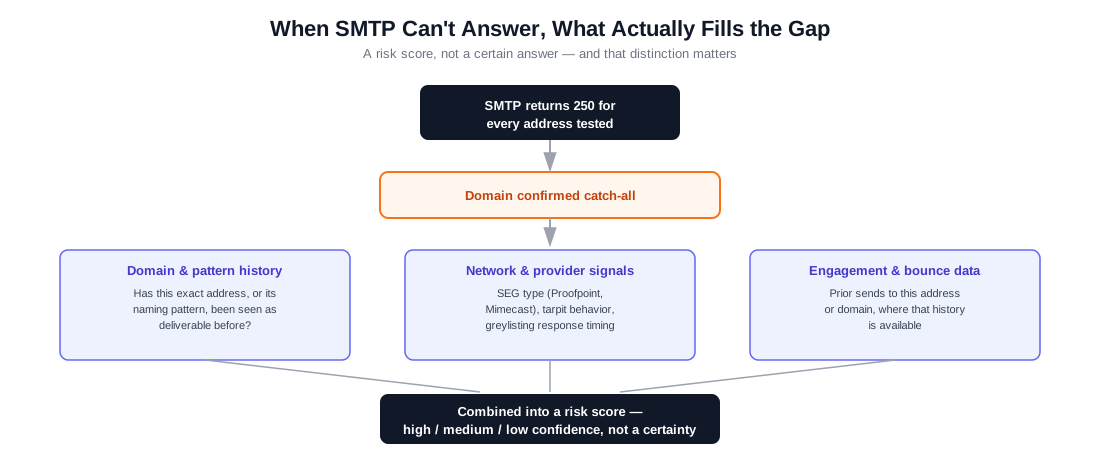
The output is a risk score, a confidence level or predicted-deliverability likelihood, not a binary valid/invalid. That’s a meaningfully different kind of answer, and treating it as anything more certain is where a lot of list-cleaning decisions go wrong. Independently benchmarked bounce-rate accuracy data is worth checking against any vendor’s advertised numbers here, since the accuracy gap between tools tends to concentrate almost entirely in how well this scoring step is handled, not in the easy majority of addresses that were never catch-all to begin with.
Gamalogic runs catch-all detection as one layer in a longer sequence, syntax, domain and MX lookup, disposable-domain detection, SMTP handshake, catch-all detection, risk scoring, rather than as a bolt-on feature. A few specifics worth knowing:
RCPT TO/QUIT point described above, on both normal and catch-all domains.None of that changes the underlying math above, Gamalogic doesn’t claim certainty on catch-all addresses, because no tool honestly can. What changes is how much usable signal you get once SMTP runs out, and whether catch-all becomes a dead end in your list or a scored, actionable category. For the full mechanics of how this is scored end to end, see the catch-all email validation page; for the rest of the detection stack, see what makes a validator accurate.
Treat a catch-all result as a flag for review, not an automatic delete. Removing every catch-all address from a B2B list routinely throws out real, reachable contacts along with the noise, catch-all configuration is disproportionately common on exactly the mid-size and enterprise domains that tend to be the highest-value contacts on a B2B list. Three concrete moves:
If you’re choosing between a free checker and a full validation setup specifically for catch-all handling, this comparison of free checker tools is the practical starting point, catch-all handling is exactly where free tiers tend to cut corners, since the scoring layer is the expensive part to build well.
A catch-all domain doesn’t make email verification wrong it makes one specific SMTP response uninformative, because the same 250 OK comes back whether the address is real or invented. No validator can out-engineer that at the protocol level; the honest move is to detect it, confirm it with a second probe, and replace the missing signal with a risk score built from pattern history, network behavior, and engagement data instead of pretending the original 250 settled the question. Gamalogic’s catch-all email validation runs that full sequence detection through scoring on every address, in both bulk cleanup and the real-time validation API, so a catch-all result comes back as an actionable confidence level rather than a dead end you have to resolve manually.
Why do some tools just label catch-all addresses “unknown” or “risky” with no further detail?
Resolving a catch-all result requires signals beyond a single SMTP check pattern history, network behavior, engagement data and building that scoring layer well is harder and more resource-intensive than the basic syntax/MX/SMTP checks most tools already run. It’s often the first thing a lighter or free tier skips, which is why a flat “risky” label with no score or reasoning is a reasonable signal that a tool stopped at detection and didn’t build the scoring step at all.
Does catch-all detection slow down real-time validation, like at a signup form?
Not meaningfully in a well-built system. The catch-all probe and scoring step run as the same kind of lightweight SMTP-level request as the primary check, so real-time validation through an API still typically completes within the same sub-second window it isn’t a separate slow process bolted on afterward.
Does catch-all detection work differently on domains protected by SMTP wrapping or a secure email gateway?
Yes, a domain sitting behind a wrapped or gateway-protected mail setup (Proofpoint, Mimecast, Microsoft 365) can accept a probe at the gateway layer before the message ever reaches the actual mailbox server, which produces catch-all-like behavior even on a domain that isn’t technically configured as accept-all at the mailbox level. See catch-all validation for how this is scored specifically.
Is a catch-all result the same thing as a bounce risk?
No, catch-all describes what the SMTP handshake could confirm at the moment of checking, while bounce risk is a forward-looking prediction. A catch-all address can turn out to be perfectly deliverable, and a non-catch-all “valid” address can still bounce later if the mailbox is deactivated after the check runs; the two are related but not interchangeable labels.



Learn how to validate large email lists instantly using the Gamalogic Bulk Email Validator. Step-by-step guide for CSV, Excel, or TXT uploads, plus tips, results, and API integration.

Discover how to measure and improve email validation accuracy. This guide compares benchmarks, metrics, and top providers — helping marketers achieve <2% bounce rates and stronger deliverability.

Learn how email validation customer retention strategies improve ecommerce engagement, lifecycle email optimization, deliverability, repeat purchases, and Customer Lifetime Value (CLV) using clean email lists.


 No credit card required
Post your Comment.