 Sign In














 Email Marketing
 ABM
ABM  List Building
  Lead Generation
  Growth Hacker
  Digital Marketing
  Data Enrichment
  Software as a Service
  Data as a Service
  Waterfall Enrichment
  Startup
  Revenue Performance
  Job Change Tracking
  Customer Data Platform
  CRM
CRM 


 Knowledge Base
  Video Tutorials
  Help Center
  Tarpitting Scoring
  ROI Calculator
  About us
  Contact us
  Testimonials
  Automation
Email Validation for Ecommerce: Improve Deliverability, Reduce Fraud & Increase Customer Retention

29 May 2026
Sreerag
12 Minutes
Read

 Blog
FAQ
Case Studies
Knowledge Base
Video Tutorials
Help Center
SEG Validation
Tarpitting Scoring
ROI Calculator
About us
Contact us
Testimonials
Blog
FAQ
Case Studies
Knowledge Base
Video Tutorials
Help Center
SEG Validation
Tarpitting Scoring
ROI Calculator
About us
Contact us
Testimonials
Ecommerce growth depends on more than traffic and ads. If your customer emails are invalid, fake, or undeliverable, critical messages like cart recovery emails, order confirmations, OTPs, and retention campaigns fail before they even reach the inbox.
Poor email data affects every stage of the customer journey from abandoned cart recovery and transactional communication to repeat purchases and long-term customer retention.
This is where email validation for ecommerce becomes essential.
This guide explains:
Email validation for e commerce is very importent, whether you run a Shopify store, WooCommerce business, or enterprise ecommerce platform, clean email data directly impacts revenue, engagement, and customer experience.
Email powers nearly every ecommerce interaction:
But ecommerce email databases decay quickly.
Customers abandon old inboxes, mistype email addresses, or use disposable accounts during signup. Over time, this creates:
Bad data silently reduces ecommerce revenue.
That’s why ecommerce brands using platforms like Shopify, WooCommerce, Magento, and BigCommerce increasingly rely on email validation API and real-time verification systems to maintain customer data quality.
Clean email data improves the entire ecommerce lifecycle.
Validated email addresses reduce hard bounces and improve sender reputation.
More emails land in inboxes instead of spam folders.
Customers receive promotions, product recommendations, and recovery emails on time.
Reliable communication improves trust and repeat purchase behavior.
This relationship between data quality and revenue performance is why many ecommerce teams now treat email validation as part of their broader customer lifecycle marketing strategy.
Cart abandonment remains one of the biggest revenue leaks in ecommerce.
But many abandoned cart emails never reach customers because of invalid or mistyped email addresses collected during checkout.
This directly affects:
Using real-time email validation during signup or checkout helps improve cart abandont recovery of emails to real customers.
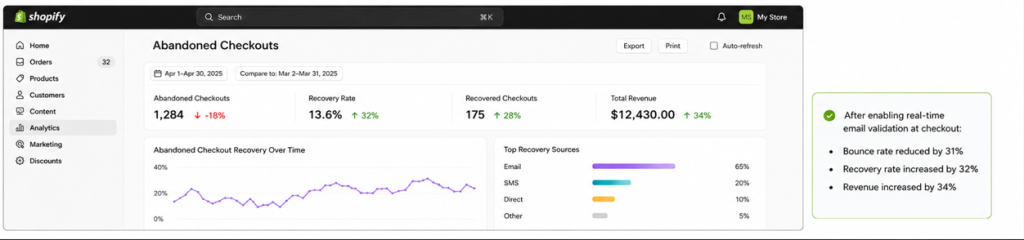
A clean recovery workflow improves:
This becomes especially important for brands using Klaviyo, Mailchimp, Omnisend, or HubSpot to automate abandoned cart workflows.
Fake accounts and fraudulent orders create major operational problems for ecommerce businesses.
Common issues include:
These fake users distort analytics and increase operational costs.
Modern ecommerce fraud prevention workflows now combine:
Email validation acts as the first trust layer by verifying whether a customer email is real before the order process continues.
This improves:
The role of email verification in reducing fake ecommerce activity is covered in Preventing Fake Orders & Fraud with Email Verification.
Transactional emails are some of the most critical messages in ecommerce.
These include:
If these emails fail, customer trust drops immediately.
Poor transactional email delivery often happens because:
Platforms like SendGrid, Amazon SES, Mailgun, and Postmark rely heavily on clean email data for reliable delivery. so the email validationn is very importent for transational emails for better results.
Real-time validation helps ecommerce brands improve:
Retention marketing depends on accurate customer communication.
If lifecycle emails fail, ecommerce brands lose opportunities for:
Dirty email lists create a dangerous chain reaction:
Invalid email data → higher bounce rate → weaker sender reputation → inbox placement drops → engagement declines → Customer Lifetime Value (CLV) decreases
This directly impacts:
That’s why ecommerce brands increasingly focus on:
Clean and validated email lists also contribute customer retention, helping ecommerce brands maintain stronger engagement and higher customer lifetime value over time.
Prevent invalid addresses from entering your database in the first place.
Real-time email validation API help detect:
Even clean ecommerce lists degrade over time.
Regular validation helps maintain deliverability and engagement.
Validation should exist across:
Validation works best when combined with:
These ecommerce email deliverability strategies help improve inbox placement and long-term campaign performance.
Email validation for ecommerce is not a single tool for a single problem. It is a data quality layer that runs across the entire customer lifecycle protecting cart recovery performance, filtering fraud signals, ensuring transactional reliability, and enabling the clean data that retention marketing depends on.
The four major use cases each deserve dedicated attention:
| Use Case | What Goes Wrong Without Validation | Primary Fix |
|---|---|---|
| Cart Recovery | Emails bounce, sequences fail, revenue lost | Real-time validation at pre-checkout email capture |
| Fraud Prevention | Disposable emails enable fake orders and return abuse | Disposable email detection at checkout |
| Transactional Email | Receipts and OTPs don’t arrive, support tickets spike | Validation before order confirmation fires |
| Retention & CLV | Invalid records in CRM corrupt segmentation and lifecycle flows | Validation at signup + periodic list hygiene |
The cause-and-effect chain is direct: better email data → better deliverability → more effective campaigns → higher revenue at every stage of the funnel.
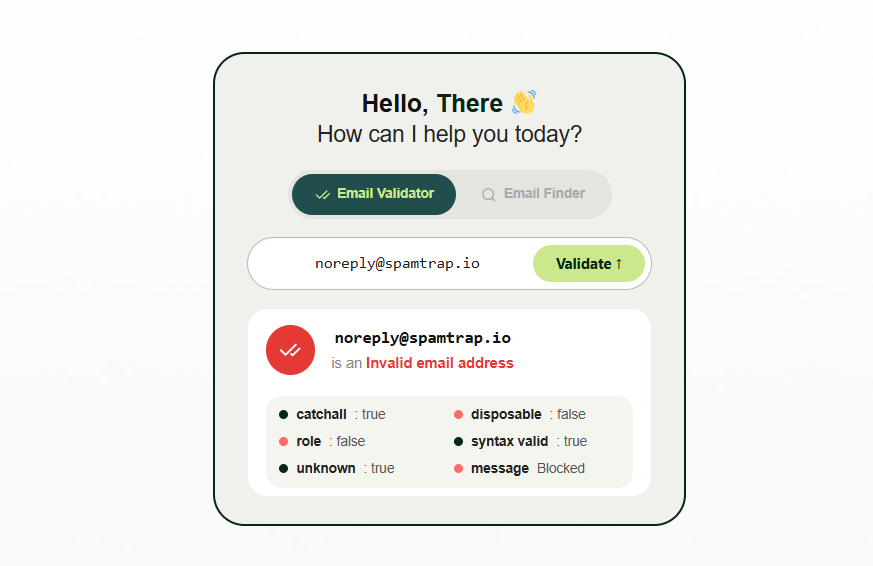
Not all validation systems are built for ecommerce workflows.
Look for solutions that support:
Email address validation tool, Platforms like Gamalogic email validation api tool, provide ecommerce-focused email validation capabilities.
For ecommerce businesses handling high customer volumes, integrations with Shopify, WooCommerce, Klaviyo, HubSpot, and Mailchimp become especially important.
A reliable validation API helps ecommerce brands:
The impact of poor email data is larger than most ecommerce brands realize.
Bad email data causes:
Fake signups → poor deliverability → failed lifecycle campaigns → lower engagement → reduced repeat purchases → lower CLV
Validated customer data creates the opposite effect:
Clean customer data → better deliverability → stronger engagement → improved retention → higher revenue growth
This is why ecommerce email verification has become a core part of modern ecommerce infrastructure.
Ecommerce growth depends on reliable customer communication.
If customer emails are invalid, fake, or inactive:
Email validation helps ecommerce brands protect every stage of the customer journey.
From checkout and onboarding to lifecycle marketing and customer retention, clean email data creates stronger engagement, better deliverability, and higher long-term revenue.
Use email validation to:
👉 Start validating customer emails before they impact revenue growth
👉 Try Gamalogic email validation API get 500 Free credits to improve ecommerce communication, reduce bounce rates, and increase long-term customer revenue.


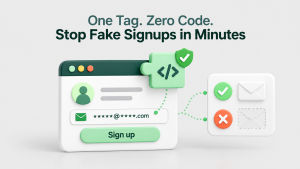
Stop fake signups without hiring a developer. Add a live email validation widget to Webflow, WordPress, or any HTML form in minutes, no code required.

The Marketer’s Handbook to Email List Hygiene & Growth explains how to clean email databases, reduce bounce rate, improve deliverability, and grow a high-quality subscriber list.
Invalid emails don’t just bounce—they damage your sender reputation and derail your campaigns. Learn how real-time email validation can keep your list clean, boost deliverability, and protect your brand's reach.


 No credit card required
Post your Comment.